
How Long Does GRP Tank Durability Actually Last?
GRP tank durability is not defined by the material alone. A glass-reinforced plastic tank can provide dependable service in a commercial water system for many years, but its real service life depends on the tank’s design, installation quality, stored liquid, supporting steelwork and maintenance regime. For facilities teams, the key question is not simply whether a GRP tank is old. It is whether its structure, joints and internal surfaces can still perform safely and hygienically.
GRP tanks remain a practical choice for potable water, process water and sprinkler storage because they are lightweight, corrosion-resistant and well suited to difficult-access locations. However, no tank material is maintenance-free. Early diagnosis of leaks, panel deterioration or failed joints gives operators more options than waiting for a loss of water, contamination concern or unplanned outage.
What determines GRP tank durability?
A GRP tank is a composite construction. Glass fibres provide strength, while the resin matrix binds those fibres and forms the protective surface. This combination does not rust in the way that unprotected steel can, but it can be affected by environmental exposure, chemical attack, physical loading and poor detailing.
The operating environment matters greatly. A clean, covered cold-water storage tank has very different demands from an external process-water vessel exposed to sunlight, temperature changes and chemical dosing. Tanks storing chlorinated water, aggressive process liquids or liquids at elevated temperatures need a material specification and lining system suited to those conditions. Using a standard tank where specialist chemical resistance is required can shorten service life considerably.
Installation is equally significant. Sectional GRP tanks rely on correctly assembled panels, sealed joints, appropriate bolts and a level, continuous base. Poor support can introduce uneven loading, panel distortion and movement at joints. In practical terms, a sound tank installed on an inadequate plinth may develop defects far earlier than a comparable tank on a properly designed base.
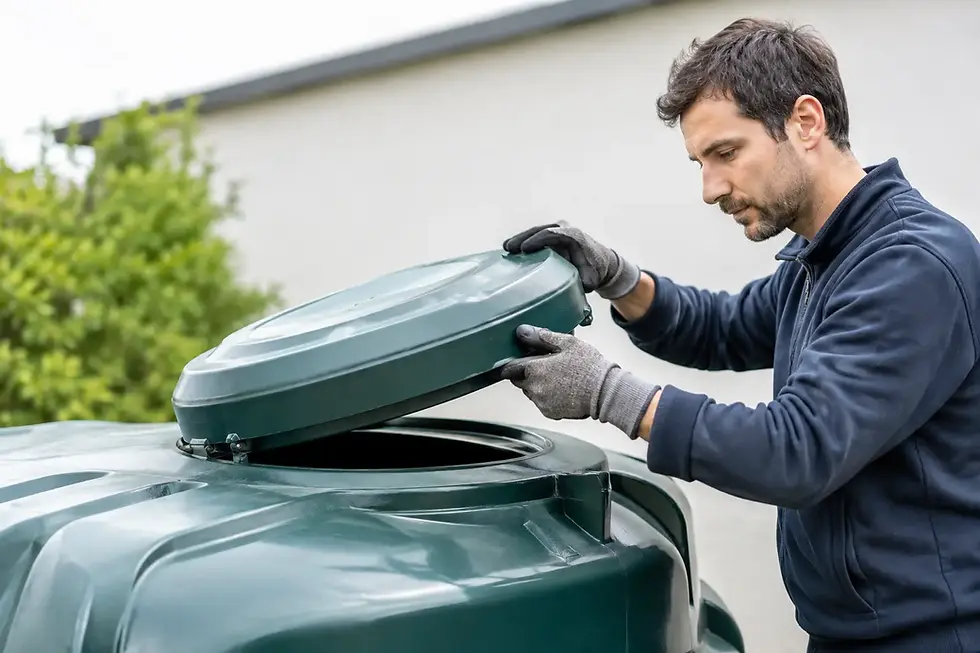
The condition of the lid and access arrangements should not be treated as secondary. Damaged or poorly fitting covers allow light, debris, vermin and airborne contaminants into stored water. They can also allow rainwater to enter the tank, affecting water quality and creating unnecessary demand on cleaning and monitoring regimes.
The warning signs that should trigger a survey
GRP tanks rarely fail without evidence. The challenge is that visible signs are often dismissed as cosmetic until a leak or operational issue becomes difficult to control. Regular visual inspection, supported by an internal survey where access and hygiene procedures permit, allows defects to be assessed before they become a capital replacement project.
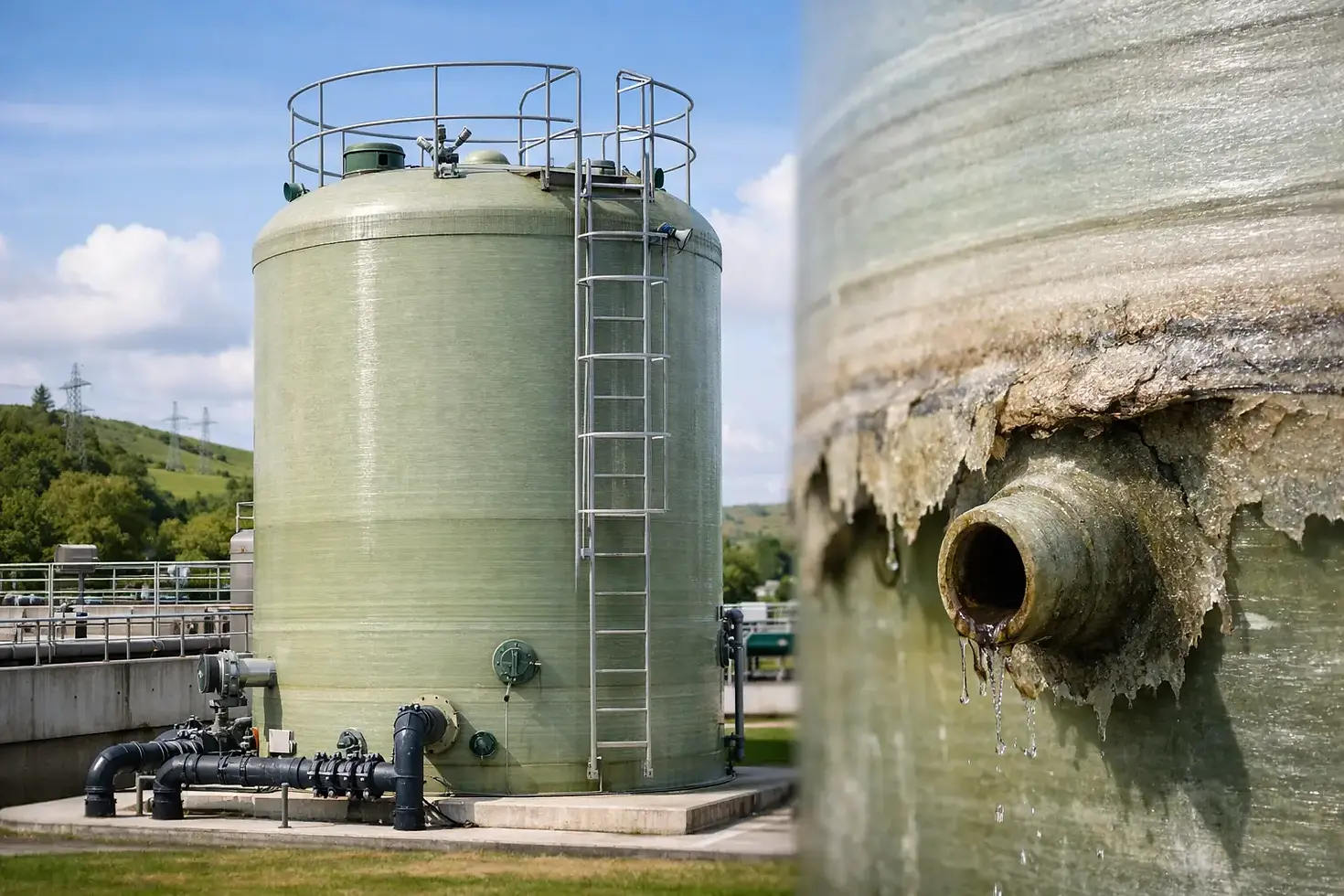
Look closely at panel joints, especially around the lower levels of a sectional tank where hydrostatic pressure is greatest. Staining, weeping, white mineral deposits, damp insulation or corrosion on external steelwork may indicate a joint failure. The source is not always obvious from outside the tank, which is why an informed inspection is more useful than repeated local sealant repairs.
Other common indicators include crazing or cracking of the internal surface, soft or damaged areas around fittings, loose fixings, distorted panels and deterioration around nozzles or flanges. A tank may also show operational symptoms: unexplained changes in make-up water demand, recurring water-quality concerns, declining insulation performance or an inability to maintain water level.
For sprinkler tanks, condition assessment must account for the fire protection system as a whole. Repairs and isolation work need careful planning so that water availability, insurer requirements and site fire precautions are properly managed. A low-cost repair that compromises protection arrangements is not a cost-effective solution.
Why joints, fittings and supports often fail first
In many GRP installations, the panels remain structurally serviceable while joints, gaskets, penetrations or support elements become the weak points. This is particularly true where tanks have undergone years of vibration from pumps, thermal movement, roof-level wind exposure or modification to connected pipework.
Joint leakage can develop because original gaskets have aged, bolts have lost tension, panels have moved or past repairs have been applied to wet or contaminated surfaces. Surface-applied mastic may temporarily reduce a leak, but it does not correct a failed joint assembly, distorted panel edge or unsuitable base. The appropriate repair depends on the cause, not merely the location of the water escaping.
Connections also deserve careful scrutiny. Inlet and outlet pipework must be independently supported so that its weight and movement are not transferred to the GRP tank wall. A heavy valve set or poorly supported pipe can place concentrated load on a flange, leading to cracking or persistent leakage around the fitting.
External frames, platforms and access steelwork can affect tank performance too. GRP does not corrode like steel, but adjacent corroding steelwork can weaken supports, damage insulation and restrict safe access for cleaning or repairs. Tank durability should therefore be assessed as a complete installation, not as panels in isolation.
When refurbishment is more appropriate than replacement
A leaking or ageing GRP tank does not automatically require replacement. Where the main tank structure remains sound, refurbishment can extend operational life while reducing cost, programme duration and disruption. This is particularly valuable in plant rooms, roof spaces and constrained service areas where removing an existing tank and installing a replacement requires major access works.
The right remedial route may include joint renewal, local GRP repairs, replacement of defective panels, new fixings, upgraded insulation or a replacement lid and cover system. Where the interior needs a hygienic barrier, a purpose-designed flexible polypropylene lining can isolate the stored water from the original tank surface. This approach is useful where the tank shell is structurally viable but internal condition, cleanliness or minor surface defects make ongoing use unsuitable without protection.
Lining is not a substitute for structural repair. If panels are significantly distorted, the base is failing, the tank has widespread laminate damage or supports are unsafe, those underlying issues must be addressed first. An engineering-led survey should distinguish between defects that can be contained by a lining and defects that affect the tank’s ability to retain load.
Epoxy resin coating systems can also be appropriate for particular surfaces and operating conditions, provided preparation, curing conditions and compatibility with the stored liquid are controlled. The decision between lining, coating, repair and replacement should be based on tank construction, duty, access, programme constraints and required design life.
Maintaining durability in potable and process-water service
For potable water storage, durability and hygiene are closely connected. A tank that remains watertight but allows debris ingress, biofilm development or deterioration of internal surfaces is not performing adequately. Cleaning, inspection and disinfection should be planned alongside physical maintenance, with suitable controls for safe entry and continuity of supply.
Process-water tanks require a more specific review of chemical compatibility. Concentration, temperature, dosing frequency and cleaning chemicals can all alter how a GRP laminate or coating performs. Small changes to process chemistry may be enough to make an existing material unsuitable. Before repairs are specified, the stored liquid and its full operating range should be confirmed rather than assumed.
Planned maintenance should include checks of lids, vents, overflows, screens, insulation, external supports, valves and connected pipework. It is also sensible to keep a clear record of leaks, repairs, cleaning dates and water-quality findings. Patterns in those records often reveal whether a tank has a local repair need or a wider deterioration issue.
A practical approach to lifecycle decisions
The most economical decision is rarely based on age alone. A relatively old GRP tank with sound panels and a manageable joint or lining issue may be an excellent refurbishment candidate. Conversely, a newer tank with incorrect support, widespread cracking or a duty outside its original specification may justify replacement.
Nationwide Water Solutions Ltd assesses tanks with the end use, site access and compliance responsibilities in mind. That means considering whether the asset can be safely repaired, whether a proprietary lining or coating system offers the required protection, and how works can be completed with the least practical disruption to the building or process.
If a tank has begun to show staining, minor leakage or internal surface deterioration, act while the remedial options are still broad. A properly scoped survey can turn an uncertain condition issue into a planned programme of repair, refurbishment or replacement - protecting both the stored water and the budget allocated to keep it available.


Comments