

Process Tank Corrosion Guide for UK Sites
A process tank rarely fails without warning. Pinholes, discolouration, sediment, coating blisters and recurring leaks are all signs that the stored liquid, the tank material or the surrounding environment is attacking the asset. This process tank corrosion guide sets out how facilities teams can identify the cause, assess the extent of damage and select a remedial route that protects operations without replacing a serviceable tank too soon.
Why Process Tanks Corrode
Corrosion is an electrochemical or chemical reaction that gradually removes, weakens or degrades a tank surface. In a process environment, it is not limited to visible rust on steel. Concrete can crack and leach, protective coatings can detach, GRP can suffer chemical attack, and fittings can fail where incompatible metals meet.
The rate of deterioration depends on the complete duty of the tank, not simply its age. A mild steel tank storing treated process water may remain sound for many years, while an identical tank holding warm, oxygenated water with chlorides, cleaning chemicals or fluctuating pH can deteriorate rapidly.
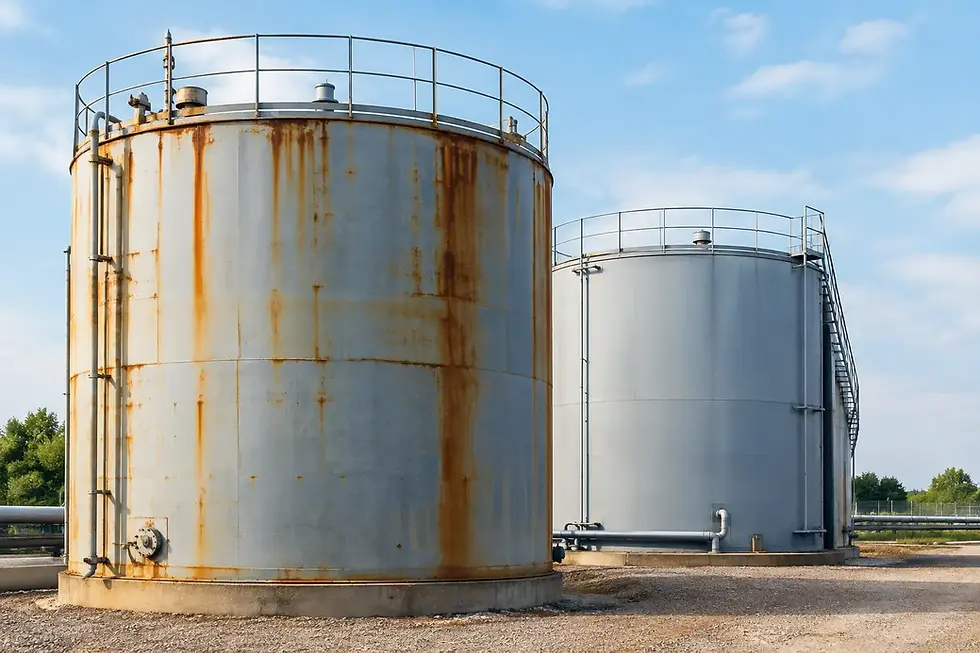
Internal conditions are usually the main driver. Dissolved oxygen, salts, acids, alkalis, microbiological activity, suspended solids and elevated temperature can each alter the corrosion mechanism. External factors also matter. Roof leaks, condensation, poor ventilation, damaged insulation and standing water around the base can create corrosion from the outside in.
Particular attention is needed at joints, penetrations, pipe connections, ladder brackets, floor-to-wall transitions and under failed coatings. These areas retain moisture or concentrate stress, making them common starting points for localised attack.
Common Forms of Tank Deterioration
Uniform corrosion affects a broad area of steel and can appear manageable until wall thickness has reduced across a significant section. Localised pitting is often more serious because small, deep holes can penetrate the tank shell with little visible surface damage.
Crevice corrosion develops in confined areas such as bolted joints, gasket interfaces and poorly detailed supports. It is difficult to inspect and may continue beneath deposits. Galvanic corrosion occurs when dissimilar metals are connected in the presence of an electrolyte, for example where unsuitable fixings, pipework or repairs have been introduced.
For concrete tanks, deterioration can involve cracking, spalling, exposed reinforcement and chemical erosion of the surface. Acidic liquids and aggressive water can degrade cementitious materials, while water ingress through cracks may corrode reinforcement and cause further cracking. GRP and fibreglass tanks do not rust, but their resin systems must still be compatible with the stored liquid, operating temperature and cleaning regime.
The following signs warrant a professional assessment rather than a cosmetic repair:
Persistent staining, rust runs or discoloured process water
Blistering, flaking or softening of an existing internal coating
Pitting around seams, nozzles, flanges, supports or floor areas
Unexplained loss of level, dampness beneath the tank or repeated top-ups
Cracked concrete, exposed reinforcement, delamination or loose surface material
Process Tank Corrosion Guide: Inspect Before Specifying Repairs
The right refurbishment begins with a tank survey. Applying a new coating to an unprepared surface, or lining over a structural defect that has not been assessed, can conceal the problem temporarily while allowing failure to continue behind the repair.
An effective inspection considers the tank construction, contents, age, service history and access constraints. The survey should establish whether corrosion is internal, external or both, identify areas of metal loss or substrate damage, and inspect the condition of roofs, covers, valves, overflows, supports and associated pipework.
For steel tanks, thickness testing can help determine whether the shell retains sufficient structural integrity. Inspectors should examine welds, seams and the floor carefully, as sediment often settles at the base and creates a more aggressive local environment. Where safe access is restricted, the inspection method must be planned around isolation, cleaning, confined-space controls and the consequences of taking the tank out of service.
The stored medium needs equal scrutiny. Obtain current information on pH, temperature, concentration, contaminants, cleaning agents and expected duty cycle. A lining or coating that performs well in ambient water may not be suitable for hot process effluent, intermittent chemical dosing or an acidic wash-down regime. Compatibility must be confirmed for the actual application rather than assumed from the tank type.
For potable water or systems connected to domestic supplies, the repair specification must also use materials suitable for the relevant drinking-water application. Process tanks may not require potable approval, but hygiene, contamination control and site-specific compliance obligations can still govern the work.
Choosing Between Coating, Lining and Replacement
Replacement is not automatically the most reliable or economical response to corrosion. It may be necessary where structural loss is extensive, access is poor, the tank is undersized, or the original design no longer meets operational or compliance requirements. However, removing a large tank can bring disruption, craneage, building alterations and extended shutdown periods.
Where the tank shell remains structurally viable, internal refurbishment can extend working life at a lower cost and with less disruption. The correct option depends on substrate condition and chemical duty.
Epoxy Resin Coating Systems
A properly specified epoxy coating creates a continuous barrier between the stored liquid and the tank substrate. It is commonly used for steel and concrete tanks where surface preparation can achieve the required profile and cleanliness. The preparation stage is decisive: corrosion products, failed coatings, deposits and contamination must be removed before application.
Epoxy systems are not interchangeable. Chemical resistance, film thickness, cure conditions and substrate moisture tolerance vary considerably. A coating should be selected for the operating temperature, immersion conditions and anticipated exposure, then applied within the manufacturer’s defined limits. Poor adhesion, insufficient preparation or premature return to service can lead to blistering and early failure.
Flexible Polypropylene Lining Systems
A flexible tank lining can be particularly effective where a tank needs a physical separation layer between its existing substrate and the stored liquid. It is well suited to many refurbishment projects because installation does not rely on curing a liquid-applied coating across every internal surface.
For tanks with complex internal geometry, degraded surfaces or difficult access, a purpose-designed lining can provide a practical alternative to replacement. Details around inlet and outlet connections, overflow arrangements, fixings and lid interfaces must be engineered carefully. A lining is a system, not simply a membrane placed inside a tank.
Nationwide Water Solutions Ltd designs and manufactures flexible polypropylene lining systems in-house, allowing the lining arrangement to be matched to the tank dimensions, use and access conditions. This can reduce installation time while providing a chemically resistant, durable internal barrier.
When Full Replacement Is the Better Decision
There are cases where refurbishment is not appropriate. Significant structural corrosion, distorted panels, failed foundations, widespread reinforcement damage or a tank that cannot meet current capacity requirements may justify replacement. A new GRP, fibreglass, steel or sectional tank can also provide an opportunity to improve insulation, access, drainage, covers and maintenance provisions.
The decision should compare the whole-life cost of each option. This includes shutdown duration, temporary storage, access works, installation risk, expected lifespan and the cost of future inspections, not just the initial contract value.
Reducing Corrosion After Refurbishment
A repaired tank still needs a managed maintenance regime. Corrosion is often accelerated by operational issues that can be corrected before they damage a new lining or coating.
Start with the stored liquid. Monitor chemistry where the process demands it, particularly pH, temperature, chlorides and any chemical dosing. Prevent sediment accumulation through suitable cleaning intervals and review whether dead legs, poorly positioned inlets or inadequate turnover are allowing deposits to remain in the tank.
Keep the external environment dry and controlled. Repair defective roofs and covers, address leaks quickly, maintain insulation and ensure drainage does not hold water against the tank base. Inspect supports, access equipment and nearby pipework because an external leak can be mistaken for a tank failure.
Planned inspections should be proportionate to the consequence of failure. A non-critical process tank may require periodic visual checks and scheduled internal inspection, while a tank supporting production, fire protection or a regulated process may need more frequent review and documented condition records. Any change in chemical duty, operating temperature or cleaning practice should trigger a compatibility review.
Avoid Short-Term Repairs That Create Bigger Risks
Patch repairs have a place where damage is isolated and the remaining system is sound. They are less suitable where corrosion is widespread, the original coating is failing throughout, or the mechanism behind the defect remains unresolved. Repeated local repairs can make future refurbishment more difficult and leave facilities teams responding to the same outage risk year after year.
The practical objective is not to make a corroded tank look acceptable. It is to establish a sound, compatible containment system with known condition, controlled risk and a realistic service life. A detailed survey provides the evidence needed to choose that route before a minor defect becomes an unplanned shutdown.


Comments