
What a Water Tank Compliance Survey Covers
Updated: May 14

A leaking panel joint, a damaged lid seal or corrosion below the waterline rarely starts as an emergency. More often, it begins as a small defect that goes unnoticed until water quality, system reliability or regulatory compliance is called into question. That is where a water tank compliance survey becomes essential. For commercial and industrial sites, it provides a clear technical picture of tank condition, hygiene risk, structural integrity and the remedial works needed to keep storage assets safe and serviceable.
For facilities managers and building services teams, the real value is not just finding faults. It is understanding which faults matter now, which can be managed, and whether the most cost-effective route is repair, refurbishment, lining, upgrade or full replacement. A proper survey should turn uncertainty into an informed maintenance plan.
Why a water tank compliance survey matters
Water storage tanks are often out of sight and, as a result, not inspected as often as they should be. Yet they sit at the centre of critical building and process infrastructure. In potable water systems, poor tank condition can create hygiene risks and expose a site to non-compliance. In process or specialist liquid storage, material failure can affect production, chemical compatibility and operational continuity. In sprinkler applications, unresolved defects may undermine system readiness when the tank is needed most.
A water tank compliance survey is therefore not a paperwork exercise. It is a technical assessment that helps duty holders understand whether a tank remains fit for purpose. That includes checking the physical condition of the structure, identifying contamination pathways, reviewing access and safety provisions, and assessing whether the tank arrangement aligns with current operational and regulatory expectations.
The survey also matters because tanks are not all the same. A sectional GRP cold water tank presents different failure patterns from a concrete reservoir, an underground steel tank or an acid storage vessel. Age, water chemistry, insulation, previous repairs and access constraints all affect what a surveyor needs to look for and what remedial route is practical.
What the survey should assess
A compliance-led survey begins with the tank as installed, not as originally specified. Over time, tanks are altered, patched, partially upgraded and exposed to environmental conditions that were not always anticipated at design stage. A survey should therefore focus on present condition and present risk.
Structural condition and material performance
The first priority is whether the tank shell, base, roof and associated components remain sound. On steel tanks, that may mean checking for corrosion, coating breakdown, pitting and thinning around joints or supports. On GRP tanks, common concerns include cracking, delamination, damaged sectional joints, distorted panels and degraded surface finishes. Concrete tanks can present issues with cracking, water ingress, failed coatings and internal substrate deterioration.
This is where engineering judgement matters. Not every visible defect means the tank has reached end of life. Some tanks with localised damage are strong candidates for refurbishment or internal lining, particularly where the main structure remains viable. Others may be too far advanced in corrosion or too difficult to modify safely, making replacement the more sensible route.
Hygiene and contamination risk
For potable water storage, hygiene is central. A survey should identify any route by which contaminants, insects, vermin, dust or standing surface water can enter the tank. Damaged lids, missing screen meshes, split seals, poorly fitted access hatches and failed overflows are all common findings. So are internal condition issues such as sediment accumulation, biofilm presence or failed coatings that can compromise cleanable surfaces.
Hygiene risk is not limited to obvious contamination. Inadequate insulation and poor lid design can create condensation problems, while damaged internal surfaces may make effective cleaning more difficult. A tank can appear serviceable externally while still presenting an avoidable water quality concern.
Compliance of fittings, access and ancillary items
A tank does not operate in isolation. Access ladders, handrails, screened vents, insulated covers, warning pipes, level controls and overflow arrangements all affect compliance and usability. A survey should review these details because remedial works often extend beyond the shell itself.
This is especially relevant on older installations. It is common to find tanks still in service with outdated covers, poor access arrangements or fittings that no longer meet expected standards. In those cases, a targeted upgrade can restore compliance without the disruption and cost of replacing the complete asset.
What defects are commonly found
Across commercial estates and industrial sites, certain issues appear repeatedly. Corroded steel internals, split GRP seams, failing sealants, damaged insulation, insecure lids and unsupported pipework are all familiar survey findings. So are tanks that have simply not been inspected for years and are carrying the legacy of piecemeal maintenance.
Another common problem is deferred remedial work. A site may know a lid needs replacing or that internal coatings are failing, but the issue is pushed back because the tank is still holding water. That approach can become expensive. Once contamination, severe corrosion or structural instability develops, the repair options narrow and the project cost rises.
There is also the issue of mismatch between tank duty and tank material. A process tank exposed to aggressive contents may need a different lining system from a standard potable water installation. If the original material selection was marginal, a survey can highlight why defects keep recurring and what specification change is needed to achieve a durable result.
Survey findings should lead to practical options
The best surveys do not stop at defect identification. They explain the remedial path in a way that helps site teams budget, prioritise and act.
When refurbishment is the right choice
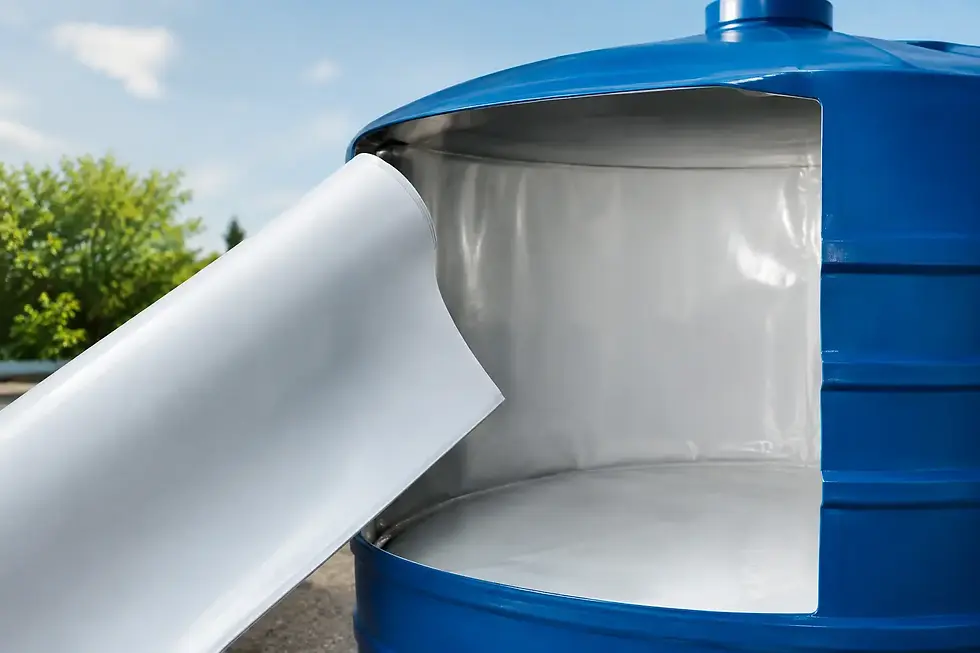
If the tank structure is fundamentally sound, refurbishment can be highly cost-effective. That may involve replacing lids and screens, repairing sectional joints, renewing insulation, preparing internal surfaces and applying a specialist lining or coating system suited to the stored liquid. For many serviceable tanks, this approach extends asset life significantly while avoiding the cost and disruption of full replacement.
This is particularly valuable where access is difficult. Removing and replacing a large roof-level tank in a live building can be far more disruptive than carrying out controlled remedial works in situ.
When replacement is the better option
There are cases where repair is false economy. Severe corrosion, advanced structural failure, poor original design, inaccessible configuration or repeated hygiene issues may justify replacement. The survey should say that plainly. A technical survey has limited value if it recommends refurbishment where the tank is unlikely to deliver acceptable service life afterwards.
The balance often comes down to remaining structure, operational criticality and access constraints. A replacement project may carry a higher upfront cost, but if it removes persistent risk and reduces maintenance demand, it can still be the better commercial decision.
Why specialist knowledge makes a difference
A compliant survey depends on more than a checklist. Different tank materials, stored liquids and operating environments require different inspection priorities and different repair strategies. A potable water tank serving a healthcare setting has different compliance sensitivities from a process tank in manufacturing or a sprinkler reserve tank on an industrial estate.
That is why survey quality matters. A contractor with practical refurbishment and installation capability can usually provide more useful recommendations than one limited to inspection alone. They understand which defects can be repaired, how proprietary lining or coating systems perform, what can be installed through restricted access, and where ancillary upgrades can resolve compliance issues without forcing unnecessary replacement.
For clients, that translates into clearer decision-making. Instead of a fault list with no route forward, they get an engineering assessment linked to realistic project options, likely service life outcomes and site constraints.
When to arrange a water tank compliance survey
The obvious trigger is visible deterioration, leaks, contamination concerns or a failed inspection. But waiting for symptoms is not ideal. A survey is equally valuable before planned maintenance cycles, before acquisition of a commercial property, after major building works, or when a tank has been in service for many years with limited documented upkeep.
It is also worth surveying tanks before they become a programme risk. If a site depends on continuous supply, it is far easier to schedule refurbishment or replacement from a planned condition report than to react to an unexpected failure.
For organisations managing multiple assets, surveys can help create a phased investment plan. Not every tank will need immediate intervention, but knowing which assets are high risk, which are stable and which are suitable for refurbishment gives estates and engineering teams a workable basis for capital planning.
A good water tank compliance survey does not simply confirm whether a tank passes or fails. It shows how the asset is ageing, where compliance risk sits and what practical route will protect water quality, performance and budget. For operators responsible for critical water storage, that kind of clarity is far more useful than waiting for a defect to make the decision for you.


Comments