

How to Inspect Tank Supports Before Failure
A tank can have a sound liner, a watertight roof and compliant water quality, yet still present a serious operational risk if its support structure is deteriorating. To inspect tank supports properly, facilities teams need to look beyond obvious corrosion and consider loading, movement, drainage, access conditions and the condition of the structure beneath the tank. For potable, process and sprinkler water storage, support defects can quickly become a wider issue affecting continuity, safety and asset life.
Why tank support inspections matter
Tank supports carry the full static load of the stored liquid, the tank shell and associated fittings. Water weighs approximately one tonne per cubic metre, so even a modest commercial tank imposes substantial forces on its base, legs, plinths, steelwork or supporting slab. A 50,000-litre tank, for example, holds around 50 tonnes of water before the weight of the tank itself is considered.
When a support system begins to fail, the consequences are not always immediate. Differential settlement can distort panels and joints. Corroding steelwork can progressively lose section thickness. A poorly draining base can hold water against the underside of a tank, accelerating corrosion and creating hidden defects. These conditions may lead to leakage, unstable access routes, compromised pipework connections or, in severe cases, structural failure.
For sprinkler tanks, support condition is also a resilience issue. Any restriction on storage capacity or requirement to take a tank out of service needs careful planning around fire protection provision. For potable water tanks, a distorted or damaged structure can make cleaning, repair and hygienic management more difficult.
Know what is supporting the tank
A meaningful inspection begins by identifying the tank type and its intended support arrangement. Steel sectional tanks, GRP tanks, concrete reservoirs and underground tanks all behave differently. The inspection scope should reflect the material, design, age, stored liquid and operating environment.
Common support arrangements include reinforced concrete slabs, ring beams, raised steel gantries, concrete piers, masonry plinths and purpose-designed foundations. Larger sectional tanks may rely on an external steel support frame, while internal columns can also be present beneath the tank floor. Tank feet, base rails, shims, holding-down bolts and pipe supports must be treated as part of the overall support system rather than separate minor components.
Original drawings and installation records are valuable where available, but the site condition must always take precedence. Changes in tank capacity, modifications to pipework, added insulation, roof access equipment or nearby construction can all alter the loads imposed on the original arrangement.
How to inspect tank supports safely
A support inspection should be planned as an engineering activity, not treated as a quick visual walk-round. Before access is arranged, establish the tank's purpose, approximate capacity, material, recent maintenance history and whether any leakage, unusual movement or changes in water level have been reported.
The external inspection should assess the visible tank shell, base and surrounding area. Look for uneven gaps beneath base rails, signs of settlement, leaning support legs, cracked plinths, displaced grout, bowed panels and deformation around nozzles or flanges. Pipework should be checked for unsupported spans, excessive strain, damaged flexible connections and evidence that the tank has moved relative to its fixed services.
Where access permits, inspect the underside of raised tanks and the full perimeter of slab-supported tanks. This is often where the most significant defects are found. Standing water, vegetation growth, accumulated debris and poor drainage can conceal corrosion or concrete damage for years.
Internal inspection may be required where floor support, internal columns, joint condition or lining performance needs assessment. This work must be carried out under appropriate health and safety controls. Tanks can present confined-space hazards, restricted access, poor lighting and risks associated with residual water or stored chemicals. Competent personnel, suitable access equipment and a site-specific safe system of work are essential.
Check for corrosion and section loss
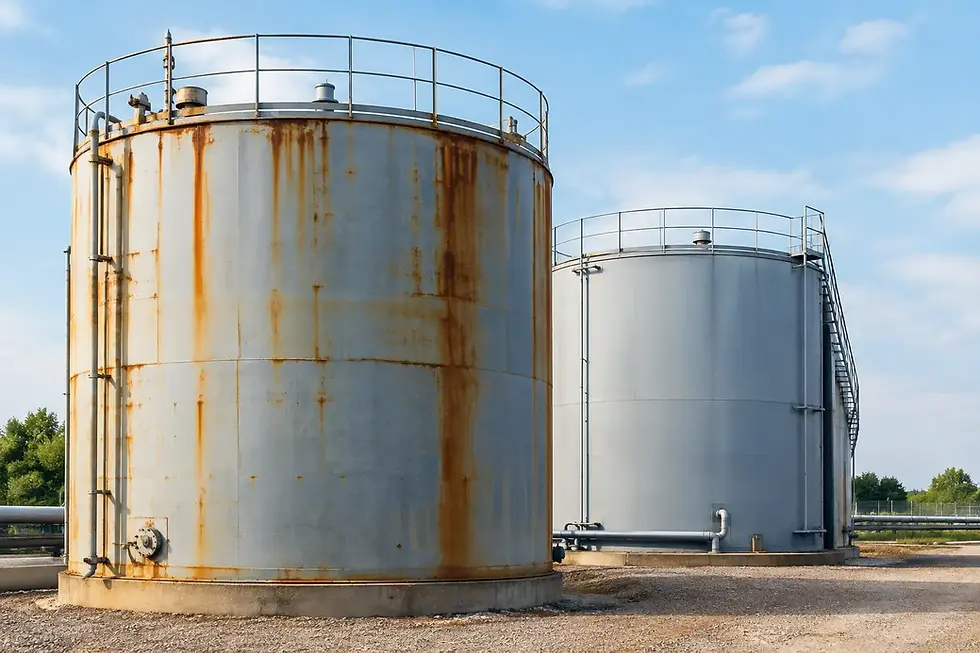
Steel support frames, legs, brackets and fixings should be examined for corrosion, coating breakdown, flaking paint, pitting and distortion. Surface rust is not necessarily evidence of immediate structural danger, but it should not be dismissed where corrosion is concentrated around connections, baseplates, bolt holes or water traps.
Pay particular attention to points where dissimilar materials meet, where rainwater runs off the tank roof, and where steelwork contacts concrete or soil. These areas are prone to retained moisture and corrosion that may be more advanced than it appears from the accessible surface. If section loss is suspected, a structural assessment may be needed before remedial coating or local repair is specified.
Look for settlement, cracking and movement
Concrete slabs and plinths should be checked for cracking, spalling, exposed reinforcement, crumbling edges and signs of movement between the support and tank base. Not all cracks indicate a critical issue. Hairline shrinkage cracking in old concrete may be stable, while stepped cracking, widening gaps or localised subsidence can indicate a more serious foundation problem.
Evidence of differential settlement includes uneven water levels relative to the tank roofline, distorted panels, doors that no longer align, changed pipework angles and gaps opening at one side of the base. These signs warrant prompt investigation because a tank is designed to distribute load in a specific way. Uneven loading can place additional stress on panels, joints, liners and connections.
Assess drainage and the condition beneath the tank
Water should not be allowed to sit around or beneath a tank. Poor drainage is one of the most common causes of avoidable deterioration, particularly on external installations and roofs. Check that drainage channels are clear, ground levels direct water away from the base, and downpipes do not discharge onto support steelwork or the tank perimeter.
The base condition is especially significant for sectional steel tanks. Moisture trapped beneath deteriorated timber bearers, insulation, base plates or protective membranes can contribute to corrosion from the underside, where it may remain unseen until leakage occurs. A survey should identify whether the tank base can be refurbished, relined or locally repaired, or whether wider intervention is required.
Defects that need urgent attention
Some defects should trigger an immediate review of tank use, load and safety controls. These include visibly buckled or leaning supports, severe corrosion at load-bearing connections, fractured support members, major settlement, rapidly worsening cracks, movement at holding-down bolts and any sign that a tank has shifted from its original position.
Active leakage near the base is also a priority. The source may be a failed joint, corroded floor, damaged liner or pipework connection, but water escaping beneath a tank can wash out supporting ground, worsen concrete deterioration and accelerate corrosion. The cause should be established before a superficial repair is attempted.
Where a sprinkler tank or critical process tank is involved, the operational implications need to be managed alongside the repair. Temporary water storage, fire system impairment procedures, isolation planning and staged works may be necessary to maintain safe site operation.
Choosing the right remedial route
The correct response depends on the condition of both the tank and its support system. A serviceable tank with localised steel corrosion may only require preparation, structural repair and an appropriate protective coating. Cracked concrete may be repairable if the underlying foundation is stable. Where water ingress has damaged the tank floor or base, a specialist lining system can provide a cost-effective route to restoring containment without full replacement.
However, lining or coating should not be used to disguise a structural defect. A tank must be adequately supported before refurbishment work proceeds. If settlement is ongoing, steelwork has lost significant strength or the foundation no longer provides a stable bearing surface, the support issue must be resolved first.
For older tanks, a condition survey can compare refurbishment against replacement using practical factors: residual structural life, access restrictions, downtime, capacity requirements, hygiene standards and the compatibility of the tank material with its stored liquid. In many cases, refurbishment provides substantial savings and less disruption. In others, replacement is the more dependable long-term decision.
Build support checks into planned maintenance
Tank support condition should be reviewed at planned intervals rather than only after a leak or failure. The appropriate frequency depends on the tank environment and criticality. External tanks in coastal, industrial or high-moisture locations usually need closer attention than protected internal tanks. Chemical storage, elevated installations and ageing sprinkler reserves also warrant a more cautious inspection regime.
A useful maintenance record includes dated photographs, observed defects, locations of corrosion or cracking, water levels, actions taken and any recommendations for structural assessment. Repeating photographs from the same viewpoint helps reveal gradual movement that is otherwise easy to miss.
Nationwide Water Solutions Ltd can assess the wider condition of commercial water storage assets, including tank structures, coatings, linings, lids, access arrangements and compliance-related defects. A clear survey report gives site teams a practical basis for prioritising work before a manageable repair becomes an unplanned outage.
The most effective time to address support deterioration is when the tank remains stable, accessible and capable of planned refurbishment. Early inspection gives you choices, while failure usually removes them.


Comments