
Industrial Tank Leak Repair Methods That Work
Updated: Jul 27

A tank that has begun weeping at a seam, corroding around a connection, or losing water through a concrete wall is not simply a maintenance issue. It can compromise potable water quality, reduce fire protection resilience, damage surrounding plant, and create an avoidable compliance risk. The right industrial tank leak repair methods depend on the tank material, stored liquid, defect location and the remaining condition of the structure.
A visible leak is often only the point at which a longer deterioration process has become impossible to ignore. Before selecting a repair, facilities teams need a clear view of what is happening inside the tank, behind the panels, beneath the floor, and around penetrations. A repair that seals the symptom but leaves corrosion, failed joints or substrate damage untreated can lead to repeat disruption and a shorter asset life.
Start with a condition survey, not a patch
The first priority is to make the tank safe and establish whether it can be repaired without compromising its intended duty. This normally involves isolating the tank where operationally possible, managing stored water or process liquid, and assessing the defect in the context of the complete structure.
A competent tank survey should examine the shell, floor, roof or lid, internal surfaces, seams, bolts, flanges, overflow arrangements, access points and supporting structure. For sectional steel tanks, particular attention is needed around panel joints, gasket lines and areas where protective coatings have broken down. Concrete tanks require assessment of cracking, spalling, water ingress and movement at construction joints. GRP tanks may show stress cracking, impact damage or local weakening around fittings.
The stored medium changes the repair decision. A lining suitable for potable water storage must be appropriate for that application, while an acid or chemical tank needs proven resistance to the specific liquid, concentration and temperature. Fire sprinkler tanks introduce another operational consideration: repairs must be planned to protect system availability and avoid unapproved impairment.
A survey also identifies the cases where repair is not the responsible option. Extensive metal loss, structural distortion, widespread delamination, a failed base, or a tank that no longer meets capacity and access requirements may justify replacement. The objective is not to preserve every tank at any cost. It is to select the most durable and commercially sensible route.
Industrial tank leak repair methods by tank type
Flexible internal tank lining
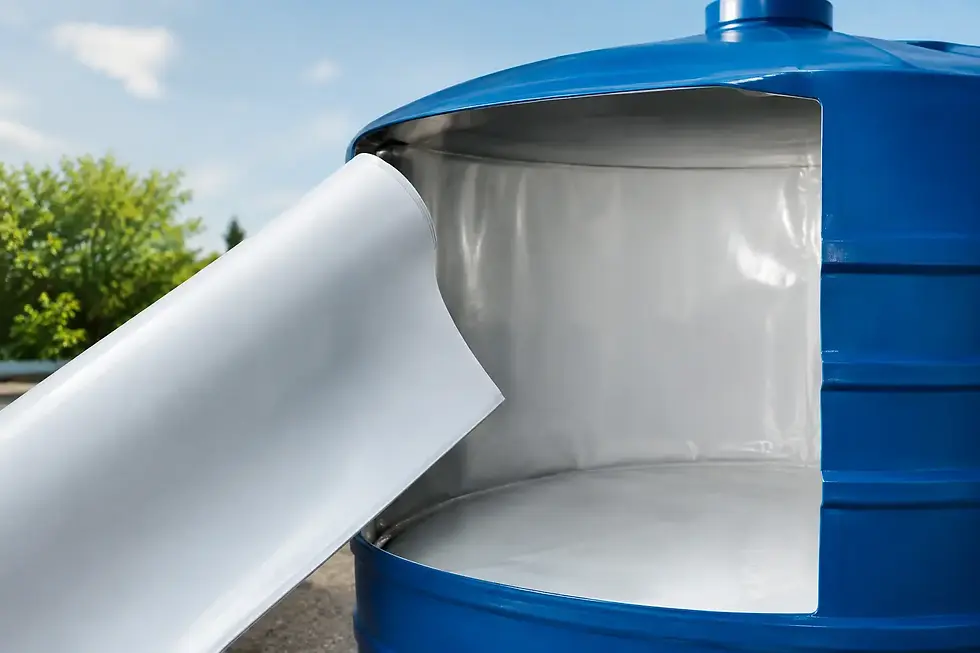
For many leaking steel, concrete and sectional water tanks, an internal flexible lining is the most effective refurbishment method. Rather than relying on the existing shell to remain watertight, a purpose-made liner creates a new containment barrier inside the tank.
Flexible polypropylene lining systems are particularly valuable where the original tank remains structurally serviceable but has leaking seams, corroded internal surfaces or recurring failures at joints. The liner is manufactured to suit the tank dimensions and internal configuration, then installed to form a continuous waterproof barrier. It can accommodate the geometry of sectional tanks, internal bracing and fittings more effectively than a simple local patch.
This approach can avoid the cost, access difficulties and extended downtime associated with removing and replacing a large tank. It is also well suited to locations where a replacement tank would be difficult to transport or install, including plant rooms, rooftops, basements and enclosed service areas.
Lining is not a cure for a structurally unsound vessel. Any sharp corrosion, failed supports, damaged panels or protrusions must be addressed before installation. The liner should also be specified for the service conditions, particularly where potable water approval, elevated temperature or chemical exposure is relevant.
Epoxy resin coating systems
Epoxy coatings provide a durable protective layer for tanks with sound substrates but deteriorated internal coatings, early-stage corrosion or local surface defects. After thorough surface preparation, the coating is applied to protect the base material from stored water, oxygen and corrosive conditions.
For steel tanks, the quality of preparation is decisive. Loose rust, failed paint, scale and contamination must be removed so that the epoxy can bond properly. Areas of severe pitting or perforation may need steelwork repair before coating. Applied correctly, an epoxy system can restore a protective internal surface, extend service life and reduce the risk of progressive corrosion.
Concrete tanks can also benefit from compatible coating systems where the substrate is stable and properly prepared. The coating must tolerate the moisture conditions and any expected movement in the concrete. A rigid coating may not be the best choice for a tank with active cracking or significant joint movement, where a flexible lining may offer a more reliable long-term solution.
Localised mechanical repairs and sealing
Some leaks are confined to a flange, pipe penetration, bolt, gasket, valve connection or isolated panel joint. In these cases, replacing seals, tightening or renewing fixings, repairing a fitting, or applying a compatible localised repair can be appropriate.
This is often the least disruptive option when the tank body is otherwise in good condition. It is particularly useful after a survey has confirmed that a defect is isolated rather than part of wider corrosion or joint failure.
Local repairs should be treated with caution where a sectional tank has several ageing seams or where leakage has appeared in more than one area. Repeated spot repairs can become a false economy, especially if access, drainage and cleaning are required each time. A full internal lining or coating programme may provide better value by addressing the underlying condition across the entire wetted surface.
Steelwork repair and panel replacement
Where corrosion has caused local perforation but the remaining structure is sound, it may be possible to replace affected panels, repair steelwork, renew gaskets and reinstate protective coatings. This method can preserve a tank that has substantial remaining service life.
The repaired section must be compatible with the existing construction and should not introduce stress points, incompatible metals or new crevices that accelerate corrosion. The condition of adjacent panels matters as much as the visible hole. Replacing one severely corroded section without addressing similar deterioration elsewhere is unlikely to deliver a durable outcome.
For bolted sectional tanks, panel replacement may need to be combined with internal lining. The replacement panel restores structural integrity, while the liner provides a complete watertight barrier across older joints and surfaces.
Concrete crack and joint repair
Concrete tanks often leak through cracks, construction joints, failed waterstops or degraded internal waterproofing. The repair route depends on whether the defect is static, moving, structural or related to external groundwater pressure.
Fine, stable cracks may be repaired using suitable injection or resin systems. Larger defects can require preparation, rebuilding and a compatible waterproof coating. Construction joints and movement joints need flexible systems that can accommodate expected movement rather than simply being filled with a rigid material.
Where concrete is breaking down through spalling, exposed reinforcement or extensive water ingress, the substrate may need more significant remedial work before waterproofing. Internal lining can be a practical alternative where the tank shape and operational requirements allow it, providing a new containment layer without relying solely on the aged concrete surface.
Plan repairs around water quality and operational continuity
The best repair method can still fail operationally if the project is poorly planned. Potable water tanks must be cleaned, disinfected and returned to service through controlled procedures appropriate to the system. Materials used internally need to be suitable for contact with stored drinking water where applicable, and the work area must be protected from contamination throughout the project.
For process, acid and chemical storage, the specification must account for chemical compatibility, concentration, temperature, cleaning regime and the consequences of a future failure. A liner or coating that performs well in ordinary cold water may be unsuitable for aggressive chemicals.
Facilities managers should also consider whether temporary storage, phased works or a planned shutdown is needed. A rapid repair is useful, but only if it maintains safe access, correct curing or installation conditions and an adequate inspection process. Pressuring a contractor to shorten critical preparation time can turn a planned refurbishment into another emergency call-out.
When replacement is the better investment
Repair is frequently more economical than replacement, particularly when the existing tank is difficult to remove or has a sound structural frame. However, replacement should be considered where defects are widespread, capacity needs have changed, the tank no longer meets current operational requirements, or future maintenance would remain disproportionately high.
A replacement GRP or fibreglass tank can offer corrosion resistance, reduced maintenance and practical installation advantages. New insulated lids, covers, access hatches, screens and ancillary components may also resolve persistent issues involving contamination, heat loss, access or water quality management. The decision should compare whole-life cost, not just the immediate price of a repair against a new tank.
Nationwide Water Solutions Ltd approaches this decision from a lifecycle perspective: retain and refurbish serviceable infrastructure where it makes engineering and commercial sense, but recommend replacement where it provides the safer long-term outcome.
Choosing a repair that lasts
The most reliable industrial tank leak repair methods do more than stop water escaping. They address the cause of failure, suit the tank material and stored liquid, and provide a clear route back to safe operation. A properly surveyed lining, coating or structural repair can extend the useful life of a valuable asset while reducing disruption and replacement cost.
If a tank is showing staining, unexplained water loss, corrosion, dampness around joints or recurring seal failures, act before the defect becomes a service interruption. Early assessment gives you more repair options, better control of downtime and a stronger basis for protecting the water storage system your site relies on.


Comments