
Potable Tank Disinfection Procedure Explained

A potable tank disinfection procedure is rarely carried out in ideal conditions. Access can be restricted, the tank may be serving an occupied building, and there is usually pressure to return the asset to service quickly. For facilities managers and building services teams, the challenge is not simply killing bacteria. It is restoring hygienic storage conditions without creating avoidable downtime, compliance gaps or repeat contamination.
That is why disinfection should never be treated as a stand-alone box-ticking exercise. If the tank has structural defects, damaged coatings, failed lids, poor insulation, corroded internals or signs of ingress, disinfection alone will not resolve the underlying risk. It may provide a short-term improvement, but the water quality problem often returns because the storage environment itself remains compromised.
What a potable tank disinfection procedure is meant to achieve
In commercial and industrial water systems, potable tank disinfection is carried out to reduce microbiological risk after installation, repair, internal refurbishment, contamination events or maintenance work that has exposed the tank interior. The objective is to ensure the tank and associated pipework are clean, hygienic and suitable for storing wholesome water.
In practice, that means more than adding chlorine and waiting. Effective disinfection starts with understanding the tank condition. Sediment, biofilm, corrosion products and organic debris can all reduce the effectiveness of a disinfectant. If those materials are left in place, the chemical treatment may not reach every internal surface properly, and the result can be inconsistent.
For that reason, the sequence matters. Inspection, physical cleaning, controlled dosing, contact time, flushing and post-treatment verification all have a role. Skipping any stage weakens the result.
When disinfection is required
There are several scenarios where a potable tank disinfection procedure is normally considered necessary. New tank installations are one obvious example, as are major repairs, lining works, replacement of internal components, contamination incidents and recommissioning after a period out of service.
It may also be required where inspections identify vermin ingress, damaged access hatches, deteriorated internal finishes, stagnant conditions or visible fouling. In older assets, especially sectional tanks and concrete structures, the need for disinfection often sits alongside remedial works rather than replacing them.
This is an important distinction. If the issue is caused by poor tank integrity, disinfection should form part of the remedial programme, not the whole response.
Before disinfection, the tank must be made ready
The most reliable results come from preparation. That begins with isolating the tank safely, draining it down and carrying out an internal inspection. At this stage, a competent contractor should be looking for sediment build-up, corrosion, coating breakdown, cracked joints, damaged screens, failed seals and any route by which contamination could enter.
If debris is present, the tank should be cleaned thoroughly before any disinfectant is introduced. Physical cleaning removes the material that shelters bacteria and consumes disinfectant. Depending on the tank type, this may involve manual cleaning, wet vacuum removal of sludge, washdown of internal surfaces and cleaning of internal structures such as stays, ladders and supports.
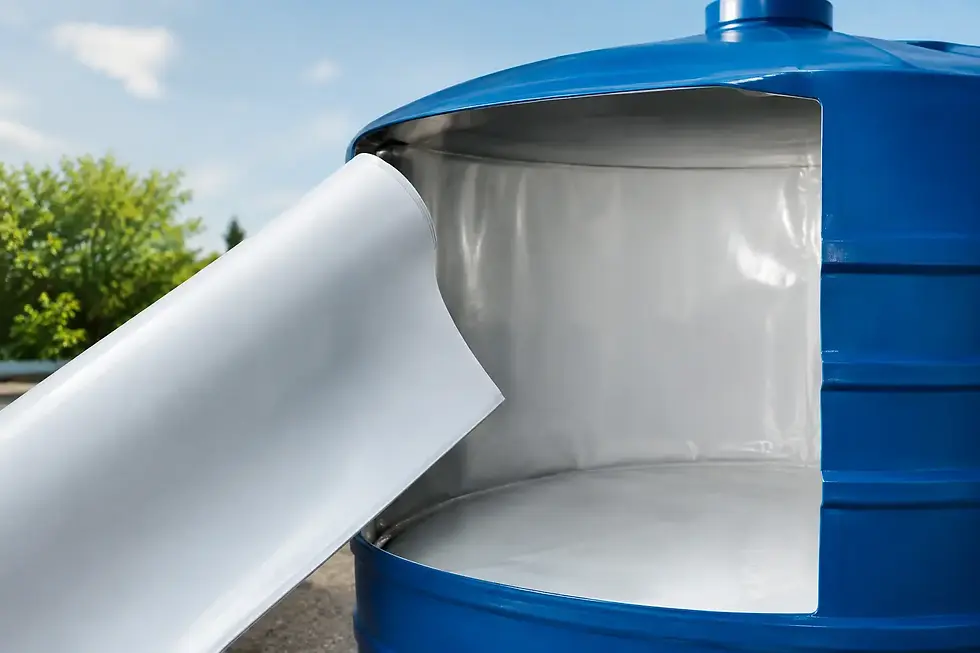
The condition of the internal surfaces also matters. Rough, degraded or flaking finishes are harder to disinfect effectively than sound, smooth surfaces. In some cases, especially where coatings have failed or substrate deterioration is advanced, lining or refurbishment may be the correct step before the tank is returned to potable duty.
The chlorination stage of the potable tank disinfection procedure
Once the tank is clean and physically suitable, the disinfection stage can begin. Chlorination remains the standard method in many potable applications because it is effective, practical and familiar within water hygiene practice. The disinfectant solution must be prepared and applied at the correct concentration, then allowed to remain in contact with all internal surfaces for the specified period.
There is no benefit in treating this as guesswork. Under-dosing may leave viable contamination behind, while excessive dosing can create handling risks, increase flushing times and potentially affect materials if poor practice is followed. Competent dosing calculations, safe chemical handling and proper circulation or surface coverage are essential.
In some cases, the tank is filled to a level that ensures complete contact with all wetted surfaces. In others, the internal surfaces and associated pipework are disinfected in a more controlled sequence. The exact method depends on tank geometry, site constraints, outlet arrangements and whether the associated distribution pipework also requires treatment.
What does not change is the need for full contact. Dead spots, inaccessible corners and overlooked fittings can undermine the whole operation. That is where experience matters, particularly on older or non-standard tanks.
Contact time and flushing
After the disinfectant has remained in place for the required period, the system is flushed until residual levels are brought back to an acceptable range. This stage is often underestimated. Poor flushing leaves excessive disinfectant in the system, while incomplete flushing may interfere with subsequent sampling.
Disposal arrangements also need planning. Chlorinated water cannot simply be discharged without considering site controls, drainage arrangements and environmental responsibilities. On larger commercial sites, this should be built into the method statement from the outset.
Sampling and verification
Disinfection is not confirmed by appearance alone. Clear water in a clean-looking tank is not the same as verified hygienic condition. Post-disinfection sampling is typically used to demonstrate that the procedure has been effective and that the stored water is suitable for use.
Sampling should be carried out correctly, with suitable controls to avoid false readings caused by poor technique. The timing of sampling matters as well. If the tank has been flushed but the system has not stabilised, or if residual contamination remains in connected pipework, results may not reflect the condition of the tank alone.
For facilities teams, the key point is that documentation matters as much as the practical work. Inspection findings, cleaning records, dosing details, contact times and sampling outcomes all help demonstrate that the process was completed properly. In regulated environments, that record is often as important as the disinfection itself.
Common reasons disinfection fails
When a tank does not stay hygienic after treatment, the failure is often operational rather than chemical. The most common cause is poor preparation. If sediment, scale or biofilm are left in place, disinfectant performance drops quickly.
The second issue is unresolved defect risk. A damaged roof cover, missing insect screen, defective hatch seal or split overflow arrangement can reintroduce contamination almost immediately. In those cases, a correctly executed disinfection procedure still produces a poor long-term result because the tank remains vulnerable.
The third issue is asset condition. Severely corroded steel, degraded concrete, broken jointing systems and failing internal coatings can create surfaces that are difficult to sanitise and harder to keep clean. Where the tank fabric has deteriorated, refurbishment or a specialist lining system may offer a more durable route than repeat cleaning and chlorination.
Why the tank condition changes the right approach
Not every potable water tank should be treated the same way. A relatively new GRP tank with minor sediment build-up presents a different challenge from an ageing concrete tank with surface degradation, or a steel sectional tank with corrosion and failed internal protection.
That is why a blanket disinfection response can be inefficient. Sometimes cleaning and chlorination are entirely appropriate. Sometimes they should be combined with repairs, hatch upgrades, insulation improvements or replacement of ancillary fittings. And sometimes the most cost-effective answer is a refurbishment scheme that restores compliance and service life without full tank replacement.
For commercial operators, the real value lies in diagnosing the condition properly before deciding the remedial route. That is especially true where downtime is expensive or access is difficult. A fast disinfection visit that ignores broader defects can become the more expensive choice if the site then faces another shutdown weeks later.
Compliance, safety and operational planning
Any potable tank disinfection procedure must be carried out with close attention to health and safety, chemical handling, confined space controls where applicable, and the operational needs of the building or site. On live commercial premises, planning is often the difference between a controlled maintenance activity and a disruptive incident.
Temporary water arrangements, isolation sequencing, permit controls and communication with building stakeholders all need to be considered in advance. Hospitals, manufacturing facilities, schools, residential blocks and industrial sites each present different operational constraints. The method should reflect that reality rather than forcing the site into a generic process.
For that reason, specialist contractors bring more than labour. They bring survey capability, material knowledge, confined space competence, disinfection experience and a practical understanding of how to keep critical water assets compliant while minimising disruption. That broader engineering view is often what separates a temporary fix from a dependable outcome.
Nationwide Water Solutions approaches this type of work with that wider lifecycle perspective, because disinfection is most effective when it sits within a clear understanding of tank condition, compliance risk and long-term performance.
A well-executed disinfection should leave more than a clean tank behind. It should give you confidence that the asset is fit for service, the contamination pathway has been addressed, and the next maintenance decision will be based on evidence rather than assumption.


Comments