
Industrial Tank Maintenance Guide for UK Sites

A water tank rarely fails without warning. Staining around seams, a persistent drop in water level, corrosion beneath a lid or sediment in outlet water are all signs that require action before they become an outage, contamination risk or costly replacement project. This industrial tank maintenance guide sets out a practical approach for UK facilities teams responsible for potable, process, sprinkler and specialist liquid storage tanks.
Start with the tank's duty, not a generic checklist
Maintenance requirements depend on what the tank stores, how it is constructed and the consequence of failure. A sectional GRP potable water tank on a hospital roof has very different risks from a steel process tank exposed to chemicals, or an underground concrete tank with limited access. The right maintenance plan begins by recording the tank's duty, capacity, material, age, water source, treatment regime, connected equipment and history of repairs.
For potable water storage, hygiene and temperature control are central concerns. Tanks forming part of a cold water system must be managed within the site's wider water hygiene arrangements, including Legionella risk control. For sprinkler tanks, the priority is dependable stored volume, serviceable valves and a structure that remains watertight when needed. Process and acid storage tanks demand closer attention to chemical compatibility, internal linings and the condition of fittings.
This distinction matters because a repair that is suitable for one application may be unsuitable for another. A coating must be compatible with the stored liquid; a liner must be selected for the operating environment; and any work on a tank connected to drinking water must use appropriate materials and controlled installation methods.
Routine inspections that find defects early
A planned visual inspection should be carried out at intervals determined by the tank's risk profile, environment and duty. The aim is to identify deterioration while remedial work remains targeted and manageable. Site teams should document findings with dated photographs, not simply mark an inspection as complete.
Externally, inspect the tank shell, roof or lid, access hatch, vents, overflows, supports, joints and associated pipework. Look for cracked GRP panels, corroded steelwork, failed sealant, distorted panels, damaged insulation, water staining and signs of movement at the base. Check that lids fit properly and that screens, vents and overflows prevent debris and pests from entering.
Internally, where safe access procedures permit, inspect for sediment, biofilm, corrosion, coating breakdown, loose components, exposed steel, liner damage and leakage at joints or penetrations. A confined-space assessment may be required before entry. Never treat internal tank work as a routine task without considering isolation, access, atmospheric testing, rescue arrangements and competent personnel.
Inspection also needs to cover the details that affect water quality and usable capacity. A damaged lid can admit contamination even when the tank body is sound. A faulty float valve can create overflow and water wastage. Sediment around an outlet can reduce effective storage or introduce debris downstream. Small defects are often connected, so the inspection should assess the whole asset rather than one visible problem.
Cleaning is a hygiene control, not cosmetic work
Cleaning frequency should be based on the tank's use, risk assessment and water quality condition. Potable water tanks may require cleaning and disinfection where inspection identifies contamination, sediment accumulation or other hygiene concerns. Tanks in dusty industrial settings, poorly protected roof spaces or areas with damaged covers may need more frequent attention.
Before cleaning begins, establish how the water supply will be maintained and whether the tank can be isolated without disrupting critical operations. Drain-down, sludge removal, cleaning, disinfection and recommissioning must be planned as a controlled sequence. For essential services, temporary storage or carefully phased work may be the better route.
Cleaning alone does not resolve a deteriorating tank. If corrosion, failed joints or a porous surface is present, returning the tank to service without repair can leave the underlying problem untouched. A post-clean inspection is often the point at which hidden defects become clear.
The industrial tank maintenance guide to repair decisions
When a defect is found, the key question is not simply whether the tank leaks. It is whether the structure remains serviceable and whether refurbishment will give a reliable, compliant life extension. A competent survey should identify the cause of deterioration, the condition of the substrate and the most appropriate remedial method.
Refurbishment and lining
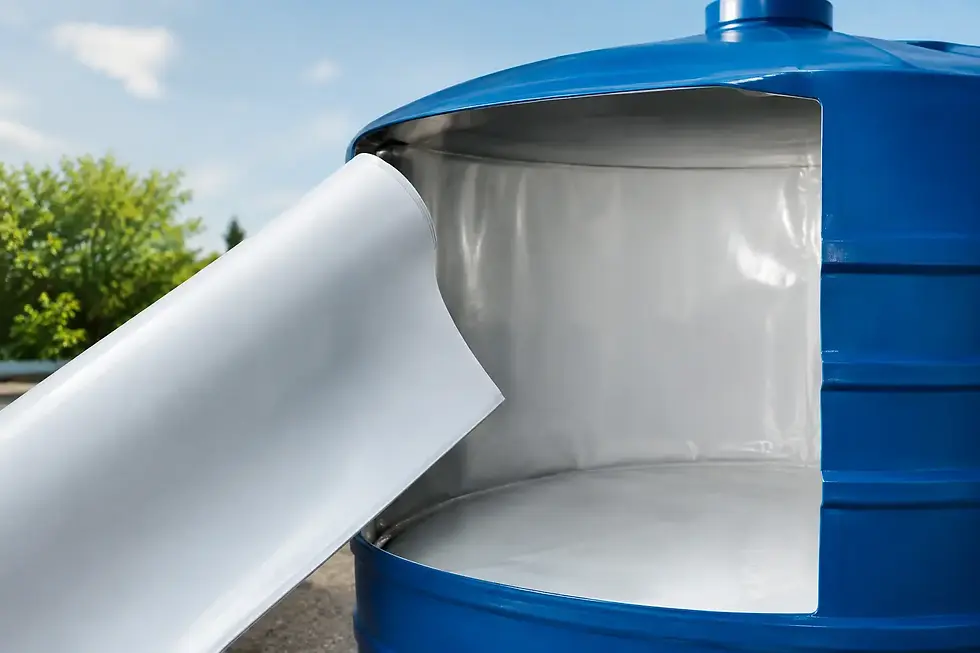
Flexible polypropylene lining systems can provide an effective solution for tanks with internal corrosion, minor leakage, aged surfaces or hygiene-related concerns, provided the tank structure is fundamentally sound. A properly specified liner creates a new internal containment barrier and can avoid the disruption and cost of complete replacement. It is particularly useful where access is restricted, the tank is difficult to remove or downtime must be controlled.
The trade-off is that lining is not a substitute for structural repair. Severely weakened panels, unstable foundations, major deformation or extensive damage to supports may require broader remedial work or replacement. The survey must determine whether the tank can safely support the intended service after refurbishment.
Epoxy resin coatings
Epoxy coating systems are commonly used where a bonded, protective internal finish is needed. They can address surface corrosion and protect suitable steel or concrete substrates, but success depends on preparation. The substrate must be cleaned, dry where required, sound and prepared to the specified standard. Poor preparation can lead to early coating failure, blistering or loss of adhesion.
For potable applications, the coating system and application process must be suitable for contact with drinking water. For chemical storage, compatibility with the specific liquid, concentration, temperature and cleaning regime should be confirmed before work is specified. One generic coating is not the right answer for every tank.
Structural repairs and upgrades
Some defects are local and can be repaired through panel replacement, joint sealing, roof repair, flange work or renewal of corroded components. Upgrades can also materially improve performance: insulated lids reduce temperature gains and contamination risk, improved access arrangements support safe inspections, and new screens or overflows help protect stored water.
Where the tank has reached the end of its practical life, replacement may be the most economical long-term option. This is especially true if repairs would be extensive, repeated or unable to address structural limitations. A replacement decision should account for access, lifting constraints, installation time, future maintenance and whether capacity or duty requirements have changed.
Protect compliance through records and competent work
Maintenance evidence is as valuable as the physical work itself. Facilities teams should retain survey reports, inspection records, cleaning and disinfection certificates, photographs, repair specifications, material details and recommissioning information. These records support internal governance, water hygiene management, insurance requirements and planned capital decisions.
For potable water systems, tank condition should be considered alongside the full water safety regime. Temperature monitoring, risk assessments, schematic drawings, outlet use and dead-leg control all influence the risk presented by stored water. For fire sprinkler storage, records should demonstrate that capacity, access, fittings and tank integrity are being managed in line with the system's operational requirements.
Competence matters particularly where tanks have confined access, contain hazardous residues or sit in occupied commercial buildings. Method statements should address isolation, lifting, work at height, confined spaces, waste handling and protection of adjoining services. The fastest installation is only valuable when it is also controlled, safe and fit for the tank's intended duty.
Build a maintenance plan around condition and consequence
A fixed annual visit can be useful, but it is not always enough. High-consequence tanks, older assets, tanks with prior leakage, exposed roof installations and chemical storage applications may need closer condition monitoring. Conversely, a newer, well-protected tank with clear inspection history may require a different interval. The plan should be reviewed after any significant defect, contamination event, change of use or alteration to the connected water system.
Nationwide Water Solutions Ltd approaches tank maintenance as a lifecycle decision: survey the asset, identify the true failure mechanism and select the repair, lining, coating, upgrade or replacement route that protects performance with the least unnecessary disruption. That approach prevents a cosmetic repair from becoming an expensive repeat visit.
A tank that is dry, clean and outwardly quiet can still be approaching a critical point of deterioration. Arrange a professional condition survey before minor defects dictate the programme, budget and operational options available to your site.


Comments