
Potable Water Tank Lining Explained
Updated: May 6

A potable water tank rarely fails all at once. More often, the warning signs show up gradually - coating breakdown, corrosion at panel joints, staining, sediment build-up, leaks around fixings, or inspection reports that raise hygiene concerns. For facilities managers and asset owners, the issue is not simply whether a tank still holds water. It is whether it remains fit for purpose, compliant, and economical to keep in service.
That is where potable water tank lining becomes a serious engineering decision rather than a cosmetic one. A correctly specified lining system can restore internal protection, protect water quality, reduce disruption, and extend the working life of a serviceable tank structure. The key is understanding when lining is the right answer, what material should be used, and where the risks sit if the specification is wrong.
What potable water tank lining is designed to achieve
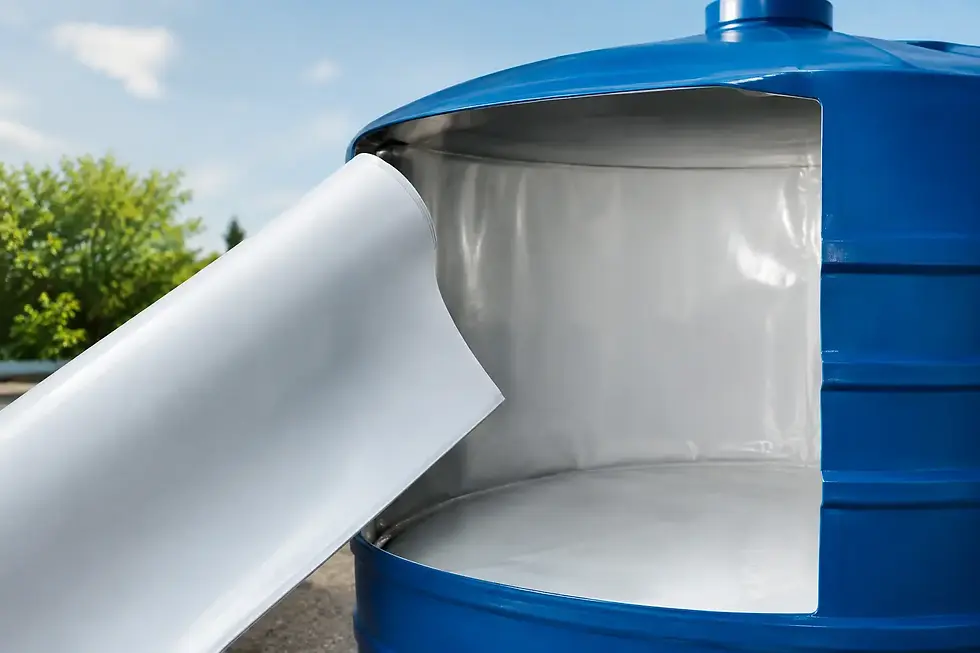
At its simplest, a lining system creates a protective internal barrier between stored potable water and the tank substrate. In practice, the job is more demanding than that. The lining must tolerate permanent immersion, resist microbiological risk, accommodate the geometry and condition of the existing tank, and comply with the requirements expected for drinking water contact materials.
For commercial and industrial sites, the objective is usually a combination of asset preservation and compliance improvement. Steel tanks may need protection from further corrosion. Concrete tanks may require an internal barrier to deal with deterioration, porosity, or contamination risk. Existing coatings may have reached the end of their service life and no longer provide a reliable hygienic finish. In each case, the lining is not an isolated product choice. It is part of a remedial strategy for the whole tank.
A well-planned lining project can also avoid the expense and programme implications of complete replacement. That matters on occupied buildings, live facilities, and sites where access is poor or shutdown windows are tight.
When potable water tank lining is the right approach
Not every tank should be lined. Some should be replaced, especially where structural failure, major distortion, severe panel degradation, or inaccessible defects make refurbishment poor value. The right starting point is always a technical survey.
Where the tank shell remains fundamentally sound, lining can often provide a faster and more cost-effective route. This is particularly relevant for sectional steel tanks, concrete tanks, and awkward plantroom installations where strip-out and replacement would involve significant disruption. On many sites, lifting out a tank is harder than repairing it.
The most common triggers for lining work include coating failure, corrosion, water quality concerns, age-related wear, and remedial works identified during inspection. It may also follow regulatory reviews where a tank does not meet current expectations for internal condition, cleanliness, lid integrity, access arrangements, or insulation.
The trade-off is straightforward. Lining can preserve a usable asset and restore performance, but it does not remove the need to assess the wider tank condition. If the roof, access hatch, vents, overflows, base supports, or division arrangements are defective, those issues should be dealt with as part of the same project.
Choosing the right lining system
The phrase "tank lining" covers several very different technologies. For potable water storage, material selection should be based on substrate, tank condition, access, programme constraints, expected service life, and compliance requirements.
Flexible lining systems
Flexible polypropylene lining systems are often the strongest option where ageing tanks need reliable internal separation from the original substrate. They are particularly useful in tanks with irregular internal surfaces, corrosion concerns, or substrates that are no longer ideal for direct coating application. Because the liner forms a new internal envelope, it can provide a practical solution where traditional coatings would be more dependent on perfect substrate condition.
This approach also suits refurbishment schemes where speed matters. Installation can often be completed with less invasive work than full replacement, while still delivering a durable potable water contact surface.
Epoxy resin coatings remain a proven option in many potable water applications, especially where the substrate is sound and surface preparation can be carried out to the correct standard. A coating system bonds directly to the tank interior and creates a hard protective finish.
The benefit is a compact, engineered solution with strong adhesion and chemical resistance when correctly specified. The limitation is that coatings are more sensitive to preparation quality, environmental conditions during application, and local substrate defects. If corrosion is advanced or the surface is unstable, a flexible lining may offer a more dependable result.
Why preparation and detailing matter more than product claims
Most tank lining failures are not caused by marketing promises. They are caused by poor diagnosis, weak preparation, or inadequate detailing around penetrations, flanges, corners, supports, and joints.
A potable water tank is a high-consequence environment. Any weak point in the internal barrier can become a route for water ingress behind the system, localised failure, hygiene issues, or recurring remedial costs. That is why the survey stage must identify not only visible degradation but also the construction type, existing coating condition, access restrictions, and any ancillary defects that could compromise the refurbished tank.
Detailing is especially important around panel joints, internal bracing, tie bars, inlet and outlet penetrations, and roof-to-wall junctions. These areas move differently, wear differently, and tend to be where ageing tanks first show distress. A specialist contractor should design the remedial route around those realities rather than applying a one-size-fits-all specification.
Compliance, hygiene and operational risk
For potable water systems, lining work is not only about extending tank life. It is about maintaining water quality and reducing compliance exposure. Building operators are under growing pressure to show that stored water assets are inspected, maintained, and kept in hygienic condition.
A deteriorated internal surface can contribute to contamination risk, sediment retention, and cleaning difficulties. Even where the stored water itself appears acceptable, an ageing tank may still represent a management risk if coatings are breaking down or internal materials are no longer suitable.
This is why lining projects should be viewed alongside associated upgrades. Insulated sectional covers, compliant access hatches, screened vents, overflows, warning pipes, and proper access arrangements all affect the long-term integrity of the stored water environment. Treating the internal lining as the whole answer can leave obvious weaknesses untouched.
Cost versus replacement
For many clients, the biggest question is whether lining is genuinely better value than replacing the tank. The answer depends on tank type, access, structural condition, and downtime implications.
Where a tank is located in a confined roof void, plantroom, basement, or difficult access area, replacement costs can rise quickly. Strip-out, disposal, builder's work, lifting plans, service interruption, and reinstatement all add programme and cost pressure. In these cases, lining can provide a substantial saving while still delivering a long service extension.
That said, lining should not be used to delay an inevitable replacement where the base structure is no longer dependable. Good engineering judgement means being clear about that threshold. Refurbishment is valuable when it solves the problem properly, not when it merely defers it for a short period.
What to expect from a specialist contractor
A competent potable water tank lining contractor should begin with a detailed condition survey, not a generic quotation. The recommendation should reflect the tank material, internal condition, service environment, and whether other remedial works are required at the same time.
Methodology matters. On live commercial sites, installation planning should address isolation, hygiene controls, confined space working, access equipment, waste handling, and return-to-service procedures. Rapid installation is useful, but only if quality control remains tight.
This is where engineering-led delivery makes a difference. Contractors with in-house system knowledge, manufacturing control, and practical refurbishment experience tend to make better decisions on site, especially when the original tank condition turns out to be worse than expected. Nationwide Water Solutions Ltd works in exactly this space, where lining is one part of a broader tank refurbishment and compliance solution rather than a stand-alone product sale.
Making the right decision for your asset
If a potable water tank is showing signs of age, the right response is not to assume replacement or to assume lining. It is to establish the real condition of the asset and choose the remedial route that protects water quality, budget, and long-term performance.
The strongest projects are the ones that solve the entire tank problem - internal protection, hygiene, compliance items, access constraints, and service life - in a single coordinated plan. If the structure is sound, lining can be an effective and commercially sensible way to restore performance. If it is not, the survey should say so clearly.
A potable water tank does not need to be new to be dependable, but it does need the right internal protection, the right detailing, and the right specification for the conditions it operates in.


Comments