

Tank Maintenance for Reliable Water Storage
A water tank rarely fails without warning. Staining at joints, recurring debris, internal corrosion, leaking seams, damaged insulation and declining water quality are all signs that tank maintenance has been deferred for too long. For facilities teams, the consequence is not simply an ageing asset. It can mean disruption to potable water supplies, process operations or fire protection provision, together with avoidable compliance and safety exposure.
The right approach is planned, condition-led and specific to the stored liquid, tank material and duty of the system. A potable water tank has different risks from a sprinkler reserve tank, an underground process tank or a chemical storage vessel. Treating every tank in the same way can lead to unnecessary replacement in some cases and inadequate remedial work in others.
Tank maintenance begins with a condition survey
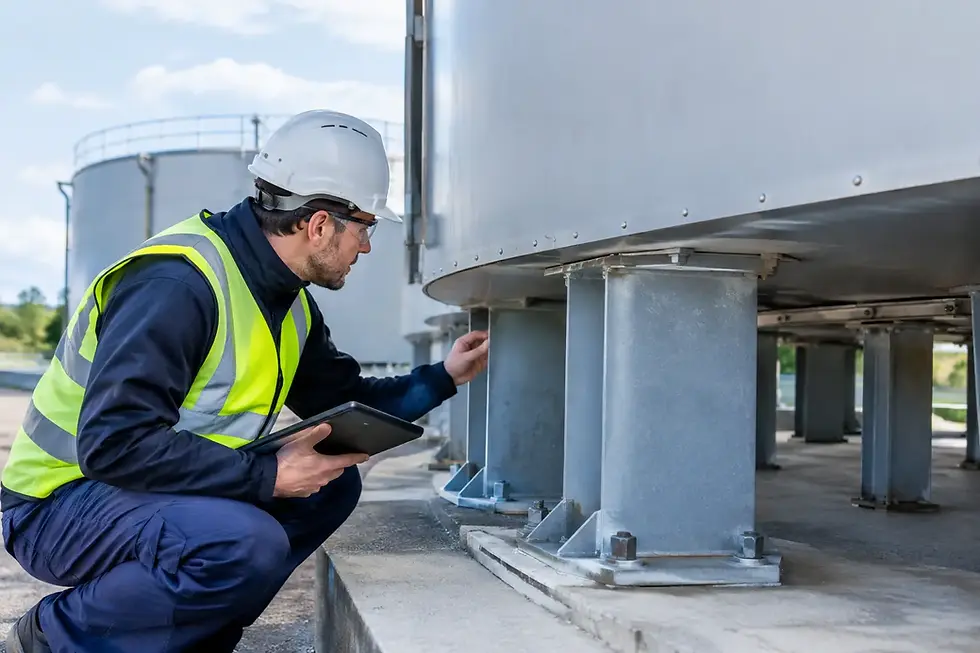
A detailed survey establishes whether a tank remains structurally serviceable and identifies the most appropriate route forward. This should examine the external structure, roof or lid, access points, internal surfaces, joints, supports, valves, overflows, screens, insulation and associated pipework. Where safe access permits, the internal condition is often the deciding factor.
For steel tanks, inspectors will look for corrosion, pitting, failed protective coatings and deterioration around seams, fixings and roof connections. Concrete tanks may show cracking, spalling, water ingress or a failing internal lining. GRP and sectional tanks can develop joint leaks, damaged panels, weakened seals or poorly performing covers. Underground tanks require particular attention because leakage and deterioration may remain hidden until there is a significant operational problem.
The survey should also assess hygiene and compliance matters. For potable systems, this includes evidence of sediment, biofilm, ingress routes, inadequate screening, damaged lids and stagnant areas that may affect water quality. The required maintenance regime should be aligned with the site's water hygiene risk assessment and wider management procedures, rather than being based on a generic calendar alone.
A useful survey does more than list defects. It separates urgent risks from planned works, explains the likely cause of deterioration and compares refurbishment against replacement. This gives asset owners a defensible basis for budgets and avoids replacing a tank whose structure can still provide many years of service.
The core elements of effective tank maintenance
Routine visual checks are the first line of defence. Site teams should look for leakage, corrosion, damage to cladding or insulation, loose access covers, blocked overflows and changes in water level. These observations are especially valuable after severe weather, nearby construction activity or alterations to the building's water system.
Internal inspection and cleaning are equally important, although frequency depends on the application and risk profile. Sediment and debris can accumulate in low-flow areas, while compromised covers or screens can allow contaminants to enter. Planned cleaning provides an opportunity to inspect internal coatings, linings and joints before small defects become extensive failures.
Mechanical and safety features should not be overlooked. Access ladders, handrails, platforms, hatches, float valves, level controls, warning pipes and overflow arrangements all affect safe operation. A tank may appear watertight while still presenting a maintenance hazard or a hygiene weakness through poor access and ineffective exclusion of insects, dust and surface water.
Records matter. Keeping clear inspection findings, photographs, cleaning reports, repair details and recommendations allows facilities managers to see patterns across an estate. Repeated minor leaks at joints, for example, may indicate a wider panel or seal issue. A history of coating failure may show that surface preparation, moisture conditions or chemical exposure need to be addressed differently during the next remedial project.
Refurbishment or replacement: making the practical choice
Full replacement is appropriate where the tank has lost structural integrity, the configuration no longer meets operational demand, or access and safety limitations cannot be satisfactorily resolved. It may also be the preferred route where a change in capacity, material specification or insulation performance is required.
However, replacement is not automatically the most cost-effective answer. Removing an existing tank can involve difficult access, lifting operations, service downtime, disposal costs and significant disruption to occupied buildings or industrial operations. Where the shell remains sound, targeted refurbishment can restore containment and extend the asset's working life at a lower overall cost.
Internal lining is often an effective option for tanks affected by corrosion, local leakage or deteriorated internal surfaces. Flexible polypropylene lining systems can provide a durable barrier between the stored water and the original tank structure. They are particularly useful where a rapid installation programme is needed and where retaining the existing tank avoids complex removal works. The lining specification must be suitable for the stored liquid and, for potable water applications, appropriate for contact with drinking water.
Epoxy resin coating systems can also be a strong solution, particularly where a bonded protective finish is required on prepared steel or concrete surfaces. Their success depends on careful assessment and preparation. Loose material, active corrosion, damp substrates and incompatible previous coatings can all affect performance. There is no universal preference between lining and coating: the right choice depends on the tank's condition, geometry, operating environment, downtime allowance and intended service life.
Address the causes, not just the visible defect
A repaired leak will return if the underlying issue remains. Corrosion may be driven by failed external cladding that has allowed moisture to sit against a steel tank. Persistent contamination can result from ill-fitting lids, missing screens or poorly designed overflows. Coating breakdown may be accelerated by aggressive process water, unsuitable cleaning chemicals or repeated cycling between wet and dry conditions.
Maintenance works should therefore include sensible upgrades where required. Insulated lids and covers can improve protection against debris, weather and temperature variation. Improved access arrangements make future inspection safer and more realistic. Replacement seals, screened vents, compliant overflows and repaired pipe connections can prevent a refurbished tank from inheriting the weaknesses of its previous condition.
For specialist applications, material selection is critical. Acid storage and chemically aggressive liquids demand resistance that differs substantially from potable or sprinkler water duties. A solution suitable for a cold-water storage tank may fail rapidly in a process environment. The tank, lining, coating, seals and fittings must be considered as one system.
Plan work around operational continuity
The best maintenance strategy recognises that taking a tank out of service is often the greatest challenge. Hospitals, commercial buildings, manufacturing sites and fire protection systems cannot always tolerate extended isolation. Early planning should establish whether water can be transferred, whether temporary storage is needed, and how the works will affect connected systems.
A specialist contractor should define the isolation sequence, access requirements, confined-space controls where applicable, cleaning arrangements, curing or installation times and return-to-service checks. For potable water storage, disinfection and water quality procedures must be planned before the tank is brought back into use. For sprinkler tanks, coordination with the responsible fire protection parties is essential so that impairment is understood and managed properly.
Rapid installation capability has real value, but it should never mean reducing preparation or quality control. A lining or coating is only as reliable as the substrate preparation, detailing at penetrations and joints, and inspection carried out before handover. Clear method statements, competent installation teams and documented completion checks protect both the asset and the operator.
Build maintenance into the asset plan
Tank maintenance is most effective when it is treated as lifecycle management rather than a reaction to leaks. Set inspection intervals according to risk, operating conditions and tank type. Use survey findings to prioritise works before water quality, containment or structural concerns become urgent. Budget for practical upgrades alongside remedial works, particularly where covers, insulation, access or screening are already nearing the end of their useful life.
Nationwide Water Solutions Ltd supports this approach with condition surveys, refurbishment, specialist lining and coating systems, and replacement installations for commercial and industrial water storage assets. The objective is not to prescribe replacement where it is unnecessary, but to provide a technically suitable route that protects performance, compliance and long-term cost control.
A well-maintained tank is easier to inspect, safer to operate and less likely to force an unplanned shutdown. The most valuable next step is often a professional assessment while the defect is still manageable, not after the tank has become a site emergency.


Comments