

A Practical Guide to Tank Joint Repairs UK
A leaking panel joint rarely stays a minor maintenance issue. Water can track behind insulation, corrode fixings, damage supporting steelwork and compromise water quality before an obvious external leak is seen. This guide to tank joint repairs explains how commercial and industrial sites should assess joint failure, select an appropriate remedial method and protect the useful life of a water storage asset.
The correct solution depends on the tank construction, the stored liquid, the location and condition of the defect, and the operational risk of taking the tank out of service. A repair that appears inexpensive at first can prove poor value if it only seals the visible leak while corrosion or degraded seals continue behind the joint.
Why tank joints fail
Tank joints are designed to accommodate panel connections, assembly tolerances and, in some cases, movement caused by filling cycles or temperature changes. Over time, the original sealant, gasket or bolt arrangement can lose integrity. On sectional steel tanks, the most common failures occur at horizontal and vertical panel joints, around bolt holes, at base connections and where pipework penetrates the tank shell.
Corrosion is a frequent underlying cause. External condensation, trapped moisture beneath cladding, coating breakdown and aggressive site conditions can attack the panel edges and fixings. Internally, poor water quality, sediment accumulation or unsuitable chemical exposure may degrade protective surfaces and joint materials.
Concrete tanks present a different pattern. Cracking at construction joints, movement joints or wall-to-floor interfaces can allow leakage and groundwater ingress. The visible crack is not always the full extent of the problem, particularly in underground structures where external hydrostatic pressure and restricted access affect the repair approach.
A joint can also fail because the tank has changed duty. A process tank that was originally used for water may now hold a liquid requiring greater chemical resistance. Likewise, a sprinkler tank may have received limited maintenance for many years before an inspection identifies deteriorated seams, panels or internal surfaces.
Inspect before specifying a repair
Effective tank joint repair starts with a survey, not a sealant cartridge. The survey should establish whether the issue is isolated, repeated across the tank or symptomatic of wider deterioration. This is especially important where a leak has been temporarily patched several times, as repeated local repairs can obscure the true condition of the joint line.
A competent inspection considers the tank type, dimensions, access arrangements, age, previous remedial work, stored liquid and operational role. The engineer should inspect joints, bolts, gaskets, panel edges, roof interfaces, internal stays, base condition, outlets, overflows and connections. Evidence of corrosion staining, displaced sealant, damp insulation, rusted fixings or distorted panels should be recorded alongside the active leak location.
For potable water storage, the inspection should also consider hygiene. Materials used inside the tank must be suitable for the intended duty, and the repair method must allow the tank to be cleaned, disinfected and returned to service in a controlled manner. Where the tank supports a critical building supply or fire protection system, the work programme should account for resilience, temporary storage and system downtime.
Guide to tank joint repairs: choosing the right method
There is no universal repair for leaking joints. The most suitable method is determined by whether the original tank shell remains structurally sound and whether access allows durable preparation and installation.
Localised resealing and gasket replacement
If the panels are in good condition and failure is limited to a small number of accessible joints, resealing or gasket replacement may be appropriate. The affected area must be fully prepared: old sealant, corrosion products and contamination should be removed, while bolts and washers should be assessed for corrosion or loss of tension.
This approach can be cost-effective for a recent, localised defect. Its limitation is that it does not address widespread internal corrosion, thinning panel edges or multiple ageing joints. It should not be used as a substitute for a condition-led refurbishment where defects are recurring across the tank.
Epoxy coating systems
Epoxy resin coating systems can provide a durable internal barrier where steel or concrete surfaces remain suitable for refurbishment. Preparation is critical. Coatings will only perform as intended when the substrate is clean, sound, dry enough for the specified system and prepared to the required profile.
For tank joints, an epoxy system may bridge prepared interfaces and protect surrounding surfaces from further corrosion. It can be a strong option for tanks with moderate surface deterioration, but it is not automatically suitable where movement is expected or where the substrate has extensive perforation. The stored liquid and any chemical exposure must also be considered when selecting the coating specification.
Flexible internal tank lining
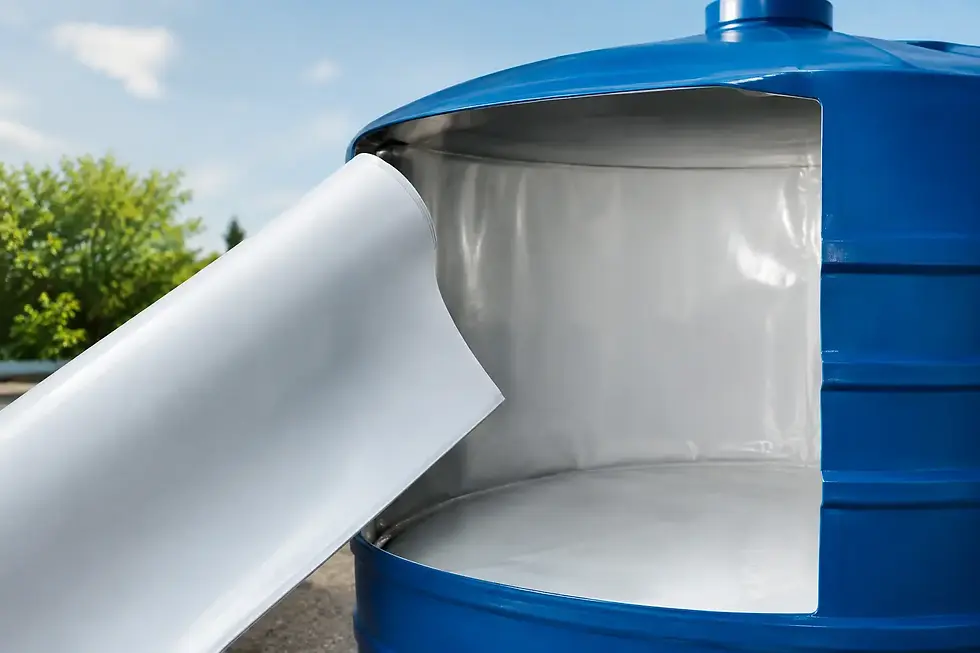
A flexible polypropylene lining system can isolate the stored water or process liquid from the existing tank shell. This is often an effective route for sectional steel tanks with leaking seams, degraded internal coatings or corrosion that would make repeated joint-by-joint repairs uneconomic.
The liner is formed to the tank and installed as a continuous containment layer, reducing reliance on ageing internal panel joints. Because the existing structure remains in place, this approach can avoid the cost, access difficulties and disruption associated with a full replacement. It is particularly valuable where the external structure is serviceable but the internal water-retaining surface has reached the end of its reliable life.
The trade-off is that the supporting tank structure still requires assessment. A liner cannot correct a tank that is structurally unsafe, significantly distorted or suffering from advanced external corrosion. Lids, insulation, fixings, access hatches and ancillary components may also require upgrading as part of the project.
Concrete joint injection and specialist lining
For concrete tanks, repair may involve resin injection to stabilise and seal cracks or construction joints, followed by a protective coating or lining where appropriate. The chosen material must match the movement characteristics of the joint and the service environment. Rigid crack repair materials have a role in stable cracks, while flexible systems are better suited to areas with controlled movement.
Underground tanks require particular care. Groundwater ingress, confined-space controls, ventilation, drainage and safe access can all influence the repair sequence. A technically correct material is not enough if site conditions prevent proper surface preparation or curing.
Plan the work around operational risk
A good repair specification should set out more than materials. It should define isolation requirements, cleaning, confined-space procedures, access equipment, substrate preparation, repair stages, curing periods, disinfection and return-to-service checks.
For sites with a single potable water tank, timing is often the main constraint. Works may need to be completed during low-demand periods, with temporary water arrangements in place. For sprinkler storage, the tank’s role in the wider fire safety system must be considered before isolation. Facilities teams should involve relevant stakeholders early rather than treating the repair as a stand-alone maintenance task.
Rapid installation is valuable, but speed should not compromise preparation. Surface cleaning, drying and detailing around joints are the stages most likely to determine whether a repair lasts. Nationwide Water Solutions Ltd assesses the tank as a complete asset, helping clients distinguish between a practical refurbishment and a tank that genuinely requires replacement.
When repair is no longer the sensible option
Replacement becomes more appropriate where the tank has extensive structural corrosion, widespread panel thinning, damaged supports, recurring leaks across multiple elevations or a capacity that no longer meets site demand. It may also be the better long-term decision where access improvements, insulation upgrades or a new tank configuration are needed.
Even then, the decision should be based on total lifecycle cost rather than the initial price alone. A serviceable tank shell with failed internal joints may be restored at a substantially lower cost than replacement. Conversely, repeated emergency repairs on a structurally declining tank can create downtime, call-out costs and avoidable operational risk.
Keep a clear record of inspections, defects and completed repairs. That history makes it easier to identify recurring joint failures early, budget for refurbishment and act before a small leak becomes an unplanned outage.


Comments