

A Guide to Potable Tank Upgrades for UK Sites
A potable water tank can remain structurally standing while becoming increasingly difficult to manage safely. Internal corrosion, failed joints, damaged insulation, unprotected access points and deteriorating lids can all compromise water quality or create conditions that demand urgent remedial work. This guide to potable tank upgrades sets out how commercial and industrial sites can assess the condition of their storage assets and select improvements that protect supply, compliance and long-term operating cost.
Start with the tank’s actual condition
An upgrade should begin with a competent survey rather than an assumption that replacement is the only answer. Many steel, concrete and sectional tanks have serviceable primary structures but need targeted refurbishment to return them to an acceptable standard. Equally, a tank that appears sound from the outside may have internal coating failure, corrosion beneath joints or inaccessible areas where contamination risk is developing.
A detailed inspection should consider the tank shell, roof or lid, floor, internal surfaces, joints, bolts, access arrangements, insulation, overflows, vents, warning pipes and supporting steelwork. The survey should also identify whether the existing layout permits safe cleaning, inspection and future maintenance. These findings provide the basis for a scope that addresses the cause of deterioration rather than simply treating visible symptoms.
For sites responsible for drinking water storage, the condition of the internal wetted surface is central. Flaking coatings, rust scale, porous concrete, degraded sealants and sediment traps can all affect hygiene and make routine tank management harder. A clear survey report allows facilities teams to prioritise work against operational risk, budget and planned shutdown windows.
Match the upgrade to the tank material and defect
Potable tank upgrades are not one-size-fits-all. The correct remedial route depends on tank construction, age, location, water use, level of deterioration and access restrictions. A lining system may be the most cost-effective solution for a structurally sound steel or concrete tank, while a badly weakened tank or one with extensive external corrosion may be better suited to replacement.
Internal lining for ageing but serviceable tanks
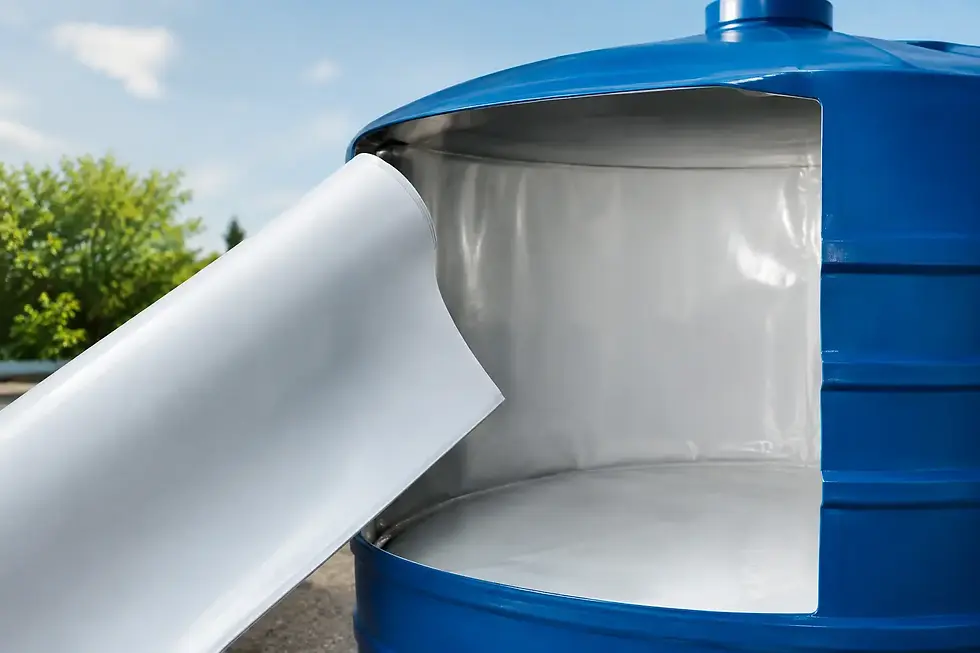
Where the tank shell remains structurally viable, an internal potable water lining can create a clean, contained barrier between stored water and the original substrate. This is particularly valuable where corrosion, pinholing, coating failure or minor leakage has affected the internal surface.
Flexible polypropylene lining systems are well suited to many refurbishment projects because they can be manufactured to suit the tank dimensions and installed with less disruption than major structural replacement. The lining should be selected for potable water suitability, chemical resistance where treatment conditions require it, and the ability to accommodate the tank’s geometry, penetrations and joints.
The practical benefit is not merely cosmetic. A correctly specified lining removes deteriorated internal surfaces from contact with the water and can extend the useful life of an existing asset. It can also reduce the time and cost associated with removing a large tank from a plant room, roof area or restricted service space.
Epoxy coating where surface preparation is achievable
Epoxy resin coating systems can be appropriate for tanks requiring a hard protective internal finish. Their suitability depends heavily on substrate condition and preparation. Loose scale, residual contamination, moisture, existing failed coatings and poor access must all be addressed before coating begins.
Coatings are often an effective option where the surface profile can be properly prepared and controlled application conditions are available. They are less forgiving of movement, complex joint details or backgrounds with continuing degradation. A survey should therefore establish whether coating offers the required durability, or whether a flexible lining provides a more dependable barrier.
Lids, covers and insulation are water-quality upgrades
An ageing lid is not a minor maintenance issue. Damaged, uninsulated or poorly fitting covers can permit debris, insects and other contaminants into the tank, while also increasing exposure to temperature variation. Gaps around access points and poorly screened vents deserve equal attention.
Insulated tank lids and covers improve protection at the top of the asset, where weathering and unauthorised access can create avoidable risk. The right arrangement supports a controlled tank environment and makes the asset easier to maintain. On outdoor installations, it may also help reduce heat loss and protect the tank from harsh weather conditions.
Design for potable water compliance and safe maintenance
A potable tank upgrade must support the wider duties of the organisation responsible for the water system. This includes maintaining hygienic storage conditions, providing safe access for inspection and cleaning, and preventing contamination routes around lids, overflows, vents and internal surfaces. The precise requirements will depend on the building, users, water system design and relevant standards or guidance applying to the site.
Good upgrade design deals with the details that are often missed during reactive repairs. Overflows should discharge visibly and be protected against ingress. Vents should be screened appropriately. Access hatches need to close securely while remaining practical for authorised personnel. Internal fixtures, pipework connections and sealant details should be compatible with potable water service.
Safe access is also a project constraint, not an afterthought. Roof-mounted tanks, basement plant rooms, enclosed concrete reservoirs and tanks located above occupied areas may require carefully planned lifting, confined-space controls, isolation procedures and temporary water arrangements. The chosen solution needs to be installable safely as well as technically suitable once complete.
Plan the work around continuity of supply
For many commercial premises, taking a potable tank out of service is more difficult than carrying out the physical refurbishment. Healthcare facilities, manufacturing sites, education estates, hotels, distribution centres and multi-occupancy buildings may all depend on reliable stored water for daily operation.
The project plan should establish the available isolation period, whether a second tank can maintain supply, and whether temporary storage or phased work is necessary. Cleaning, disinfection, repairs, lining installation, curing where relevant, inspection and recommissioning must be sequenced realistically. Rushing the final stages can undermine an otherwise well-executed upgrade.
Early planning also prevents common cost increases. Restricted delivery routes, crane requirements, plant-room access, asbestos considerations, working-at-height controls and the removal of redundant materials can all affect programme and price. A specialist contractor should identify these factors during the survey stage, not after the tank has been drained.
Know when refurbishment is no longer the right answer
Refurbishment can offer significant savings compared with full replacement, but it is not always the correct engineering decision. A tank with severe structural deterioration, widespread panel failure, unstable foundations, major roof damage or obsolete configuration may need replacement to provide a reliable long-term solution.
Replacement can also be preferable when capacity needs have changed, access has become unsafe, or the existing tank cannot be brought to an acceptable standard without disproportionate work. Modern GRP and fibreglass sectional tanks can be installed in challenging locations and configured with insulated covers, suitable access arrangements and components designed for the operating environment.
The decision should be based on lifecycle value rather than the lowest initial cost. A lower-cost repair may be sensible where the tank structure is sound and the defect is contained. However, repeated patch repairs to a tank approaching the end of its service life can create more disruption and expense than a planned replacement.
Specify the upgrade clearly
A well-defined scope protects the client, contractor and the water system. It should identify the tank dimensions and construction, existing defects, required cleaning and preparation, selected lining or coating system, lid or cover works, repairs to associated components, access controls, testing requirements and handover information.
It is equally useful to agree what constitutes completion. For a lining project, this may include inspection of seams, penetrations and termination details. For coating work, it may include surface preparation records and confirmation that the specified system has been applied correctly. For any potable water storage work, cleaning, disinfection and recommissioning procedures should be planned before works begin.
Nationwide Water Solutions Ltd approaches these projects as lifecycle work rather than isolated repairs. In-house manufactured lining systems, survey-led recommendations and rapid installation capability help clients select a practical route that reflects the tank’s condition and the operational demands of the site.
Make the next inspection easier than the last
The best potable tank upgrade leaves the asset easier to inspect, clean and manage over its remaining life. That means preserving safe access, protecting vulnerable openings, recording the completed works and setting a realistic inspection and maintenance schedule. A tank does not need to be visibly leaking to justify attention. Acting while the structure remains recoverable usually provides more options, lower disruption and a better return on the maintenance budget.


Comments