

Can Tank Covers Prevent Water Contamination?
A tank lid is often treated as a minor accessory until debris, insects or surface water find their way into a stored-water supply. At that point, the question is no longer cosmetic: can tank covers prevent contamination? In many cases, yes. A properly specified, well-fitted and maintained cover is one of the first physical barriers protecting a tank from external contamination. It is not, however, a substitute for tank cleaning, inspection, disinfection or repair.
For commercial and industrial sites, effective protection depends on the tank’s duty, location, construction and condition. A cover that suits a clean internal potable water tank may be unsuitable for an external sprinkler tank, a process-water tank or a chemical storage application. The detail matters.
Can tank covers prevent contamination?
Tank covers can significantly reduce the chance of contaminants entering stored water, provided they fully protect the access opening and are compatible with the tank environment. Their primary purpose is to exclude airborne dirt, leaves, bird droppings, insects, vermin, rainwater and unauthorised access. On potable water systems, these entry routes can compromise water quality and create conditions that require remedial action.
Covers also limit light entering the tank. This can be valuable where sunlight may encourage algae growth, particularly in externally located tanks or tanks with translucent roof panels. Preventing debris and organic matter from entering the water reduces the nutrient load that can support microbiological growth.
The limitation is equally clear. A cover cannot correct contamination already within the system. Sediment at the tank base, corrosion products, failed internal coatings, damaged seals, stagnant areas and poorly maintained pipework can all affect water quality even where the lid itself is sound. A cover is one control within a wider water storage management plan.
Where contamination enters an unprotected tank
Open, damaged or poorly fitting lids leave tanks exposed to risks that are easy to underestimate. A small gap around an access hatch can admit insects and wind-blown debris. A warped sectional tank roof may allow rainwater to track into the tank. Missing mesh on vents and overflows can provide an entry point for insects or rodents.
The risk is often higher on roofs, plant decks and remote external compounds, where routine visual checks may be less frequent. Trees, nesting birds, weather exposure and nearby construction work can rapidly increase the debris load around a tank. Internal tanks are not automatically protected either. Dust from plant rooms, damaged ceiling finishes and unauthorised access can still introduce contaminants.
For potable water storage, these faults should be considered alongside the wider duties to manage water hygiene. Guidance such as the Approved Code of Practice L8 and HSG274 places emphasis on maintaining water systems in a condition that does not encourage the growth of harmful bacteria. A secure, hygienic tank cover supports that objective, but it should sit alongside inspection, cleaning, temperature control where relevant and documented monitoring.
What an effective tank cover needs to do
A suitable cover must do more than sit over an opening. It needs to create a reliable barrier while allowing the tank to remain safe to inspect, clean and maintain. The best specification depends on the application, but several requirements are consistent across most installations.
The cover should fit the tank aperture correctly, with no open edges, failed joints or distorted sections. It should resist wind uplift and withstand the expected loading without cracking or deflecting. For external tanks, weather resistance and drainage are essential. Standing water on a lid can accelerate deterioration and may enter through poorly sealed joints.
Access is another key consideration. Inspection hatches should be secure, appropriately sized and positioned to allow safe maintenance activity. They should close tightly after use and should not create a trip hazard for operatives working around the tank. On potable applications, materials in contact with the tank interior must be suitable for the duty and should not introduce odours, residues or substances that could affect water quality.
A well-designed insulated lid can provide additional benefits. It protects the stored water from debris while helping to reduce temperature fluctuation. This can be particularly useful for tanks located outdoors or in unheated areas, where solar gain and cold weather can affect the stored water and the tank structure.
Covers, lids and complete roof systems
The terms cover and lid are sometimes used interchangeably, but they can describe different scopes of work. A simple access cover may protect one inspection opening. A replacement lid may cover a larger tank aperture. A complete roof or sectional tank cover system protects the full tank footprint and may be required where existing roof panels have deteriorated, cracked or lost their weatherproof integrity.
This distinction matters during surveys. Replacing a single hatch will not resolve contamination risk if the surrounding roof is split or the tank’s vent and overflow remain unprotected. Equally, full roof replacement may not be necessary where the tank structure is sound and the issue is limited to damaged access points. The right remedial route follows a close assessment of the tank, not a standard product choice.
The cover must work with vents, overflows and connections
A tank can have a secure lid and still be vulnerable through other openings. Vents, warning pipes, overflow pipes and cable penetrations all need attention. Ventilation is necessary for many tank systems, but vent openings should be protected with suitable insect-proof mesh that is secure, clean and maintained. Overflow arrangements must discharge safely while preventing pests and debris from travelling back towards the tank.
Pipe entries should be properly sealed without placing stress on the pipework or restricting movement where thermal expansion is expected. Temporary gaps around penetrations are a common source of dust ingress and can become larger over time as materials age or the tank moves under load.
During a tank condition survey, these details should be inspected as part of the complete contamination-control picture. It is rarely enough to look only at the visible lid. The condition of roof joints, flanges, internal surfaces, valves, insulation and access arrangements can all influence the long-term performance of the tank.
When a cover alone is not enough
There are occasions when fitting a new cover is the correct immediate measure, but not the complete solution. If a tank has visible internal corrosion, failed sealant, porous concrete, damaged GRP, blistered coatings or a worn internal liner, contaminants may arise from the tank fabric itself. In these circumstances, refurbishment can offer a more effective and cost-conscious alternative to full tank replacement.
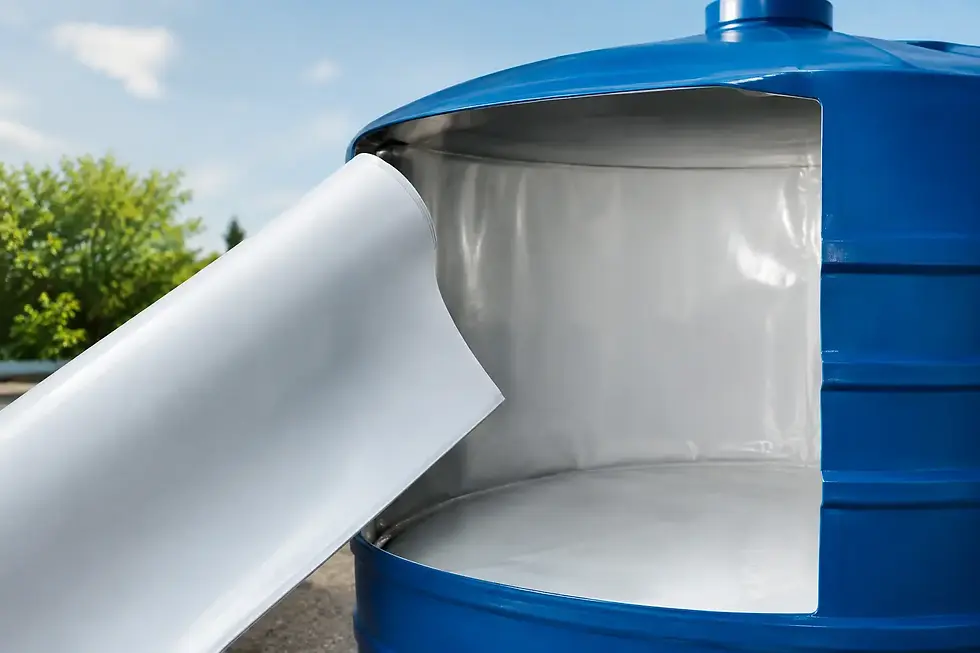
Flexible polypropylene lining systems can isolate the stored water from a deteriorated substrate and provide a clean, durable internal surface. Epoxy resin coating systems may be suitable for certain steel or concrete tank refurbishment projects where the substrate is correctly prepared and the coating is selected for the stored liquid. The choice depends on tank material, service conditions, chemical exposure, access and the required service life.
Cleaning and disinfection may also be required before the tank is returned to use. This is particularly relevant where debris, biological contamination or sediment has been identified. A new lid fitted over an uncleaned tank simply closes off the evidence rather than addressing the cause.
Selecting a cover for the tank’s actual duty
Potable water tanks require careful attention to hygiene, material suitability and access control. Sprinkler tanks have different operational priorities, including protection from external debris and maintaining dependable water availability for fire suppression. Process tanks may need covers that tolerate vapours, elevated temperatures or particular operating conditions. Acid and chemical storage applications demand materials selected for the specific chemical, concentration and temperature, rather than a general-purpose lid.
The tank’s location also changes the specification. An underground chamber may need a cover designed for safe access and the loading conditions above it. A roof-mounted tank needs weather resistance, secure fixing and consideration of wind exposure. Difficult-access sites may benefit from lightweight components that can be transported through restricted routes and installed with minimal disruption to the building.
For this reason, a site survey should establish more than the opening dimensions. It should confirm the tank construction, existing defects, access constraints, operating duty, safety requirements and whether the tank can remain in service during the works. These findings allow the cover, lining, coating or replacement proposal to be matched to the real risk.
Inspection keeps the protection effective
Even a high-quality cover needs periodic checking. Site teams should look for cracked panels, distorted frames, failed seals, loose fixings, pooling water, damaged mesh and signs of unauthorised access. Any debris accumulating around the lid should be removed before it is carried into the tank during inspection.
Checks should also confirm that access points are closed after maintenance and that vents and overflows remain clear. Where tank hygiene is managed through a written scheme of control, cover condition and remedial actions should be recorded alongside broader inspection and cleaning activity.
Nationwide Water Solutions Ltd assesses tank condition as a complete system, identifying where a replacement lid will resolve the issue and where lining, coating, structural repair or full replacement is the more dependable answer. Acting before a damaged cover becomes a water-quality incident protects the tank, the building and the people who rely on the stored supply.


Comments