
Epoxy Coating vs Tank Liner: Which Fits?
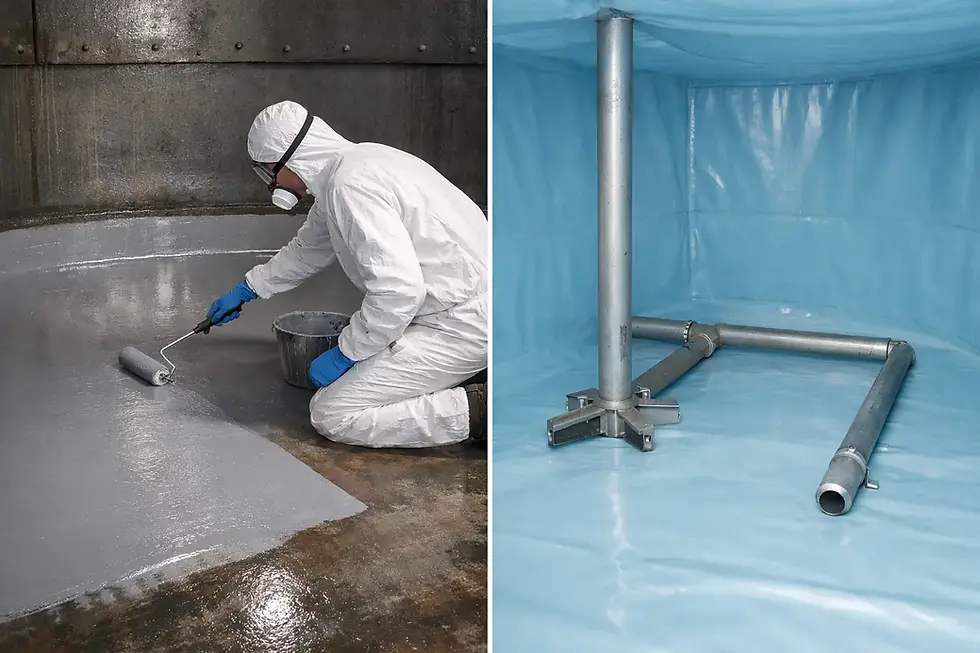
When a tank starts showing corrosion, coating failure, leaks or hygiene concerns, the real question is not simply whether it needs repair. It is whether epoxy coating vs tank liner is the right remedial route for the tank you have, the liquid you store and the operational risk you can tolerate. For commercial and industrial sites, that decision affects compliance, programme length, service life and total cost far more than the initial scope might suggest.
Too often, these two systems are treated as interchangeable. They are not. Both can extend the life of a serviceable tank and both can be highly effective when specified correctly, but they solve different problems and behave differently once installed. The correct choice depends on substrate condition, access, duty, hygiene requirements, chemical exposure and whether the priority is restoring a sound internal surface or creating a new internal barrier independent of the original tank shell.
Epoxy coating vs tank liner: the core difference
An epoxy coating is a bonded surface treatment. It is applied directly to the prepared internal face of the tank, where it cures to form a protective barrier over steel or concrete. Its performance depends heavily on substrate preparation, adhesion and environmental control during application. If the underlying structure is fundamentally sound and accessible for correct preparation, an epoxy system can provide a durable refurbishment outcome.
A tank liner is different in principle. Rather than relying solely on adhesion to the tank wall, a liner creates a new internal containment layer within the existing structure. In practical terms, that can be a major advantage where the substrate is uneven, heavily degraded, difficult to blast back to the required standard or where long-term separation from the original surface is preferable. For many ageing tanks, especially those with corrosion, pitting or awkward geometry, a liner offers a more forgiving and often more strategic solution.
This is why specification should start with condition and duty, not product preference. A well-selected system works because it matches the tank's defects and operating demands.
When epoxy coating is the better option
Epoxy coating is usually strongest where the tank structure remains in good order but the internal protective finish has deteriorated. Steel tanks with localised coating breakdown, surface corrosion or ageing internal finishes are common examples. Concrete tanks can also be suitable, provided the substrate can be prepared properly and the coating system is compatible with the stored medium.
Where potable water is involved, compliance matters as much as protection. The coating must be suitable for contact with drinking water, and the installation process must be controlled accordingly. Surface preparation, cure times, ambient conditions and cleanliness all affect the finished result. A coating specified for the wrong environment, or applied onto a poorly prepared substrate, can fail prematurely even if the material itself is technically suitable.
The main advantage of epoxy is that it restores the tank interior without significantly reducing usable volume. It can also be a cost-effective route where the steel or concrete remains structurally sound and where shutdown planning allows for the preparation and cure programme. In the right setting, it is a precise engineering answer rather than a stopgap repair.
That said, epoxy is not especially tolerant of poor substrate condition. Deep pitting, active corrosion, moisture-related preparation issues and complex internal details can all increase risk. If adhesion is the foundation of performance, anything that compromises adhesion must be taken seriously.
Where coatings can become less suitable
Problems usually arise when a coating is expected to bridge defects that really call for a different remedial philosophy. If the tank interior is heavily corroded, if access is restricted, or if there is a history of repeated coating breakdown, another coat is not always the most dependable long-term answer.
This is particularly relevant with older sectional tanks, difficult underground structures and assets that have seen years of service without ideal maintenance conditions. A coating may still be possible, but possible is not the same as best.
When a tank liner is the better option
A tank liner comes into its own when the existing structure can still serve as the outer shell but the internal surface is no longer a reliable basis for a bonded coating. In these cases, the goal is often to install a new internal barrier that isolates the stored liquid from the old substrate.
This approach is especially useful in tanks with corrosion, irregular surfaces, previous failed coatings, challenging geometry or defects that would make preparation-intensive coating work more difficult, more time-consuming or less predictable. Flexible lining systems can also suit projects where installation speed and reduced disruption are major concerns.
For potable water assets, a correctly specified liner can provide a clean, compliant internal surface while avoiding the need to fully replace an otherwise serviceable tank. For industrial applications, the right liner material can offer strong chemical resistance across a range of duties. The specification has to be exact, because chemical compatibility, temperature and operating conditions all affect long-term performance.
A further benefit is programme control. Lining systems can often reduce dependency on the exact substrate profile needed for high-performance coating adhesion. That does not remove the need for inspection or preparation, but it can make refurbishment more achievable in older assets where ideal coating conditions are hard to secure.
Nationwide Water Solutions Ltd has seen this distinction become increasingly important on refurbishment projects where clients want to avoid the cost and disruption of full replacement but still need a durable internal system engineered for the tank's actual condition.
Why liners are not automatically the answer either
A liner is not a universal fix for every tank defect. Structural issues still matter. If the shell, supports, base or sectional integrity are compromised, lining alone may not address the underlying problem. Likewise, details such as penetrations, flanges, fixings, access points and roof interfaces need to be designed and installed correctly if the new internal barrier is to perform as intended.
In short, a liner can overcome many substrate-related limitations, but it does not remove the need for a proper survey and a technically sound refurbishment design.
Cost, downtime and service life
Buyers often ask which option is cheaper. The honest answer is that the lower contract price does not always produce the lower whole-life cost.
An epoxy coating may appear attractive where the tank is fundamentally sound and the preparation scope is straightforward. If the substrate condition is better than expected, coating can be an efficient route with a strong service outcome. But if preparation becomes extensive, if environmental controls are difficult, or if defects are uncovered during works, cost and programme can move quickly.
A tank liner may have a different cost profile up front, yet offer better value where it avoids major substrate reconstruction, shortens programme time or delivers a more dependable long-term barrier in a compromised tank. For operational sites, downtime often carries its own hidden cost. Any refurbishment method that reduces outage, temporary water arrangements or repeat interventions deserves serious consideration.
Service life is similarly conditional. A well-installed epoxy system on a suitable substrate can perform very well. A properly engineered liner can do the same, particularly where substrate independence is an advantage. Neither should be selected on headline claims alone. The question is how each system will behave in your tank, under your duty, over time.
How to choose between epoxy coating vs tank liner
The starting point should always be a detailed tank survey. Not a quick visual glance, but an inspection that considers corrosion, pitting, coating failure, structural condition, access limitations, roof and cover condition, hygiene risks, service duty and compliance obligations. Without that, specification is guesswork.
If the internal surfaces are stable, preparation is achievable and the tank is a good candidate for a bonded system, epoxy coating may be the logical choice. If the existing surface is too degraded, too irregular or too risky for coating reliance, a liner may offer a more durable and cost-effective route.
This is also where tank type matters. Potable water tanks, sprinkler tanks, process tanks, concrete structures, steel sectional tanks and underground assets each bring different constraints. The right answer for one is not automatically right for another.
A good contractor should be prepared to explain not only what they recommend, but why the alternative is less suitable. That level of technical reasoning matters, especially where compliance, hygiene and continuity of service are on the line.
The best refurbishment decisions are rarely driven by product labels. They are driven by condition data, operating demands and a clear understanding of risk. If your tank still has service life in it, the right remedial system can recover performance, protect compliance and avoid unnecessary replacement. The useful question is not which option sounds better on paper, but which one gives your specific tank the most dependable future.


I want to upgrade the surfaces in our workshop office and breakroom here in Las Cruces without replacing the base structures. A custom epoxy finish would give us seamless style and stain resistance. If you’re searching for local installation ideas, consider https://speedway-flooring.com/epoxy-countertops/ for custom epoxy countertops.