

How to Seal a Steel Tank Without Replacing It
A steel tank rarely fails without warning. Rust staining around seams, blistered paint, sediment in stored water, damp patches at the base and recurring leakage are all signs that the protective barrier has been compromised. Knowing how to seal steel tank defects correctly can save a serviceable asset from premature replacement, but the right repair depends on the tank’s condition, its contents and the duty it performs.
For commercial water storage, a quick external coating over corrosion is seldom a durable answer. The work needs to address the cause of deterioration, restore containment and protect the stored water or process liquid from contact with degrading steel.
Start by identifying why the steel tank is failing
Steel tanks deteriorate for different reasons, and each demands a different remedial approach. Atmospheric corrosion commonly affects external panels, roofs, ladders and supports where coating systems have broken down. Internal corrosion is often more serious, particularly at the waterline, around fixings, beneath sediment and in areas where a previous coating has lifted.
A leaking joint may result from corroded steel, failed sealant, movement between panels, loose bolts or a damaged gasket. Pinholes within a tank shell can indicate localised pitting, while widespread blistering may point to moisture trapped beneath an old coating. Before specifying a seal, establish whether the tank remains structurally sound.
A competent tank survey should assess the shell, floor, roof, joints, access points, internal condition, supports, overflows, valves and associated pipework. It should also identify whether the tank stores potable water, sprinkler water, process water or a specialist liquid. This matters because the lining or coating must be compatible with both the liquid and the operating environment.
If there is severe section loss, distortion, unstable supports or extensive failure across the tank structure, replacement or partial steelwork renewal may be the safer route. Sealing is highly effective when the tank structure is viable. It is not a substitute for engineering judgement where integrity has been lost.
How to seal a steel tank: choose the correct system
There are two principal approaches to sealing a steel water tank: an internally applied coating system or a flexible tank lining system. The best option depends on access, corrosion severity, tank geometry, downtime allowance and required service life.
Epoxy coating for prepared steel surfaces
An epoxy resin coating can provide a hard, chemically resistant barrier where the underlying steel is sound and can be prepared to the required standard. It is particularly suitable for tanks with manageable internal access, limited surface pitting and a defined need for a bonded protective coating.
The longevity of epoxy depends heavily on preparation. Steel must be cleaned, decontaminated and mechanically prepared so that the coating can achieve adhesion. Loose corrosion, failed paint, deposits and incompatible previous coatings must be removed. Edges, welds, corners and penetrations require particular attention because these are common points of coating failure.
Epoxy is not automatically the right answer for every ageing tank. It can be less forgiving where surfaces are heavily corroded, access is restricted or the tank contains complex joints and penetrations. Conditions during application also matter. Poor temperature control, condensation or inadequate curing can compromise performance before the tank returns to service.
Flexible polypropylene lining for complex or corroded tanks
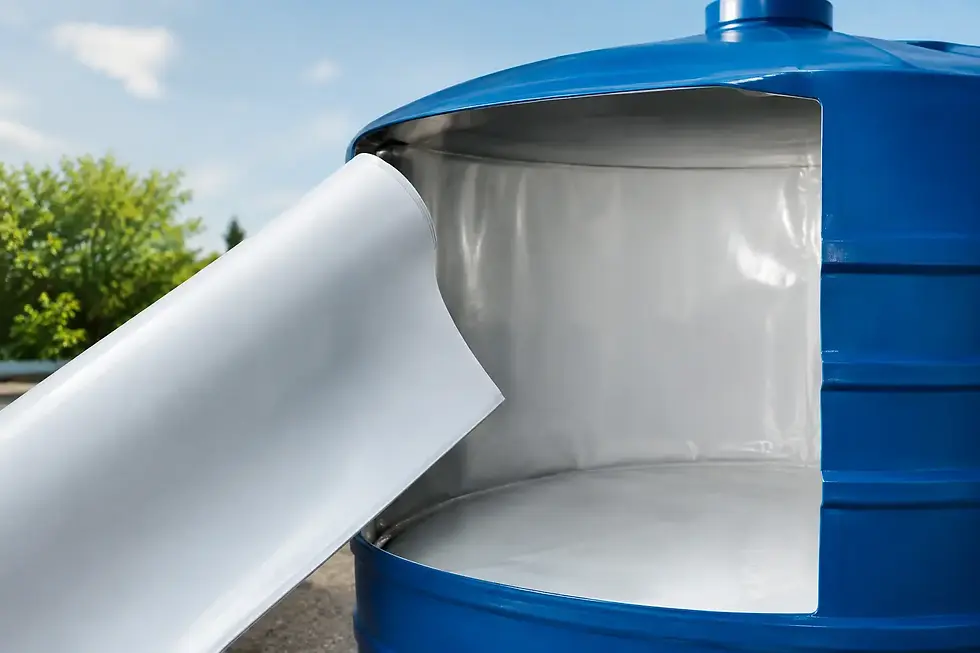
A flexible polypropylene lining creates a new internal containment barrier within the existing tank. Rather than relying solely on adhesion to a degraded substrate, the lining is manufactured to suit the tank dimensions and installed around internal features, connections and access arrangements.
This approach can be particularly effective for panel tanks and older steel tanks with corrosion, minor pitting or difficult internal geometry. It avoids the need to return every internal surface to a near-new coating condition, helping to reduce preparation time and operational disruption. A properly designed lining also separates stored water from the original steel shell, helping to prevent further internal corrosion.
For potable water storage, material suitability is essential. The lining system, jointing method and installation process must be selected with potable-water compliance in mind. For process or chemical duties, compatibility must be checked against the specific liquid, concentration, temperature and cleaning regime. No lining or coating should be selected on a generic assumption of chemical resistance.
Preparation determines whether the seal lasts
The most common reason tank repairs fail is not the lining or coating itself. It is inadequate preparation, poor diagnosis or failure to deal with details around joints and penetrations.
The tank must first be isolated, drained and made safe for entry where internal works are required. Confined-space procedures, safe access, cleaning controls and rescue arrangements must be planned before work starts. Industrial tanks can present hazards from restricted access, residual water, contaminated sediment, poor air quality and working at height.
Once empty, the tank should be cleaned to remove silt, scale, biological deposits and loose coatings. Sediment is not merely a housekeeping issue. It can conceal corrosion, interfere with repair materials and affect water quality when the tank is recommissioned.
Corroded areas then need assessment and repair. Depending on the defect, this may involve local steel repairs, replacement bolts and gaskets, sealing around flanges, treatment of pitted areas or strengthening of vulnerable sections. Roof leaks, defective covers and damaged overflows should also be corrected. There is little value in sealing the interior if water can continue entering through an unprotected roof or if external corrosion remains active.
Do not overlook joints, fittings and tank details
A tank shell may be sound while leakage continues at connections or construction joints. These details deserve the same attention as the main wall and floor surfaces.
Panel tank seams, floor-to-wall junctions, flanges, inspection hatches, internal bracing points, level sensor entries and outlet connections all require an engineered detailing plan. The chosen system must accommodate movement, maintain continuity and allow the tank to operate without stressing the seal.
Where a flexible liner is used, penetrations should be properly formed and sealed to suit the fitting rather than cut and patched in an ad hoc manner. With coating systems, sharp corners may need stripe coating and additional build thickness. These measures are straightforward, but they separate a durable refurbishment from a repair that fails at the first vulnerable point.
External protection should also form part of the scope where needed. Recoating exposed steelwork, improving drainage, renewing weatherproof lids and addressing trapped moisture can slow further degradation of the tank structure. Internal sealing protects the stored liquid. External maintenance protects the asset around it.
Test the tank before returning it to service
A sealed tank is not ready for use simply because the installation work is complete. Inspection and testing should confirm that the containment barrier is continuous, fittings are secure and no damage occurred during installation.
For a potable water tank, cleaning, disinfection and flushing should be completed before recommissioning. The precise procedure should reflect the site’s water hygiene controls and the tank’s role within the system. Facilities teams should also confirm that warning and overflow arrangements, access covers, screens, level controls and drainage provisions are operating as intended.
Documenting the condition of the tank, the materials installed, repair locations and recommended inspection intervals gives the responsible person a useful maintenance record. This is especially valuable for sites managing multiple tanks, sprinkler reserves or critical process supplies.
When sealing is more cost-effective than replacement
Full tank replacement can be necessary, but it brings fabrication, lifting, access, pipework alteration and extended downtime considerations. Where the steel structure remains serviceable, refurbishment can often extend operational life at a lower cost and with less disruption to the site.
The decision should not be based on the visible leak alone. Compare the condition of the structure, remaining design life, access constraints, hygiene requirements, future capacity needs and the consequences of a shutdown. A lining may be the most practical option for a tank in a restricted plant area, while a coating system may suit a tank with sound steel and good access for preparation.
Nationwide Water Solutions Ltd approaches this work through condition-led surveys, selecting proprietary lining and coating solutions that suit the tank’s duty rather than forcing every asset into the same repair method.
A steel tank does not need to look new to deliver reliable service. It does need a sound structure, a continuous protective barrier and a repair specification that reflects how the tank is actually used. Addressing those three factors early can turn a developing leak into a planned refurbishment instead of an unplanned replacement project.


Comments