
Tank Refurbishment vs Replacement
Updated: Jul 27

A tank that still holds water is not necessarily a tank that still meets duty. That is usually the point at which the tank refurbishment vs replacement decision moves from a maintenance query to an operational risk question. For facilities managers, building services teams and industrial operators, the right answer depends less on age alone and more on structure, compliance, access, coating condition, hygiene performance and the cost of downtime.
In practice, many tanks are replaced too early, while others are patched for too long. Both routes can be expensive. The value comes from understanding what the tank shell is still capable of, what standards the asset now needs to meet, and whether remedial work can restore long-term performance without introducing unnecessary disruption.
How to assess tank refurbishment vs replacement
The first issue is whether the base structure remains sound. If a concrete, steel or sectional tank has localised corrosion, failed coatings, leaking joints, degraded insulation, damaged covers or hygiene-related defects, refurbishment is often a viable and cost-effective route. If the shell itself has widespread structural failure, severe deformation, advanced corrosion through critical sections or defects that cannot be reliably isolated, replacement becomes the safer option.
This is why a proper survey matters. A visual inspection alone rarely tells the full story, particularly with underground tanks, internally corroded steel, ageing sectional joints or tanks where coatings have failed beneath accumulated deposits. A compliance-led condition survey should establish not only what is damaged, but whether the defects are superficial, progressive or terminal.
That distinction has a direct effect on budget planning. Refurbishment can extend service life substantially when the primary tank structure remains recoverable. Replacement makes more sense when remedial works would approach the cost of a new installation without delivering the same certainty.
When refurbishment is the stronger option
Refurbishment is often the right route where the tank body is fundamentally serviceable but ancillary components or internal protection systems have deteriorated. This is common in potable water tanks where hygiene standards have moved on, in steel tanks where internal coatings have broken down, and in older concrete tanks where internal surfaces need a chemically resistant, waterproof barrier.
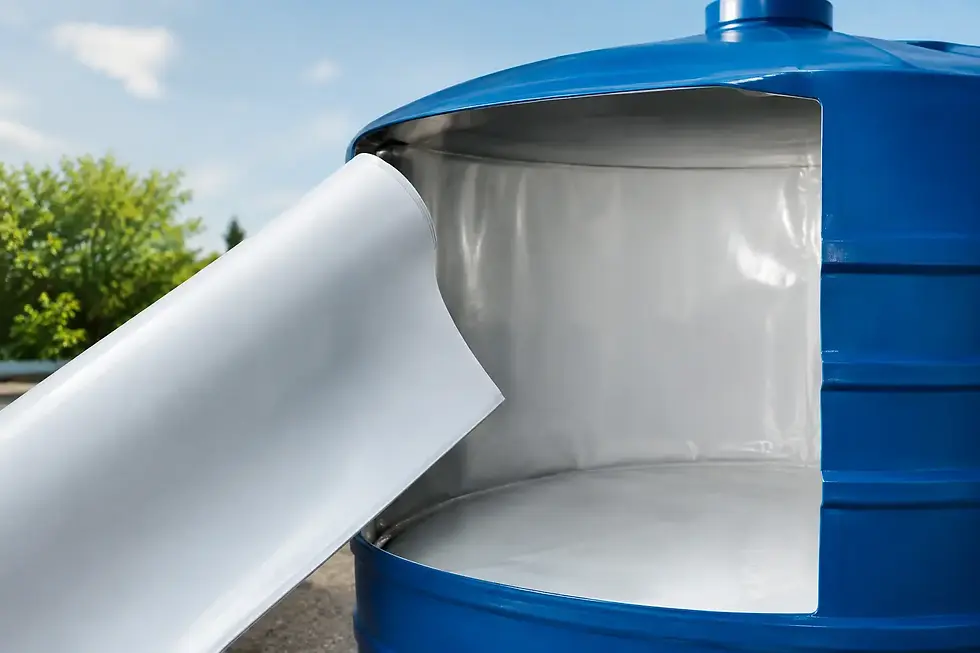
A well-specified refurbishment may include internal lining, epoxy coating, joint sealing, roof and lid upgrades, hatch replacement, insulation improvements, access and safety alterations, and overflow or vent modifications. In many cases, this resolves the actual operational problem without the cost and delay of stripping out the entire asset.
For occupied commercial buildings, hospitals, schools, manufacturing sites and live plant environments, disruption is a major factor. Refurbishment can often be completed more quickly than full replacement, especially where difficult access would make removal and craneage complex. If a tank is located in a plant room, roof void, basement or confined service area, retaining the existing structure and restoring its internal performance may be the more practical engineering solution.
There is also a compliance benefit. Where the issue is linked to water quality risk, failed internal surfaces or non-compliant tank fittings, a refurbishment programme can bring the asset back into line with current operational expectations. That matters when duty holders need a clear remedial path rather than a lengthy capital replacement project.
When replacement is the better investment
Replacement becomes more compelling when the existing asset can no longer justify the remedial spend. This usually happens when structural integrity is compromised, access limitations cannot be overcome safely, or the tank is the wrong material or configuration for its application.
A common example is a heavily corroded steel tank with multiple failure points, degraded supports and outdated internal arrangements. Another is an undersized or poorly configured tank that no longer suits demand, turnover rates or site compliance requirements. In those cases, refurbishment may solve one problem while leaving several others in place.
Replacement also deserves serious consideration when the installation needs to be re-engineered rather than simply repaired. If the site requires sectional GRP, a more chemically resistant lining system, improved insulation, divided compartments, better access provision or a different footprint, a new tank can offer a cleaner long-term answer.
There are cases where replacement is actually the lower-risk option even if the initial cost is higher. If repeated repairs have already been carried out, if outages are becoming more frequent, or if confidence in the tank has dropped to the point where contingency plans are routinely needed, the asset may already be beyond economical recovery.
Cost is important, but whole-life cost matters more
Too many decisions are made on the headline quote alone. Tank refurbishment will often be less expensive than replacement on day one, but that does not automatically make it the right choice. The real comparison should include installation time, downtime, access costs, enabling works, waste disposal, hygiene risk, expected service life and future maintenance demand.
For example, a tank in a restricted roof space may be expensive to replace because the existing structure has to be dismantled in sections and removed through a difficult route before a new system is brought in. In that scenario, a high-performance lining or coating solution can produce significant savings while still delivering a durable result.
On the other hand, if the tank has advanced structural decay and refurbishment only delays a full replacement by a short period, the lower upfront cost can be misleading. Spending less now may simply mean paying twice.
This is where engineering judgement matters. The right recommendation is not the cheapest route in isolation, but the one that offers the strongest balance of safety, service life and operational continuity.
Material type changes the answer
The tank material has a major influence on the tank refurbishment vs replacement decision. Concrete tanks are often good candidates for refurbishment because the main structure can remain stable for many years, even when internal surfaces require full renewal. A correctly specified lining system can restore watertightness, chemical resistance and hygiene performance without rebuilding the tank itself.
Steel tanks vary more widely. Some can be successfully refurbished with internal coatings or proprietary lining systems if corrosion is limited and the shell retains integrity. Others deteriorate beyond the point where internal treatment alone is sensible, particularly if corrosion has affected critical structural areas.
GRP and sectional tanks may sit somewhere in between. Joint issues, cover defects, insulation failures and ancillary non-compliances can often be addressed through remedial works, but cracked panels, poor original installation or advanced weathering may point towards replacement.
Specialist liquid storage adds another layer. Process water, sprinkler reserves and acid or chemical storage all place different demands on internal surfaces and construction materials. A refurbishment approach that suits potable water would not necessarily be appropriate in a chemically aggressive environment. Material compatibility and long-term resistance must come first.
Compliance, hygiene and liability
For commercial and regulated environments, this decision is not purely mechanical. It is also about duty of care. A tank may still function in a basic sense while posing a hygiene, safety or regulatory problem. Missing or damaged lids, poor access arrangements, inadequate screening, failed internal coatings and contaminated surfaces can all trigger remedial action even before structural concerns are considered.
That is why a specialist contractor should assess the tank as an operational asset, not just a container. The objective is not simply to stop leaks. It is to ensure the tank supports water quality, safe maintenance access, insulation performance, appropriate materials and reliable service under site conditions.
For many clients, that shifts the conversation. The question is no longer whether refurbishment is cheaper than replacement. It becomes whether the chosen route leaves the site with a compliant, maintainable and durable asset.
The role of installation speed and site disruption
Speed matters, particularly where shutdown windows are tight or water storage is critical to operations. One of the strongest arguments for refurbishment is that it can often reduce programme length significantly. Internal lining systems, coating applications and targeted upgrades can be carried out without the full strip-out, disposal and reinstallation cycle of a replacement project.
That said, speed should not be confused with shortcuts. A fast refurbishment only adds value if preparation, surface treatment, detailing and final specification are carried out properly. Poor remedial work can create a false economy and a second outage.
Likewise, replacement can sometimes be completed rapidly where sectional systems, in-house manufacturing and an experienced installation team are in place. For some sites, a new tank delivered and installed to suit the exact application is more efficient than attempting to rescue a compromised asset.
Nationwide Water Solutions Ltd often sees this balance clearly during surveys: tanks that appear to require replacement can be restored for a fraction of that cost, while others that look repairable are better removed from service before they create a larger operational problem.
Choosing the right route
The best decisions are made from evidence, not assumptions. Age is only one indicator. A 30-year-old tank with a sound structure and failed internal surfaces may be an excellent refurbishment candidate, while a younger tank with design flaws, severe corrosion or repeated hygiene failures may justify replacement.
A reliable recommendation should account for structural condition, material type, access, compliance gaps, outage tolerance, future maintenance burden and whole-life cost. It should also reflect how the tank is actually used, whether for potable water, process duty, fire protection or specialist storage.
If the existing asset still has a solid foundation, refurbishment can deliver substantial savings, reduced disruption and many more years of service. If that foundation has gone, replacement is the more responsible investment. The key is not choosing the cheaper option by instinct, but choosing the one that leaves your site with confidence rather than compromise.
The most useful starting point is a specialist survey that tells you what can genuinely be saved, what must be upgraded and what is no longer worth carrying forward.


Comments