
Sprinkler Tank Repair That Prevents Downtime
- m12674
- Apr 30
- 6 min read
Updated: May 6

A sprinkler tank rarely fails at a convenient moment. More often, the warning signs build quietly - coating breakdown, corrosion around fixings, leaking joints, damaged covers, sediment, or structural wear that only becomes obvious during inspection, testing, or after a service concern is raised. That is why sprinkler tank repair needs to be approached as a risk-control exercise, not just a maintenance task.
For commercial buildings, industrial sites, warehouses and regulated facilities, the tank is part of a wider fire protection strategy. If its condition is compromised, the issue is not limited to the tank shell itself. It can affect water quality, stored volume, system reliability, asset life, compliance position and business continuity. In many cases, a properly specified repair programme restores performance at a far lower cost than full replacement. The key is understanding what has failed, why it has failed, and whether refurbishment will deliver a dependable long-term result.
When sprinkler tank repair is the right option
Replacement is not always the most sensible answer. Many steel, concrete and sectional tanks remain structurally serviceable even when internal surfaces have deteriorated or localised defects have developed. Where the core asset is sound, repair can extend service life significantly while avoiding the disruption, access complications and capital cost associated with installing a new tank.
That said, it depends on the tank's age, material, condition and operating environment. A tank with isolated corrosion, failing internal coatings, roof damage, leaking seams or degraded insulation may be an excellent candidate for remedial work. A tank with widespread structural failure, severe panel distortion, major base movement or extensive material loss may not be. The decision should be based on a technical survey rather than assumption.
For facilities teams, that distinction matters. Spending money on cosmetic patching when the tank requires more substantial intervention creates repeat cost and operational risk. On the other hand, replacing a tank that could have been refurbished efficiently is equally wasteful. A survey-led specification usually gives the clearest route.
Common failures in sprinkler tanks
Sprinkler tanks operate in demanding conditions, especially where maintenance cycles have been uneven or where original materials are now approaching end of design life. Internal corrosion is one of the most common issues in steel tanks, particularly where protective coatings have broken down or where moisture and oxygen ingress have persisted around vulnerable areas. Joints, fasteners, support interfaces and roof details can all become weak points over time.
Concrete tanks present a different repair profile. Cracking, water ingress, surface degradation and chemical attack can all reduce performance, particularly if the tank has been exposed to fluctuating temperatures or long-term damp conditions. In some cases, the concrete substrate remains structurally suitable but needs lining or sealing to restore a reliable water-retaining barrier.
Ancillary components are often overlooked. Lids, access hatches, vents, overflows, ladders, warning signage and insulation all affect the tank's operational condition and compliance. A tank may hold water, but still fall short because access is unsafe, covers are defective, contamination risks are present, or key fittings are no longer suitable.
What a proper repair scope should cover
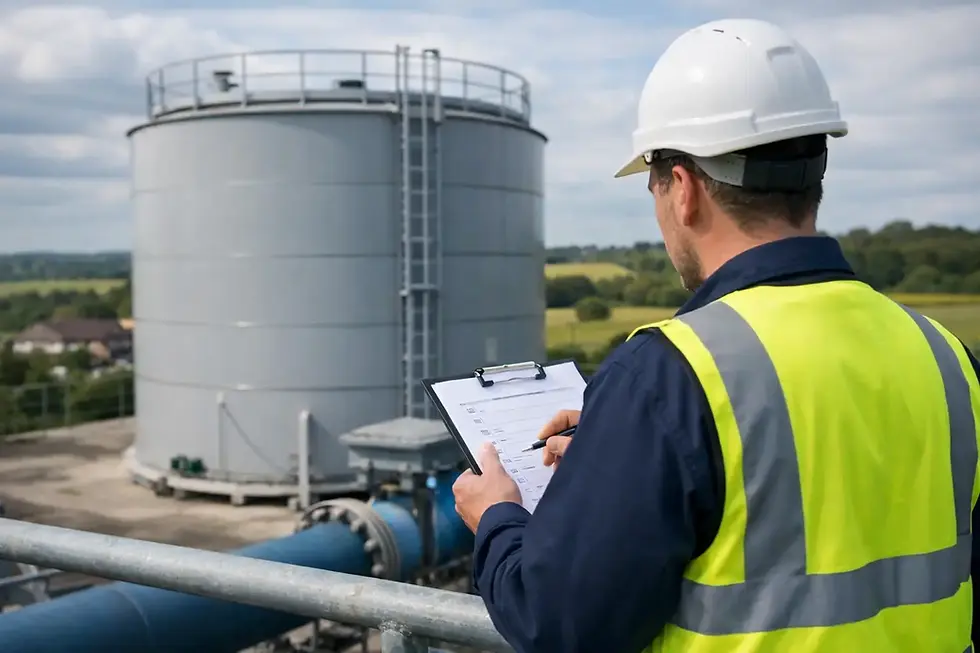
Effective sprinkler tank repair starts with diagnosis. That means more than noting a leak or identifying corrosion. The survey should assess the tank material, internal condition, coating or lining performance, signs of structural movement, joint integrity, access constraints and any compliance-related concerns. It should also consider whether repair works can be completed in situ and how downtime will be managed.
Once the failure mechanism is understood, the repair method can be matched to the asset. For steel tanks, this may involve surface preparation, local steel repairs, specialist coating systems, joint sealing, roof refurbishment or the installation of a flexible internal liner. For concrete structures, remedial work may include crack treatment, substrate preparation, waterproof lining systems and associated upgrades to covers and fittings.
The best results come from integrated remedial packages rather than isolated fixes. If internal corrosion is treated but the roof remains defective, the moisture pathway continues. If a liner is installed but damaged access covers are left in place, contamination and deterioration risks remain. Repair scopes should deal with root causes as well as visible defects.
Lining and coating systems in sprinkler tank repair
Where the tank shell is fundamentally sound, lining and coating systems can provide a practical and cost-effective alternative to replacement. The choice depends on tank material, defect type, intended service life and the operational demands of the site.
Epoxy coating systems are often used where prepared substrates can support a durable bonded finish and where corrosion protection is required. Their performance depends heavily on correct preparation, environmental control and application quality. If those conditions are not achieved, coating failure can return quickly.
Flexible polypropylene lining systems can be particularly effective where the objective is to create a new internal barrier within an existing tank structure. They are well suited to refurbishment projects where speed, durability and reduced disruption are priorities. Because the liner forms the water-contact surface, it can bypass many of the limitations associated with ageing substrates, provided the existing structure remains suitable to support the system.
This is where engineering judgement matters. Not every tank is best served by the same material. A repair contractor should be selecting the system around the asset, not forcing the asset into a standard product offering.
Compliance, safety and operational planning
A sprinkler tank sits within a life-safety environment, so repair work needs to be planned with that wider responsibility in mind. The obvious question is whether the tank can be taken offline and, if so, for how long. In some cases, temporary arrangements or phased works are needed to maintain system resilience. Access, confined space controls, working at height, cleaning, waste handling and reinstatement all need to be managed properly.
Compliance is also broader than simply making the tank watertight. Condition surveys often identify issues around tank security, access covers, screening, insulation, warning notices and general asset integrity. Addressing these items at the same time can improve both compliance and long-term maintenance performance.
For commercial dutyholders and facilities managers, a documented survey and clear remedial specification also support budgeting and accountability. If the tank condition has been identified formally and the repair route is evidence-based, it becomes much easier to justify expenditure and demonstrate responsible asset management.
Repair versus replacement - the real cost question
The cheapest quotation is rarely the lowest-cost decision. A superficial repair may appear attractive in the short term, but if it leaves ageing surfaces untreated, fails to address underlying water ingress, or requires repeat shutdowns, the lifetime cost quickly rises.
Full replacement has its place, especially where the tank is beyond economic repair or where capacity, layout or material selection need to change. But replacement can involve substantial strip-out work, difficult access logistics, structural considerations and longer programme periods. On constrained commercial sites, those factors can drive cost well beyond the tank itself.
A well-designed refurbishment often sits in the middle ground. It preserves usable infrastructure, upgrades critical components and extends service life without the disruption of a complete new installation. For many sites, that is the most commercially sensible route - provided the remedial specification is technically sound.
Choosing a specialist for sprinkler tank repair
Sprinkler tank repair is not a generic maintenance trade. It requires an understanding of tank materials, internal protective systems, confined working environments, fire water storage duty, and the practical realities of working on live commercial and industrial sites. That is why specialist capability matters.
Look for a contractor that can survey, specify and deliver the work rather than outsource key technical decisions. In-house manufacturing, proprietary lining systems and direct installation teams usually provide better control over quality, programme and long-term performance. It is also worth asking whether the contractor handles associated upgrades such as insulated covers, access improvements and structural remedials, because these are often part of the real problem.
Nationwide Water Solutions Ltd operates in this specialist space, combining tank surveys, refurbishment, lining, coating and replacement services for demanding commercial and industrial applications. That kind of end-to-end capability is valuable when a project needs more than a patch repair.
The strongest repair projects are the ones that solve the actual failure mechanism, restore confidence in the asset and reduce the likelihood of another unplanned intervention a year later. If your sprinkler tank is showing signs of deterioration, the right next step is not guesswork or a temporary sealant fix. It is a technical assessment that tells you whether the tank should be repaired, lined, upgraded or replaced - and what will give the site the most reliable result over time.
A sprinkler tank does not need to be new to be dependable, but it does need to be understood properly before any remedial work begins.


Comments