
Steel Water Tank Corrosion Repair Options
Updated: May 6

A steel tank rarely fails without warning. More often, corrosion starts as a localised coating breakdown, a stained seam, rust bleed around fixings, or pitting in an area that stays wet longer than the rest. For facilities teams, that early stage is where steel water tank corrosion repair delivers the greatest value. Act quickly and the asset can often be restored, protected and returned to service without the cost and disruption of full replacement.
For commercial and industrial sites, the real question is not simply whether corrosion is present. It is whether the tank remains structurally viable, whether stored water quality is at risk, and whether the remedial route will provide a durable, compliant outcome. Those decisions need to be based on tank condition, service duty, stored medium, access constraints and the operational consequences of downtime.
What causes corrosion in steel water tanks?
Corrosion in steel water tanks is usually the result of a protective barrier failing over time. Once the original coating, galvanised finish or lining is breached, exposed steel reacts with moisture and oxygen. In potable and process water applications, this can be accelerated by poor water quality, sediment build-up, microbial activity, condensation beneath lids, or standing water in dead spots.
The corrosion pattern often tells you a great deal about the underlying issue. General surface rust may point to ageing coatings and poor maintenance intervals. Localised pitting can indicate prolonged water retention, coating holidays or aggressive chemical conditions. Corrosion around seams, supports and penetrations often reflects movement, trapped moisture or failure at vulnerable details rather than across the whole tank.
External conditions matter as well. Roof void tanks, plantroom tanks and exposed external tanks all age differently. High humidity, insulation defects, leaking lids, failed overflows and poor ventilation can all contribute to corrosion from the outside in as well as from the stored liquid side.
When steel water tank corrosion repair is viable
Not every corroded tank should be replaced. Equally, not every corroded tank should be repaired. The right decision depends on the degree of metal loss, the location of the damage and the long-term service requirement.
A tank is often a good candidate for repair when corrosion is primarily affecting internal coatings or localised steel areas, while the main shell remains structurally sound. This is common in sectional steel tanks, process tanks and older site assets where the original tank fabric still has useful life left in it. In these cases, refurbishment can extend service life significantly at a lower cost than replacement.
Replacement becomes more likely where corrosion is widespread, structural integrity is compromised, access for effective repair is poor, or the tank no longer meets current operational or compliance requirements. There are also cases where the tank itself is repairable, but related defects such as obsolete covers, inadequate insulation, poor access arrangements or contamination risks make a broader upgrade the smarter investment.
This is why condition surveys matter. A proper assessment should establish wall thickness loss, coating failure extent, hygiene issues, leakage risk, roof and cover condition, support condition, and whether the existing structure can accept a new protective system.
Steel water tank corrosion repair methods
The phrase steel water tank corrosion repair covers several different remedial routes. The best one depends on whether the problem is cosmetic, protective, hygienic or structural.
Surface preparation and recoating
Where corrosion is relatively early stage and the steel substrate remains sound, abrasive preparation followed by an appropriate coating system is often effective. The quality of preparation is critical. If corrosion products, failed coatings and contamination are not removed correctly, even a high-specification coating will have a shortened life.
For potable or process water tanks, coating choice must match the service environment. Epoxy resin systems are commonly used where a hard-wearing, chemically resistant internal barrier is required. The coating must also be suitable for the substrate condition, application environment and cure requirements. This approach can be highly effective, but it depends on achieving the required surface standard and film build throughout the tank, including corners, seams and awkward details.
Localised steel repairs
Where corrosion has caused measurable pitting or section loss in isolated areas, local steel repair may be possible before the tank is recoated or lined. This can include patch repairs, replacement of affected panels or remedial works around nozzles, flanges and support details.
The key point is that local repair should address the cause, not just the visible symptom. If a seam continues to trap moisture or a leaking cover continues to introduce water from above, the same area will fail again regardless of how well the immediate patch is executed.
Flexible lining systems
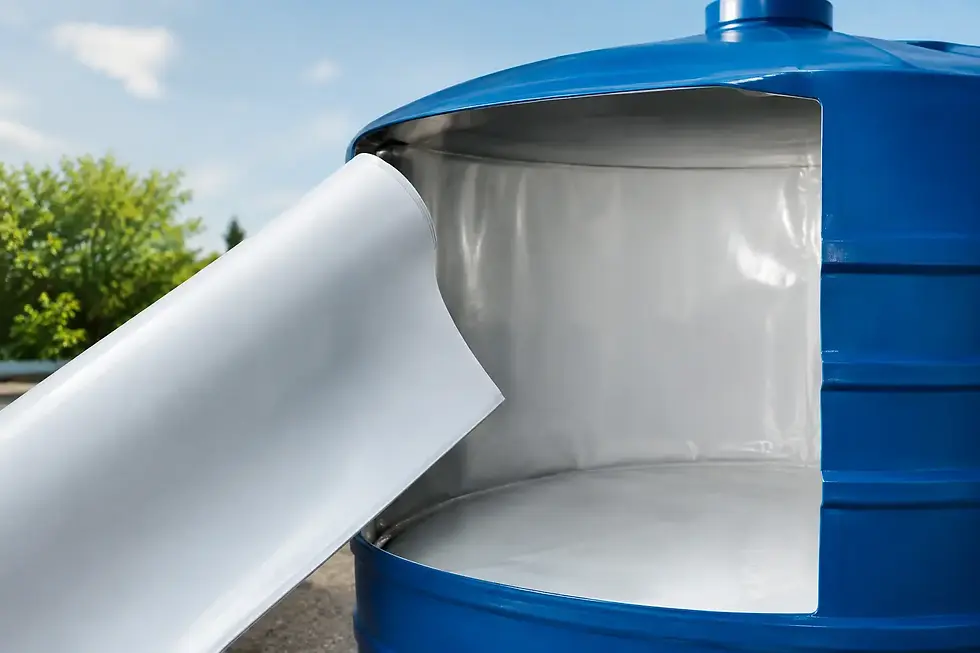
For many ageing steel tanks, a flexible lining system offers a practical alternative to full internal recoating or replacement. This is particularly relevant where internal surfaces are uneven, previous coatings are unreliable, or a fast installation programme is needed with minimal hot works. A properly specified liner creates a new internal containment barrier independent of the original steel surface.
This approach can be especially valuable in potable water storage, underground tanks and difficult access environments where maintaining hygiene, reducing downtime and avoiding major strip-out are priorities. It also helps when the original tank remains structurally serviceable but is no longer suitable as the wetted surface.
Ancillary upgrades during repair
Corrosion repair should not be treated as an isolated task if surrounding components are also compromised. Lids, access hatches, screened vents, overflows, internal supports and insulation details often contribute to the original failure. Repairing the steel while leaving defective covers or contamination risks in place is a false economy.
A more durable outcome usually comes from combining the corrosion remedial works with targeted upgrades. That may include insulated covers, improved access arrangements, replacement fittings or hygienic improvements that support compliance and reduce repeat deterioration.
Compliance, hygiene and operational risk
For regulated buildings and industrial sites, corrosion is not just a maintenance issue. It is a water quality, asset integrity and compliance issue. Internal rusting can create sediment, harbour contamination and make cleaning more difficult. In potable water systems, that raises obvious concerns around system hygiene and inspection findings.
Facilities managers also need to consider business continuity. A tank that is visibly corroding may still be operational today, but waiting until leakage or contamination forces an emergency shutdown usually leads to a more expensive project. Planned repair allows time to assess options, programme works sensibly and avoid reactive decisions under pressure.
The best contractors approach corrosion repair with the full service environment in mind. That means understanding whether the tank stores potable water, process water, sprinkler reserves or aggressive liquids, and then matching materials and installation methods accordingly. One-size-fits-all repair specifications rarely perform well across different tank duties.
Repair versus replacement - the real cost question
Many clients first assume that a corroded steel tank is nearing the end of its life and should be replaced. Sometimes that is true. But in a large number of cases, refurbishment is the more cost-effective route because it preserves the existing structure while renewing the wetted surface and correcting the defect pathway.
The cost comparison should include far more than the contract value alone. You need to account for access works, removal logistics, programme duration, outage planning, lifting requirements and the practical difficulty of getting a new tank into an existing building. In roof voids, basements and congested plant areas, replacement can become far more disruptive than the tank price suggests.
By contrast, a well-planned repair or lining project can often be completed more quickly, with less disturbance to the building and lower overall capital spend. It also allows sites to upgrade the tank in stages, rather than forcing a full asset change where the underlying structure is still serviceable.
Nationwide Water Solutions Ltd often sees this on older commercial sites, where the correct remedial package extends tank life significantly without the cost and disruption of complete replacement.
Choosing the right contractor for steel water tank corrosion repair
Corrosion repair is only as good as the diagnosis behind it. A contractor should be able to explain why the corrosion has developed, whether the tank is structurally suitable for refurbishment, what preparation standard is needed, and why a particular coating or lining system is being recommended.
That engineering judgement matters. A generic paint specification applied to a failing tank is not a repair strategy. Neither is replacing a few visibly rusted components while ignoring hidden substrate loss, water ingress points or compliance defects. The right contractor will assess the complete asset, not just the damaged patch.
It also helps to work with a specialist that can deliver more than one remedial route. If a business only offers replacement, every problem starts to look like a replacement project. If it only offers coatings, the same limitation applies. A credible recommendation should follow the tank condition, not the contractor's narrowest service line.
A corroding steel water tank is a warning, not necessarily a write-off. When the asset is surveyed properly and the repair method is matched to the actual failure mode, corrosion can often be contained before it becomes a structural or hygiene emergency. That gives operators something far more useful than a short-term fix - a clear, practical route to longer service life and better control over future maintenance.


Comments