
Tank Relining vs Replacement: Which Works?

A tank that is leaking, corroding or failing inspection does not automatically need to be ripped out and replaced. In many commercial and industrial sites, the real question is tank relining vs replacement - and the right answer depends on condition, compliance risk, access, downtime tolerance and whole-life cost.
That decision matters because storage tanks rarely fail in a convenient way. A potable water tank above a plant room, a sectional tank in a live building, an underground structure with limited access, or a process tank exposed to aggressive chemicals all bring different technical constraints. Choosing the wrong route can mean avoidable capital spend, prolonged disruption, or a remedial system that does not suit the application.
Tank relining vs replacement - what is the difference?
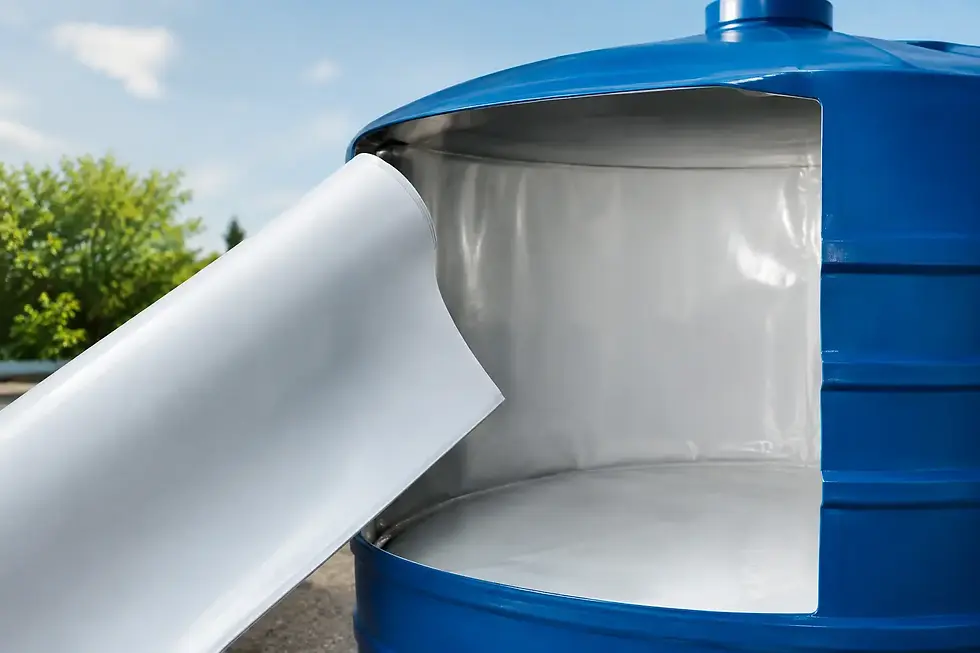
Relining keeps the existing tank structure and restores its internal performance with a new protective barrier. Depending on the tank type and duty, this may involve a flexible polypropylene lining system, an epoxy coating system, structural repairs, joint sealing, insulated lid upgrades, access hatch improvements and hygiene-related remedial works. The objective is to extend service life while correcting defects and bringing the asset back to a compliant operational standard.
Replacement removes the existing tank and installs a new one. That could be a new GRP, fibreglass, steel or specialist tank system sized and specified for the duty. Replacement is usually considered where the tank has reached the end of its practical life, where the structure itself is no longer sound, or where the existing design is fundamentally unsuitable for current use.
Neither option is automatically better. A serviceable tank shell with localised corrosion, failed coatings, poor covers or hygiene defects can often be refurbished very effectively. By contrast, a tank with major structural deformation, severe concrete deterioration, extensive section failure or a completely outdated arrangement may be a poor candidate for relining.
When relining is usually the stronger option
Relining is often the best route when the main body of the tank remains structurally viable but the internal surfaces, joints or protective finishes have deteriorated. This is common in ageing potable water tanks, process tanks and concrete structures where corrosion or coating failure has compromised performance but not destroyed the asset.
The commercial case is usually straightforward. Relining tends to reduce capital cost compared with a full strip-out and new installation. It can also avoid major builder's work, craneage, access alterations or plant shutdowns that often accompany replacement projects. In buildings where tanks were installed before surrounding services, walls or roof structures were added, getting a new tank into position can be far more difficult than refurbishing the one already in place.
Downtime is another major factor. In many live environments, the ability to refurbish in situ is valuable because it shortens programme duration and reduces operational disruption. That matters in hospitals, commercial estates, manufacturing facilities and other sites where stored water supports critical operations.
There is also a technical advantage when the lining system is properly matched to the stored liquid and tank substrate. A well-specified lining can provide corrosion resistance, potable water compatibility, improved hygiene performance and a clean internal surface without the need to replace the entire structure.
When replacement is the better engineering decision
Replacement becomes the right answer when the tank itself is beyond economic repair or fails the basic test of structural reliability. If the support arrangement is unsafe, the panels or shell are badly degraded, or the original design no longer meets the operational duty, relining alone may simply preserve a bad asset.
This often arises where previous neglect has allowed widespread corrosion, severe section damage, cracked concrete, unstable bases or repeated leakage through multiple failure points. It also applies where the tank size, insulation level, access configuration or material specification is no longer suitable for current regulations or site demand.
For example, a site may need improved access for cleaning and inspection, better thermal performance, upgraded lids and screens, or a different material to handle chemical exposure. If the existing tank cannot realistically be adapted to meet those needs, replacement offers a more reliable long-term solution.
There are also cases where replacement gives better whole-life value. A heavily patched tank with recurring defects may continue to absorb maintenance cost and operational risk even after remedial works. In that situation, installing a new tank can be the more disciplined engineering choice.
Cost is important, but it is not the only cost
Most buyers start with budget, and understandably so. In simple terms, relining is usually less expensive than full replacement. But comparing two quotations on day one does not tell the whole story.
The more useful comparison is whole-project cost and whole-life cost. Replacement may involve demolition, confined access removal, lifting operations, temporary water storage, service disconnections, reinstatement works and longer site occupation. Those items can quickly move the true project cost far beyond the tank supply itself.
Relining can also become poor value if the tank requires extensive structural repair before any lining can be applied, or if the chosen system is not suitable for the stored medium and fails prematurely. The lowest price is not always the lowest cost over ten or fifteen years.
Facilities managers and project teams are generally better served by asking three questions. Is the tank structurally sound enough to justify refurbishment? Will the remedial system provide the required service life? And what level of disruption will each route create for the site?
Compliance, hygiene and risk should drive the decision
For potable water tanks especially, compliance is not a secondary issue. If the tank has hygiene defects such as damaged lids, poor seals, corrosion, unprotected overflows, or internal surfaces that are no longer suitable, the remedial decision must address those points directly.
A relining project should not be treated as a cosmetic exercise. It needs to be part of a compliance-led scope that considers water quality, material suitability, access, insulation, screens, warning pipes and the overall condition of the asset. The same is true for process and specialist tanks, where chemical resistance and containment integrity are central to safe operation.
This is where a proper survey is critical. A competent inspection distinguishes between a tank that looks poor but is fundamentally recoverable, and one that presents ongoing structural or regulatory risk. Without that assessment, replacement can be recommended where refurbishment would have been entirely viable, or relining can be attempted where the substrate is already too far gone.
Access and installation constraints often decide the project
In practice, tank relining vs replacement is frequently decided by the building as much as by the tank. Restricted access, occupied premises, rooftop plant areas, basements, underground chambers and congested service zones all affect what is realistically deliverable.
If replacement means dismantling building fabric, shutting down adjacent services or using major lifting equipment, the operational burden can be substantial. In situ refurbishment becomes attractive because it works with the existing footprint. That can be particularly valuable for sectional tanks, concrete tanks and underground structures where removal is disruptive and costly.
On the other hand, if the tank location allows straightforward removal and the existing unit is obsolete, replacement may be more efficient than attempting to work around decades of deterioration.
Material compatibility matters more than many buyers realise
A sound decision also depends on what the tank stores and what the original substrate is made from. Potable water, sprinkler water, process liquids and acidic contents all place different demands on the remedial system. Steel, concrete and GRP tanks also age differently and fail in different ways.
A specialist lining system should be selected for the duty, not chosen as a generic fix. Flexible polypropylene lining systems can offer strong performance where chemical resistance, rapid installation and separation from deteriorated substrates are important. Epoxy systems may suit other applications where surface preparation and adhesion can be properly controlled. The correct answer depends on the tank condition and service environment.
That same principle applies to replacement. A new tank should not just replicate the old one without reviewing insulation, access, cover design, outlet arrangements and maintenance requirements.
The best decision starts with an honest survey
The most reliable route is rarely decided from photographs or age alone. It comes from a technical survey that reviews structure, substrate condition, coating or lining failure, compliance defects, access limitations and the operational consequences of each option.
For many commercial assets, refurbishment is the smarter answer because it restores performance, controls cost and reduces disruption. For others, replacement is the only route that properly removes risk. An engineering-led contractor should be able to justify either recommendation with clear evidence, not a sales preference.
Nationwide Water Solutions approaches this question from that practical standpoint: preserve and upgrade serviceable assets where that delivers compliance, durability and value, and replace tanks only when replacement is the right engineering outcome.
If you are weighing up tank failure, ageing infrastructure or a recent inspection report, the useful starting point is not which option sounds cheaper. It is whether the existing tank still deserves to be part of the next ten years of service.


Comments