
Tank Repair or Replacement: Which Is Right?
Updated: May 6

When a tank starts leaking, failing inspection, or showing signs of corrosion, the real question is not whether action is needed. It is whether tank repair or replacement will deliver the safest, most cost-effective result for the site. For facilities managers and commercial operators, that decision affects compliance, downtime, capital spend, and the long-term reliability of the water storage system.
There is no one-size-fits-all answer. A tank that looks poor from the outside may still be structurally suitable for refurbishment, while a tank with limited visible damage may be close to the point where replacement is the only responsible option. The right route depends on material condition, hygiene risk, access constraints, service duty, and whether the existing asset can be brought back to a compliant standard.
How to assess tank repair or replacement
The first step is a proper tank survey. Too many decisions are made on appearance alone, or on the assumption that age automatically means replacement. In practice, condition-based assessment is what matters. A detailed survey should review the substrate, internal surfaces, joints, roof condition, access hatches, insulation, supports, outlets, overflows, warning pipes, ladders, and any evidence of contamination or structural movement.
For potable water tanks, compliance is a major part of the decision. If the tank presents hygiene issues, damaged internal coatings, failed seals, or features that no longer align with current standards, repair may still be viable, but only if the remedial scope fully addresses those defects. A cosmetic patch-up is not enough where water quality or public health is at stake.
For process tanks, sprinkler tanks, underground tanks, and specialist chemical storage, the criteria shift slightly. Chemical compatibility, structural integrity, and service continuity often carry more weight than appearance. A steel tank used for aggressive contents may need a specialist lining system rather than a full replacement, provided the shell remains sound. Equally, if the substrate has thinned beyond tolerance or the duty has changed, replacement may be the more reliable engineering solution.
When tank repair is the better option
Repair is often the strongest commercial choice when the tank structure remains fundamentally serviceable. Corrosion, coating breakdown, localised leaks, failed joints, damaged lids, poor insulation, and hygiene defects do not always justify removing the entire asset. In many cases, refurbishment restores performance at a fraction of replacement cost and with far less disruption on site.
This is particularly true where access is difficult. Plant rooms, roof locations, basements, and confined service areas can make tank replacement expensive before installation even begins. Stripping out a large sectional tank and bringing in a new unit may involve crane lifts, builders' work, service isolation, and significant programme risk. A repair strategy using internal lining, sectional refurbishment, or upgraded covers can often avoid that disruption.
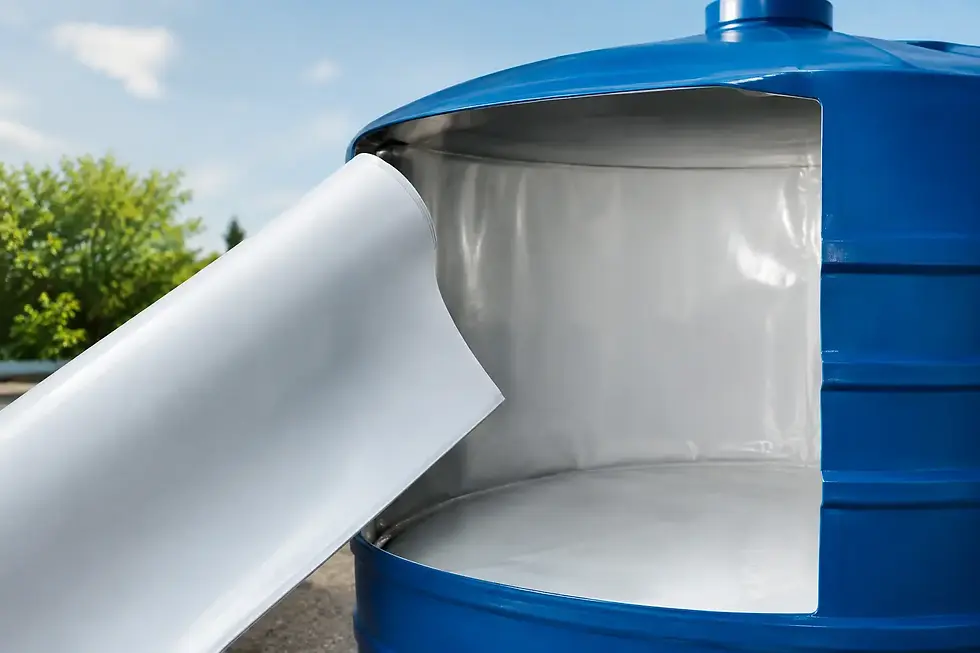
Flexible polypropylene lining systems are a strong example of where repair provides clear operational value. Where an existing tank shell is structurally acceptable but internal surfaces are degraded, a tailored lining can create a clean, durable internal barrier without the cost and logistics of a full tank change. For many commercial buildings, this approach reduces downtime and extends service life while maintaining potable water suitability.
Epoxy coating systems can also be appropriate, especially where the substrate and application conditions support a long-lasting bond. The key is choosing the remedial method to suit the tank material, service environment, and compliance requirement. Not every coating is suitable for every tank, and not every damaged tank should be coated. Good engineering judgement matters more than a standardised sales answer.
When replacement is the right decision
There are cases where repair becomes false economy. If the tank has severe structural deterioration, widespread corrosion, failed panels, substrate instability, or repeated historic repairs, replacement is often the safer and more cost-effective route over the asset life.
Replacement should also be considered where the original design no longer suits the application. That may include undersized capacity, poor compartment arrangement, inadequate access for inspection and cleaning, outdated materials, or a lack of insulation in temperature-sensitive environments. In those situations, even a technically possible repair may leave the site with an asset that still falls short operationally.
Compliance can also force the issue. If a potable water tank cannot realistically be upgraded to meet hygiene expectations, or if surrounding defects make safe maintenance impractical, replacement may be the only route that removes ongoing risk. The same applies to specialist tanks where chemical duty has changed and the existing material is no longer compatible.
A well-planned replacement is not simply a like-for-like swap. It is an opportunity to improve maintainability, reduce future remedial spend, and install a tank system better suited to the building and duty. GRP and fibreglass systems, for example, can offer fast installation, corrosion resistance, and long service life in commercial applications. Where programme matters, rapid installation capability can make replacement far more practical than many operators expect.
Cost is not just the tender figure
The phrase tank repair or replacement often gets reduced to capital cost, but that is only part of the picture. A cheaper quote can become the more expensive option if it creates longer downtime, repeat failures, hygiene risks, or additional building works.
Repair usually carries a lower initial cost, but only if it is technically appropriate and properly executed. If the tank is near the end of its structural life, spending money on limited remedial work can simply defer a larger problem by a year or two. That may still be a valid choice in some budgeting cycles, but it should be an informed one.
Replacement usually demands higher upfront spend, yet it may reduce ongoing maintenance and provide a longer design life. It can also remove hidden liabilities such as inaccessible internals, obsolete components, or recurring contamination issues. For sites where operational reliability is critical, those long-term gains can justify the capital outlay.
This is why lifecycle thinking matters. The right question is not only what costs less this quarter, but what delivers the best technical and financial outcome over the next ten to twenty years.
Material, application and access all change the answer
A concrete tank presents different repair options from a steel or GRP tank. Underground tanks introduce different risks from those in open plant areas. Sprinkler storage has different resilience priorities from potable water systems. That is why broad advice can be misleading.
Concrete tanks may be good candidates for internal lining and remedial sealing if the structure is stable. Steel tanks may be refurbished effectively where corrosion is controlled and wall thickness remains acceptable. GRP tanks often allow sectional repairs or component upgrades, but once structural cracking or significant distortion is present, replacement may be the safer route.
Access can be the deciding factor. A tank in a restricted roof void may be technically replaceable, but the enabling works could make refurbishment far more attractive. Conversely, a ground-level tank with straightforward access may be quicker to replace than to carry out complex phased repair work.
The best contractors will not push one answer for every asset. They will assess the duty, the environment, the material, the compliance standard, and the practicalities of carrying out the work on a live site.
What a sound recommendation should include
A credible recommendation on tank repair or replacement should be evidence-led. It should explain the present defects, the associated risks, the feasible remedial options, and the likely service life outcome of each route. It should also set out access assumptions, downtime implications, and any compliance issues that need to be resolved as part of the works.
That level of detail matters because the decision often sits between engineering, operations, and procurement. Facilities teams need confidence that the recommendation is technically sound. Commercial teams need clarity on cost and programme. Responsible duty holders need assurance that the chosen route will stand up to scrutiny if water quality, safety, or fire system reliability is involved.
This is where specialist contractors add real value. A company such as Nationwide Water Solutions Ltd can assess whether an ageing tank should be lined, coated, upgraded, or replaced entirely, based on actual condition rather than assumption. That matters when the difference between a smart refurbishment and an avoidable replacement can be substantial.
Make the decision before failure makes it for you
The most expensive tank projects are often the ones left too late. Once a leak becomes an emergency, or a failed inspection forces immediate action, the range of options narrows quickly. Planned assessment gives you time to choose the right technical route, control cost, and avoid unnecessary disruption.
If there is one practical rule worth following, it is this: do not treat repair as a compromise or replacement as the default. The best outcome comes from understanding what the tank still has left in it, what the application now demands, and what level of intervention will genuinely protect performance for years to come.


Comments