
Water Storage Contractor Selection: What Matters
Updated: Jul 27

A leaking panel joint, deteriorating internal coating or failed tank lid is rarely an isolated maintenance issue. For commercial and industrial sites, it can affect water quality, fire protection resilience, production continuity and legal compliance. Water storage contractor selection therefore needs to be based on far more than a quoted price or promised programme.
The right contractor should be able to identify the actual cause of failure, establish whether the tank can be economically refurbished, and carry out the work without creating further operational risk. That requires practical experience across tank types, stored liquids, access constraints and the standards that govern the system.
Start with the tank’s duty, not the visible defect
The same corrosion patch can demand very different remedial work depending on the tank’s purpose. A potable cold-water tank must protect water hygiene and be finished with materials suitable for contact with drinking water. A sprinkler tank must retain reliable capacity and remain available to support the fire protection system. A process or acid storage tank may need a lining system designed for a defined chemical concentration, temperature and exposure cycle.
Before appointing a contractor, provide clear information on the tank’s duty, capacity, construction and operating conditions. Useful records include previous inspection reports, drawings, photographs, water treatment history, known leaks and any restrictions on isolation. If these records are incomplete, that is not unusual. It does mean the contractor’s survey process becomes more important.
A competent specialist will not prescribe a lining, coating or replacement tank from photographs alone. They should inspect the tank structure, internal condition, roof or lid, supports, access points, overflows, screens, seals and associated pipework. Where required, they should identify defects that could compromise water quality, structural integrity or safe access.
Assess the quality of the survey and scope
A survey is where a project is either correctly defined or set up for avoidable variations. Ask what the contractor will inspect, how findings will be recorded and whether the report will distinguish urgent risks from planned lifecycle work.
The scope should state the tank condition and recommended route clearly. That might be localised repair, preparation and epoxy coating, a flexible polypropylene lining system, lid replacement, GRP sectional tank installation, or full replacement. A credible recommendation explains why that option suits the tank rather than simply favouring the most extensive work.
For example, a structurally sound steel or concrete tank with failing internal protection may be a strong candidate for refurbishment. Installing a specialist liner can extend service life, reduce downtime and avoid the cost and disruption of removing a large existing structure. Conversely, widespread structural deterioration, severe deformation or inadequate foundations may make replacement the safer long-term decision.
Be cautious of scopes that describe only a product, such as “apply coating” or “install liner”, without defining surface preparation, repairs, termination details, cleaning, disinfection and testing. The preparation and interface details often determine whether a remedial system performs for years or fails prematurely.
Specify the material against the service environment
Not all lining and coating materials are interchangeable. A contractor should be able to explain how the proposed system responds to the stored liquid, temperature range, substrate condition and expected movement within the tank.
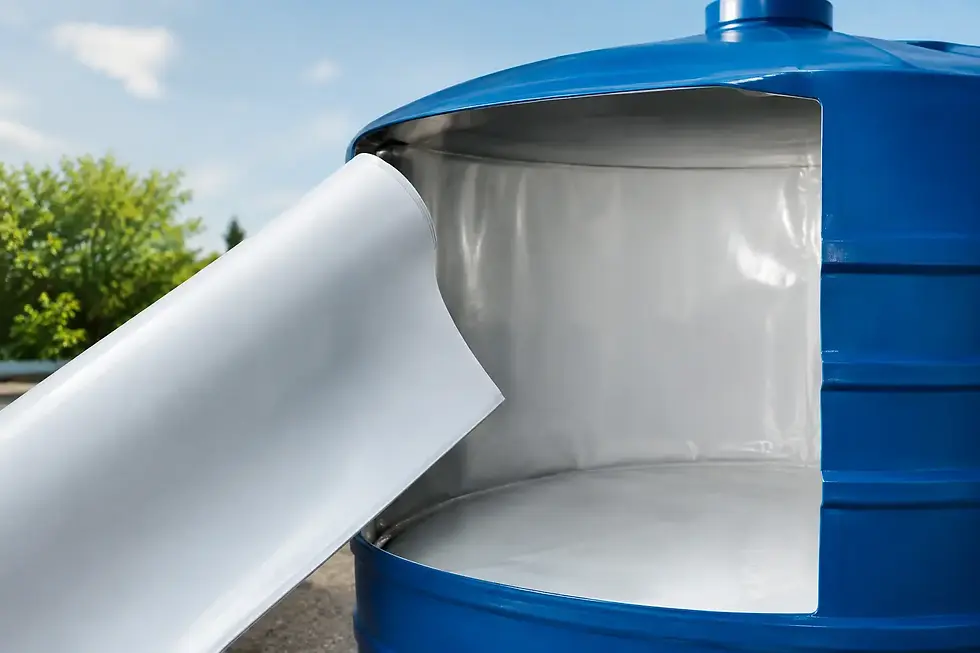
Epoxy resin coatings can provide durable internal protection when the substrate is properly prepared and the product is matched to the service. Flexible polypropylene lining systems can be particularly valuable where a tank needs a new watertight internal barrier without extensive structural replacement. Their flexibility can accommodate certain substrate irregularities and make them well suited to refurbishment projects where rapid installation is essential.
For potable water systems, ask for confirmation that the proposed materials are appropriate for their intended contact with drinking water. For chemical or process tanks, confirm chemical compatibility in writing. A generic assurance that a material is “chemical resistant” is not enough. Resistance depends on the specific liquid, concentration, temperature and duration of exposure.
Make compliance and hygiene part of the programme
Water storage work has to support the wider duty to manage the system safely. In potable water applications, this includes measures that protect against contamination, stagnant water, insect ingress and poor access for cleaning or inspection. In fire protection systems, the contractor must understand how tank works affect system availability and what coordination is required with the responsible persons, insurers and fire protection specialists.
The method statement should address isolation, draining, cleaning, confined-space controls, working at height, lifting operations and reinstatement. It should also set out how the tank will be protected from contamination during the works, particularly where a lid, roof section or access hatch is being removed.
Where a tank is returned to potable use, clarify the arrangements for cleaning, disinfection, sampling where required and recommissioning. A contractor that treats these as separate, last-minute activities may leave the site team with an unclear path back to service.
Documentation matters as much as the physical work. Request a record of the completed scope, materials used, inspection points, guarantees, photographs and any maintenance recommendations. These records help facilities teams demonstrate control of the asset and plan future budgets.
Test capability in difficult site conditions
Water tanks are often located where access is inconvenient: plantroom roofs, basements, service risers, confined compounds or operational industrial areas. A good contractor plans around these realities rather than assuming clear access, unrestricted lifting and lengthy shutdowns.
Ask how the work will be delivered if the site has limited headroom, narrow access routes, occupied premises or restricted crane access. For sectional tank replacement, the ability to bring components through constrained routes and assemble them in position can be decisive. For lining or coating projects, the contractor needs to control ventilation, lighting, drainage and curing conditions within the available work area.
Programme claims should also be tested. Rapid installation can be a genuine advantage, but it depends on accurate survey information, material availability, access preparation and a defined decision-making process. The contractor should identify what must be in place before the crew arrives, including isolation arrangements, permits, welfare, access equipment and any required temporary water provision.
Compare quotations on whole-life value
The lowest quotation may exclude essential preparation, access works, temporary arrangements or reinstatement. It may also rely on a material that is unsuitable for the tank’s duty. Compare prices only after confirming that each contractor is pricing the same condition, specification and completion standard.
A useful commercial comparison considers the full cost of the decision: initial expenditure, expected service life, operational downtime, future maintenance and risk of failure. Refurbishment is often substantially more cost-effective than replacement when the core structure remains serviceable. However, it is not automatically the right choice. A short-term repair to a tank nearing structural end of life can create repeat disruption and higher cumulative cost.
Ask contractors to state exclusions and assumptions plainly. This is especially important where internal inspection is limited, concealed corrosion is possible, or substrate condition cannot be fully confirmed until cleaning and preparation begin. Sensible contingency planning is preferable to a low headline price followed by poorly controlled variations.
Look for accountable delivery, not a sales handover
Water storage projects bring together technical assessment, fabrication, installation, health and safety management and aftercare. The contractor should be clear about who is responsible for each stage and who will manage the site works.
In-house manufacturing and product development can provide useful advantages where specialist liners, covers or bespoke components are required. It gives the contractor greater control over material quality, lead times and installation detail. Nationwide Water Solutions Ltd combines this approach with tank surveys, refurbishment and replacement capability, allowing the remedial route to be matched to the condition of the asset rather than to a single product line.
Before appointment, ask who will attend site, what experience they have with comparable tanks and how issues discovered during the work will be escalated. The answer should be practical and specific. Named responsibility, clear communication and a realistic programme are stronger indicators than broad assurances.
The best appointment is one that leaves the tank safer to operate, easier to maintain and properly documented for the next inspection. Select the contractor that can explain that outcome before work starts, then demonstrate the capability to deliver it on site.


Comments