
When Should Tanks Be Relined? Key Warning Signs
A tank rarely fails without warning. Rust staining beneath a steel panel, recurring leaks at joints, flaking internal coatings or sediment that returns soon after cleaning are all signs that its protective barrier may be compromised. Knowing when should tanks be relined allows facilities teams to act before a manageable refurbishment becomes an urgent replacement, water-quality incident or disruption to critical building services.
For commercial, industrial and regulated sites, relining is not simply a cosmetic repair. A correctly specified lining restores the internal protective surface, separates stored water or process liquids from a deteriorating substrate, and can extend the useful service life of a structurally sound tank for many years.
Tank age matters, but condition matters more
There is no single age at which every tank should be relined. The correct timing depends on the tank material, its previous maintenance history, the stored liquid, the operating environment and the condition of the existing protective system. A well-maintained GRP tank may need a different remedial route from an older sectional steel potable water tank, concrete reservoir or acid storage vessel.
Many tanks warrant a detailed condition survey after 10 to 15 years in service, particularly where internal coatings have reached the end of their expected life. However, age should be treated as a prompt for inspection rather than an automatic instruction to reline. Some tanks require intervention sooner because of aggressive water chemistry, external corrosion, poor ventilation, thermal movement or historic coating failure. Others remain suitable for service beyond that point if inspections confirm that the structure and internal finish remain sound.
The key question is whether the tank shell is still viable. Relining is normally an excellent option where the tank retains structural integrity but its internal surface can no longer provide reliable containment, corrosion protection or hygienic performance.
When should tanks be relined? The warning signs
The earliest signs are often visible during routine inspections, tank cleaning or remedial work elsewhere in the water system. Ignoring them can allow deterioration to spread beneath coatings and around joints, where defects are more difficult and expensive to address.
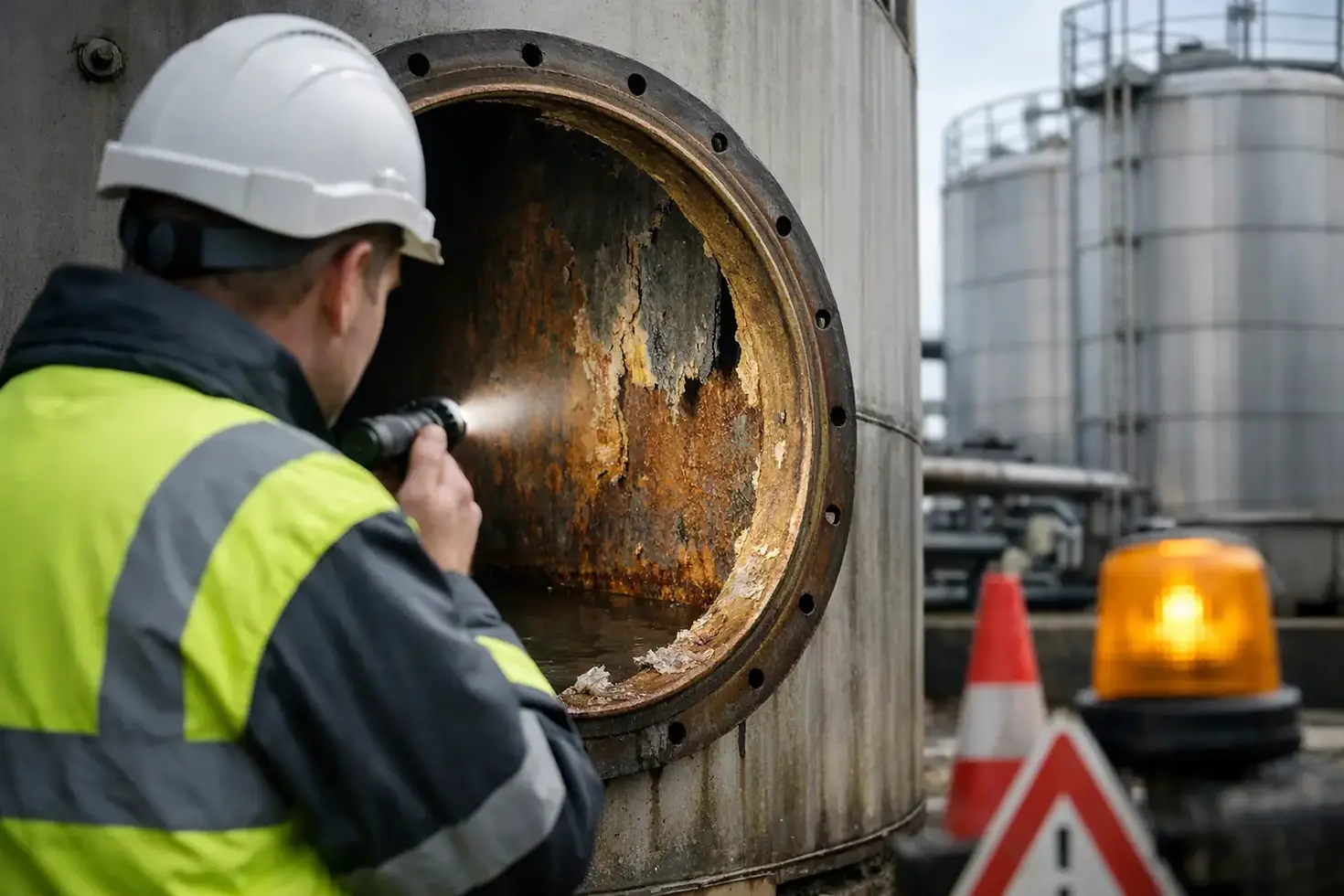
Internal corrosion is one of the clearest indicators for steel tanks. Surface rust may be localised and treatable, but widespread corrosion, pitting or blistering beneath an old coating suggests that the barrier has failed. If left untreated, corrosion can reduce panel thickness, affect fixings and eventually lead to leakage.
Coating breakdown is equally significant. Peeling, cracking, chalking, soft areas and pinholes create routes for water to reach the substrate. In potable-water applications, a failed coating can also make cleaning more difficult and contribute to poor tank hygiene. Concrete tanks can suffer from cracking, spalling, porous surfaces or failed waterproof renders, while older GRP tanks may show crazing, worn surfaces or damage around penetrations.
Persistent leaks should never be treated as a simple nuisance. Seepage from seams, flanges, bolt holes, outlets or floor-to-wall junctions can indicate failed seals, corrosion or movement within the structure. Temporary external repairs may control the immediate problem, but they do not necessarily protect the internal surface or prevent further deterioration.
Changes in water quality also require prompt investigation. Discolouration, sediment, metallic debris, unusual odours or repeat hygiene concerns may originate from a damaged tank interior, although the wider system must always be assessed. For potable water tanks, the lining material and installation method need to be suitable for contact with drinking water and compatible with the tank's intended duty.
Other practical triggers include a change of use, a planned asset-life extension, repeated cleaning failures or upcoming compliance work. If a tank is being adapted for different water treatment conditions, higher temperatures or a more chemically demanding process, the existing lining may no longer be appropriate even if it appears intact.
A survey should decide the remedial route
A professional survey turns visible symptoms into an evidence-based recommendation. It should assess the tank internally and externally, with attention to the shell, roof or lid, access points, seams, supports, floor, outlets, overflows, insulation and associated pipework. For sectional tanks, panel condition, bolts, jointing materials and internal tie systems may also be relevant.
The survey should establish the cause of deterioration, not just record the defect. For example, corrosion may be accelerated by condensation beneath an ineffective lid, damaged insulation, external water ingress or an unsuitable historical coating. Relining without resolving the underlying cause risks shortening the life of the new system.
It is also the point to confirm operational requirements. Facilities managers need to know whether the tank can be isolated, whether stored water must be temporarily maintained, what confined-space controls are required and how long the work will affect the asset. A practical specification considers access restrictions, hygiene controls, curing or installation time, and the compatibility of materials with the stored liquid.
When relining is the right answer
Relining is often the most cost-effective solution when a tank is structurally serviceable but has an internal coating, corrosion or containment problem. It avoids the expense and disruption of dismantling and replacing a large tank, especially where the asset is located in a plant room, roof enclosure, basement or difficult-access location.
Flexible polypropylene lining systems can provide a durable barrier for suitable tank applications and are particularly valuable where rapid installation and minimal disruption are priorities. Unlike site-applied coatings, a fabricated liner can be designed around the tank geometry and installed after the substrate has been prepared and defects addressed. The right system depends on the liquid being stored, temperature, pressure conditions, tank construction and required chemical resistance.
Epoxy resin coating systems remain appropriate in many situations, particularly where a bonded coating is required and the substrate can be properly prepared. Their performance depends heavily on surface preparation, moisture conditions, application control and correct curing. A specialist contractor should recommend the system that fits the tank's duty rather than applying one solution to every asset.
Relining also provides an opportunity to address associated weaknesses. Damaged lids, inadequate insulation, corroded fittings, defective screens and poorly protected access hatches can undermine an otherwise successful refurbishment. Combining these works during a planned shutdown can improve the reliability of the complete storage installation.
When replacement is the safer option
Relining cannot compensate for a tank that has lost structural integrity. Severe corrosion that has materially reduced steel thickness, extensive panel deformation, unstable foundations, major concrete failure or damaged supports may make replacement the only responsible route. The same applies where the tank's size, configuration or location no longer meets operational requirements.
Replacement may also be preferable when defects are widespread across both the tank structure and its ancillary components, or when future demand calls for greater capacity, improved insulation or a different material specification. In these cases, continued repair can become false economy.
The decision should be based on whole-life value, not the lowest immediate price. A capable survey will set out whether refurbishment can safely deliver the required service life, what ancillary work is needed and where replacement offers a better long-term result.
Plan relining before failure forces the timetable
The best time to organise tank relining is during planned maintenance, not after water has escaped or a critical supply has been compromised. Build condition assessments into the maintenance programme, retain inspection records and investigate changes promptly. This gives site teams time to arrange isolation, temporary storage where necessary, access equipment and safe working controls.
For potable water, sprinkler and process-water assets, the consequences of unplanned failure are rarely limited to the tank itself. They can affect building operations, fire protection, production continuity and compliance obligations. Nationwide Water Solutions Ltd can assess deteriorating tanks and specify refurbishment, relining or replacement work that reflects the actual condition of the asset and its operating duty.
A serviceable tank does not need to become a replacement project simply because its internal surface has aged. Act when inspection evidence first shows protective failure, and the tank can often return to dependable service with far less disruption than an emergency repair.


Comments