
Best Commercial Water Tanks for UK Sites
Updated: Jul 27

A tank that appears sound from the outside can still be the weak point in a building’s water system. Internal corrosion, failed sealant, damaged linings, poor insulation and inaccessible valves can affect water quality, fire protection availability and site operations long before a visible leak develops. Selecting the best commercial water tanks is therefore not simply a question of capacity or purchase price. The right solution must suit the stored liquid, the site layout, the duty of the system and the required service life.
For UK facilities managers, consultants and contractors, the most dependable approach is to assess the existing asset and the operating requirement together. A new tank is sometimes necessary. In many cases, however, a structurally serviceable tank can be refurbished, relined or upgraded at significantly lower cost and with less disruption than full replacement.
How to Choose the Best Commercial Water Tanks
The best commercial water tank is the one that performs reliably under its actual operating conditions. That sounds straightforward, but commercial storage installations vary widely. A cold-water tank supplying a multi-storey office has different requirements from a process-water tank in a manufacturing plant, a sectional sprinkler tank serving a warehouse, or a below-ground concrete reservoir.
Start with the liquid. Potable water storage requires materials and internal surfaces appropriate for contact with drinking water, along with a design that supports cleaning, inspection and hygiene management. Process water may introduce elevated temperatures, suspended solids or treatment chemicals. Acid and chemical storage demand verified compatibility between the liquid, tank substrate, lining system, fittings and seals.
The duty is equally important. A break tank may cycle frequently and need carefully controlled inlet, overflow and warning arrangements. A sprinkler tank may remain static for extended periods but must retain its design volume and remain available when needed. Where water is a critical production input, planned maintenance and isolation options can be as important as the tank shell itself.
Match the Tank Material to the Application
There is no universally superior tank material. GRP, galvanised steel, concrete and polyethylene each have a place in commercial water storage, provided they are correctly specified and maintained.
GRP sectional tanks
GRP sectional tanks are widely used for potable water, process water and fire sprinkler storage because they can be installed in sections where site access is restricted. They are particularly useful in plant rooms, rooftops, service yards and confined areas where a factory-built one-piece vessel cannot be moved into position.
A well-designed GRP tank offers corrosion resistance and a practical route to larger capacities. The quality of installation remains critical. Panel joints, internal stays, base support, roof integrity, access points and drainage arrangements all need proper consideration. Insulated panels or external insulation may be required where frost protection and stable stored-water temperatures are necessary.
Steel tanks
Steel tanks can provide substantial capacity and strength for industrial, process and sprinkler applications. Their long-term performance depends heavily on the protective system. Coating breakdown, corrosion at joints, pitting and deterioration around penetrations can progressively compromise the asset.
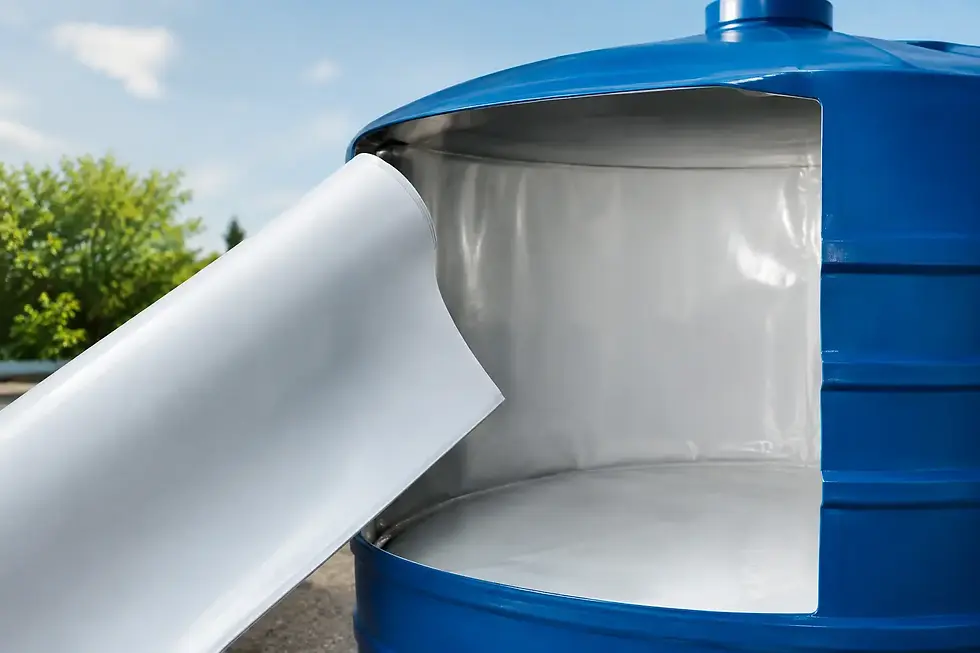
Where the tank structure remains viable, specialist epoxy coating or flexible lining systems can restore protection without the disruption of replacement. The choice between a coating and a lining should be based on substrate condition, liquid chemistry, expected movement, access and the required design life. A lining can provide a contained internal barrier, while an epoxy system may be appropriate where surface preparation and substrate condition support its use.
Concrete and underground tanks
Concrete reservoirs and underground tanks are often difficult and expensive to replace. They may suffer from cracking, water ingress, failed construction joints, reinforcement corrosion or degraded internal surfaces. Their position within the site can also make excavation or replacement impractical.
In these cases, a survey should establish whether the issue is structural, waterproofing-related or confined to the internal protective surface. Purpose-designed lining and coating systems can extend the useful life of suitable concrete assets, reduce leakage risk and improve cleanability. The remedial method must account for hydrostatic pressure, substrate moisture, joint movement and the nature of the stored liquid.
Do Not Size Capacity in Isolation
Tank volume should be calculated from demand, duty and resilience rather than selected from a catalogue alone. For potable water systems, this means considering occupancy, peak demand, incoming mains performance, storage turnover and the risk of water remaining stagnant for excessive periods. Oversizing can create avoidable hygiene management issues as well as increasing capital cost.
For process applications, consider production demand, batch requirements, treatment cycles and what happens during an interruption to supply. A tank that supports only normal demand may offer little protection against operational downtime. Conversely, a very large tank may be unnecessary where a controlled process and reliable supply arrangement are in place.
Sprinkler storage should be designed in line with the applicable fire protection design and insurer requirements. The required volume, refill provisions, tank construction, frost protection and monitored water level are not matters to be decided independently of the wider sprinkler system.
Access, Maintenance and Compliance Shape the Specification
A tank is not a fit-for-purpose asset if it cannot be safely inspected, cleaned and maintained. Before selecting a replacement tank or refurbishment system, assess the route into the building, lifting constraints, available working area and whether the tank can be isolated without taking essential services offline.
Practical features should be specified early. These include secure access hatches, suitable ladders and platforms, screened vents and overflows, warning pipes, drains, level indication, sampling points and insulated covers. A well-fitted lid is particularly important for reducing contamination risk, heat loss and debris ingress.
For potable systems, the tank arrangement should support the site’s water hygiene management plan, including inspection and cleaning. Facilities teams should also consider the requirements of the Water Supply regulations, relevant material approvals and Legionella control guidance. Compliance is not achieved by a tank material alone. It depends on installation quality, maintenance access, turnover, cleanliness and the condition of all associated components.
When Refurbishment Is Better Than Replacement
Replacement is the correct decision when a tank has reached the end of its structural life, no longer meets capacity requirements, cannot be made safe, or is fundamentally unsuitable for its duty. It is not automatically the best answer to corrosion, surface degradation or minor leakage.
A detailed survey can identify whether the main tank structure remains serviceable. If it does, internal lining, epoxy coating, joint repairs, roof upgrades, insulation improvements or replacement of ancillary fittings may provide a more economical route. Refurbishment can also reduce waste, shorten programme times and avoid major building alterations needed to remove an existing tank.
The trade-off is that remedial work must be technically matched to the defect. Applying a coating over poorly prepared corroded steel, or lining a tank without addressing structural defects and failed penetrations, simply defers the problem. The survey should define the substrate condition, defect locations, access limitations and the preparation required before any system is selected.
Nationwide Water Solutions Ltd approaches this assessment as a complete lifecycle decision, combining tank surveys with specialist lining, coating, repair and installation capability. This is particularly valuable where a site needs a clear comparison between refurbishment costs, programme implications and a full replacement option.
Specify for Whole-Life Performance
The initial tank price can be misleading. A lower-cost installation may become the more expensive choice if it has inadequate insulation, difficult access, unsuitable internal protection or fittings that cannot be maintained without extended shutdowns.
A whole-life specification considers expected service conditions, inspection frequency, ease of cleaning, spare component availability and the consequences of failure. For chemical and process tanks, verified resistance to the actual liquid concentration and temperature is essential. For potable storage, hygienic design and internal surface suitability should be prioritised. For sprinkler storage, reliability, design volume and ongoing availability take precedence.
It is also worth planning for future works. If a tank is installed in a tight plant room, can a lining system be fitted later? Can the lid be removed safely? Is there enough room to replace valves, screens or level controls? These questions are inexpensive to answer during design and costly to solve after commissioning.
Commissioning Should Confirm More Than Water Tightness
A completed tank should be inspected as a functioning part of the wider water system. Checks should cover structural support, internal finish, joint condition, lid security, overflow and warning arrangements, drainage, level controls, insulation and all connections. Potable water installations may require cleaning, disinfection and appropriate records before being returned to service.
For critical installations, establish a documented inspection schedule from the outset. Early identification of damaged seals, coating defects, corrosion or insulation failure gives operators more options and reduces the likelihood of an unplanned outage.
The strongest commercial water storage decision is usually made before a product is chosen: define the duty, inspect the asset honestly and specify the solution that can be maintained safely for years to come.


Comments