
How to Specify a GRP Tank for Commercial Sites
Updated: Jul 27

A tank capacity figure alone is not a specification. When considering how to specify GRP tank systems, the required water duty, installation environment, access constraints and future maintenance arrangements all need to be defined before panels are manufactured or delivery is planned. A well-specified GRP tank provides reliable stored water and practical access for inspection. A poorly specified one can create avoidable hygiene, compliance and operational problems for years.
How to Specify a GRP Tank: Start With Its Duty
The first question is what the stored water is required to do. Potable cold-water storage, process water, sprinkler reserve, rainwater harvesting and specialist chemical storage each place different demands on the tank, its fittings and its internal finish.
For potable water, the specification must support water quality management. Materials in contact with water should be suitable for the intended potable application, while the design should minimise stagnation, prevent the ingress of debris and permit effective inspection and cleaning. A cold-water storage tank serving a commercial building must also be considered as part of the wider water system, including turnover rates, incoming mains pressure, booster sets and distribution pipework.
A process water tank may need different temperature tolerance, chemical resistance or solids management. For fire sprinkler storage, capacity, refill arrangements, suction connections and tank configuration must align with the approved fire protection design, insurer requirements and relevant standards. Do not assume that a standard sectional tank is automatically suitable for every duty simply because its volume is adequate.
Establish the true storage volume
Specify the required usable volume rather than selecting a nominal gross capacity. Allow for water below the outlet level, operational drawdown, freeboard and any required emergency reserve. The tank should be sized against actual demand profiles, not only a daily consumption estimate.
For example, a building with variable occupancy may have short high-demand periods that require greater stored capacity than average use suggests. Conversely, oversizing a potable water tank can increase water age and raise water hygiene concerns where demand is low. The right answer depends on consumption, resilience requirements and how often the water is replenished.
Assess the Site Before Fixing the Tank Design
GRP or fibreglass tanks are commonly supplied as sectional panel systems, making them suitable for difficult access locations. However, sectional construction does not remove the need for a detailed site assessment. The available installation route can determine panel size, roof configuration, lifting method and programme.
Measure the clear route from delivery point to final position. This includes gates, corridors, plant-room doors, stairwells, service risers and roof access, as well as any turning points for components and equipment. A tank that can be assembled inside a restricted plant room may still require a carefully planned route for panels, insulation and tools.
The support base deserves equal attention. It must be flat, level, continuous and capable of carrying the full imposed load of the tank and water. A full tank is significantly heavier than an empty one, and inadequate support can lead to distortion, leaks and premature failure. For raised installations, the supporting structure should be assessed by an appropriately qualified engineer.
Also establish whether the installation is indoors, outdoors, at roof level, below ground or within an enclosure. Wind exposure, solar gain, frost risk, drainage, nearby plant and restricted working space all influence the final specification. If an existing tank is being replaced, survey the condition and dimensions of the base rather than assuming it remains suitable.
Select the Appropriate GRP Tank Construction
A sectional GRP tank offers flexibility in capacity and layout, particularly where a single-piece tank cannot be transported into position. Panel dimensions, jointing arrangements, internal bracing and roof construction should be selected to suit the tank height, footprint and loading conditions.
The specification should make clear whether internal tie rods are acceptable. Externally flanged systems can remove internal bracing from the wet area, which may improve cleanability and access for certain potable water applications. The trade-off is that this arrangement can require additional clearance around the tank, so the plant-room envelope must be checked early.
For specialist duties, specify the required resin system, chemical resistance and temperature range rather than using general descriptions such as fibreglass tank. Stored liquids, cleaning chemicals and operating temperatures can affect material selection. Where water is intended for human consumption, all wetted components, seals and fittings should be selected for that service and supported by the appropriate product evidence.
Specify the Lid, Insulation and Environmental Protection
The lid is a functional part of the tank, not an optional finishing item. It prevents light, dust, insects and other contaminants entering stored water, while also helping to manage heat loss and condensation. A poorly fitted cover can undermine an otherwise sound installation.
Outdoor installations usually require insulated panels and a suitably insulated lid to reduce frost risk. The required insulation level will depend on location, exposure, stored water temperature and the consequences of freezing. In vulnerable areas, frost protection may also involve trace heating, insulated pipework and controls, but these measures must be coordinated rather than treated as separate additions.
For potable systems, screened vents and properly configured overflows are essential to protect against contamination. Overflows should discharge where they can be seen and investigated, not into a concealed drain where a failed inlet valve may go unnoticed. Consider condensation within cold plant rooms too, particularly where lids and tank walls are exposed to warm, humid air.
Define Connections, Access and Safe Maintenance
Tank connections should be designed around how the system operates and how it will be maintained. Inlets, outlets, overflows, warning pipes, drains, level controls and vent connections must be correctly sized, positioned and supported. Pipework should not impose unintended loads on tank walls or fittings.
A potable water tank should have an accessible drain or scour arrangement that enables controlled emptying for cleaning and inspection. Outlet positions should avoid creating a large unusable volume, but they must also support the intended distribution arrangement. Where sediment is a concern, the drain detail and floor falls become more relevant.
Access openings need to be large enough for safe inspection and cleaning activities, while remaining secure and insulated. Consider safe routes to the tank, fixed access ladders where appropriate, edge protection, lighting and the implications of confined-space procedures. A tank may technically fit within a room but still be unsuitable if operatives cannot safely inspect its internal condition or carry out future remedial work.
For larger capacities or critical supplies, a divided tank can be worthwhile. Two compartments allow one side to be isolated, cleaned or repaired while the other remains in service. This adds cost and design complexity, but it can materially reduce disruption for hospitals, manufacturing facilities, multi-occupied buildings and other sites where shutdowns are difficult.
Build Compliance and Water Hygiene Into the Specification
A compliant installation depends on more than the tank itself. The completed arrangement must support applicable water regulations, water hygiene controls and site-specific safety requirements. For potable water, this means considering lid security, screened ventilation, warning arrangements, water turnover, access and materials suitability as a whole.
Facilities managers should also make sure the specification supports the site’s written scheme of control for Legionella and the practical requirements of tank inspection, cleaning and disinfection. A tank that cannot be readily accessed, isolated or drained creates unnecessary risk and cost during planned maintenance.
For sprinkler and other regulated applications, the tank must be specified against the system designer’s requirements, not adapted from a domestic or general-purpose water storage arrangement. Capacity, reserve, inlet rate, connections and monitoring provisions can all be critical to acceptance.
Consider Refurbishment Before Full Replacement
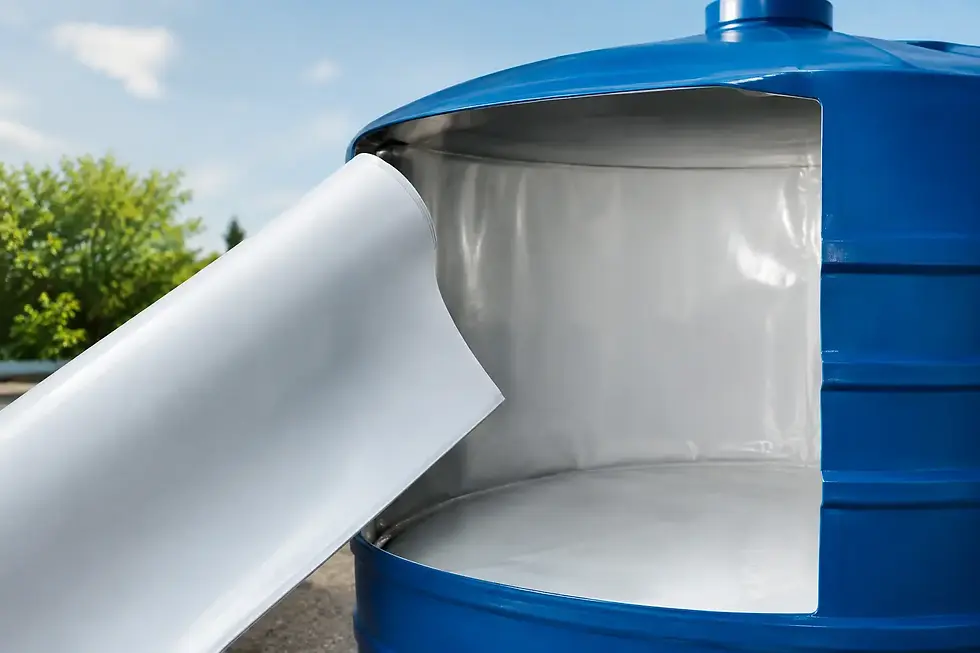
Replacement is not always the most cost-effective route. If an existing steel, concrete or GRP tank remains structurally serviceable, internal lining, epoxy coating, replacement covers, insulation upgrades and fitting renewals may extend its life while avoiding the disruption of a full tank change.
The decision should follow a competent survey of the structure, joints, base, roof, corrosion or degradation, water quality risks and access conditions. A liner can provide an effective watertight barrier in an appropriate tank, but it does not correct a failed support base or a structurally unsound shell. Equally, installing a new tank without addressing poor drainage, defective pipework or inadequate access simply transfers the problem to a new asset.
Nationwide Water Solutions Ltd assesses these factors as part of a practical lifecycle approach, combining tank surveys with refurbishment, lining, coating and replacement options where appropriate.
The best GRP tank specification is one that remains practical after installation day. Define the water duty, survey the site, allow for cleaning and safe access, and select construction details that protect both stored water and the people responsible for managing it.


Comments