

Factory Tank Restoration: Repair or Replace?
A leaking seam, blistered internal coating or corroding steel panel is not simply a maintenance issue. In a factory environment, it can compromise process continuity, potable water hygiene, fire protection provision and safe containment. Factory tank restoration gives operators a practical way to return a serviceable asset to duty without automatically accepting the cost, access challenges and downtime associated with full replacement.
The right approach depends on what the tank stores, the condition of its structure, its location and the performance requirement after works are complete. A potable water tank, for example, must be assessed differently from an acid storage vessel or a sprinkler reserve tank. The most effective projects begin with a proper survey, followed by a remedial specification that addresses the actual failure mechanism rather than merely covering its visible symptoms.
Why factory tanks deteriorate
Industrial and commercial tanks work in demanding conditions. Steel tanks can corrode internally where coatings have failed, externally where insulation traps moisture, or at joints where movement and ageing seals allow water ingress. Concrete tanks may suffer cracking, spalling, water penetration and deterioration around construction joints. GRP tanks can develop crazing, local damage or weakened joints, while older sectional tanks may experience failed gaskets, distorted panels and unsupported roof sections.
The stored liquid matters just as much as the tank material. Process water can carry sediment or treatment chemicals. Potable water systems need clean, maintainable surfaces that support hygiene management. Acid and chemical storage demand lining systems with proven resistance to the particular liquid, temperature and concentration involved. Using a generic coating where a chemically compatible lining is required can create an expensive second failure.
Operational conditions also accelerate deterioration. Infrequent inspection allows small defects to progress. Poor access makes cleaning and maintenance difficult. Condensation beneath inadequately insulated lids may introduce contamination or speed corrosion. A tank that was suitable for its original duty may no longer be adequate after a change in process demand, building use or fire protection requirements.
Factory tank restoration starts with a condition survey
A reliable restoration decision should not be based on photographs of one damaged area alone. The survey needs to establish whether the tank remains structurally suitable, identify the extent of deterioration and determine how the tank can be safely isolated, accessed and returned to service.
For sectional steel tanks, this commonly includes inspection of panels, bolts, gaskets, internal stays, base condition, roof, access points and overflow arrangements. For concrete structures, attention should focus on cracking, delamination, failed waterproofing, joint condition and evidence of substrate movement. The survey should also consider associated components such as ladders, platforms, screens, level controls, valves, pipework connections and insulation.
This assessment is where restoration and replacement begin to separate. Localised corrosion in an otherwise sound steel tank may be well suited to lining or coating. Widespread loss of section, severe distortion, unstable foundations or a tank that no longer meets its required capacity may point towards replacement instead. Neither answer should be assumed before the evidence is available.
Choosing between lining, coating and replacement
Flexible tank lining for contained, hygienic protection
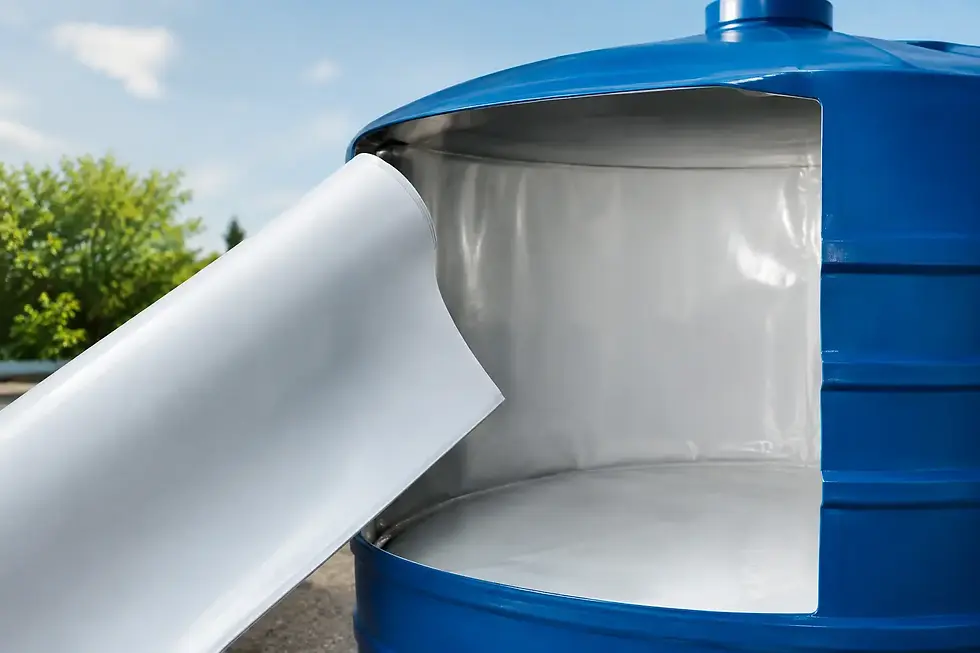
A flexible polypropylene lining system creates a new internal barrier within the existing tank. It can be an effective route for tanks with deteriorated internal surfaces where the primary structure remains sound. The liner separates the stored water or liquid from corroded steel, ageing concrete or damaged internal finishes, helping to restore containment without intrusive structural reconstruction.
For potable and process water duties, the material selection and installation detail are critical. The liner must be appropriate for the application, accurately fabricated and secured to accommodate penetrations, corners and connections. A well-designed system also needs to allow for inspection, cleaning and practical maintenance after handover.
Lining can reduce programme time and avoid the disruption of removing a large tank from a congested plant room, roof or restricted external compound. It is not a cure for structural failure, however. If panels are unsound, the foundation is compromised or the tank cannot safely retain its shape, the underlying issues must be resolved first.
Epoxy resin coatings for surface restoration
Epoxy coating systems are often appropriate where the substrate is sound but needs a durable protective finish. They can be used to protect steel and concrete surfaces from moisture, corrosion and selected chemicals, subject to correct preparation and product compatibility.
Surface preparation determines coating performance. Loose material, corrosion products, contamination and failed previous coatings must be removed to the required standard. The substrate must then be dry enough, stable enough and suitably profiled for adhesion. Applying a high-quality coating over poorly prepared steel or damp concrete risks early failure, regardless of the product specification.
Coating is particularly useful where operators need a repair that follows complex surfaces or where a liner is not the best engineering fit. The trade-off is that preparation can be more sensitive to environmental conditions and access. It may also require a longer outage than a prefabricated lining installation, depending on cure times and the extent of repair.
Full replacement when the asset has reached its limit
Replacement is the correct option when restoration would leave too much risk in the remaining structure or when the tank no longer meets operational needs. This may include tanks with extensive structural corrosion, failed floors, major concrete defects, unsuitable dimensions, recurring leakage or an inability to achieve required access and hygiene standards.
A replacement project can also be an opportunity to correct long-standing design problems. New GRP or steel tanks can be specified with suitable capacity, sectional configuration, insulated covers, access hatches, internal partitions, safe access arrangements and connections tailored to the current system. Where site access is restricted, sectional construction can make installation possible in locations where a pre-assembled tank cannot be delivered.
The capital cost is higher than many restoration schemes, and removal can be disruptive. Yet a replacement may offer better value where repeated repairs are consuming maintenance budgets or where an ageing asset presents a significant operational risk.
The wider works that protect the investment
Factory tank restoration is rarely just an internal repair. A tank returned to service with a new liner or coating can still underperform if its lid leaks, screens are missing, insulation is damaged or access arrangements make routine inspection unsafe.
Upgrades should be considered alongside the principal works. Insulated lids and covers help manage temperature, condensation and contamination risk. Secure hatches, correctly protected vents and overflow screens support water hygiene. New gaskets, bolts and flange seals may be needed where deterioration has affected joints. Access ladders, platforms and handrails should be reviewed so that future cleaning and inspection can be carried out safely.
For fire sprinkler storage, any work must be planned carefully around system availability, insurer requirements and the site’s impairment procedures. For potable water, cleaning, disinfection and a controlled return-to-service process should form part of the programme. For process or chemical storage, compatibility verification and containment planning are essential before the tank is drained.
Planning restoration around production
The practical success of a project is often measured by its impact on operations. A technically correct repair that leaves a factory without essential process water for too long may still be the wrong solution. Early planning should establish whether the tank can be isolated, whether temporary storage or bypass arrangements are required, and what shutdown window is realistically available.
A competent contractor will sequence drainage, cleaning, access, substrate preparation, installation, inspection and recommissioning around the site’s operational constraints. This includes safe control of confined-space risks, lifting activities, waste water and removed materials. Clear hold points allow the client team to see the tank condition after cleaning and before the new protective system is installed.
In-house manufacture can be particularly valuable for lining systems because dimensions, penetrations and site constraints can be incorporated before the installation team arrives. That reduces on-site fabrication, helps shorten programme duration and gives greater control over the finished fit.
Selecting a restoration partner
The lowest initial quotation is not always the lowest whole-life cost. Ask whether the proposed system is suitable for the stored liquid, whether the existing structure has been assessed, how the contractor will prepare the substrate, and what testing or inspection will confirm the work is complete.
A credible scope should also state the boundaries of responsibility. It should identify associated defects, access requirements, isolation arrangements and any assumptions about tank condition that need confirmation once the asset is opened up. This protects both the operator and the project programme from avoidable surprises.
Nationwide Water Solutions Ltd combines tank surveys, proprietary flexible polypropylene lining systems, epoxy coating solutions and replacement tank installation to provide a remedial route matched to the asset rather than a one-size-fits-all product.
A factory tank does not have to be replaced simply because it is old or showing signs of deterioration. With a detailed condition assessment and the right restoration method, many tanks can continue to provide reliable service for years while protecting budgets, compliance obligations and production resilience.


Comments