

How Water Tank Contractors Protect Critical Assets
A water tank rarely fails without warning. Corrosion beneath a lid, a deteriorating internal coating, sediment build-up, cracked panels or a leaking joint can all develop while the tank remains in service. For facilities teams, the real risk is not simply water loss. It is compromised potable water quality, impaired fire protection, unplanned shutdowns and a growing capital liability. Experienced water tank contractors identify the cause of deterioration and select a remedial route that protects the asset, its users and the wider site operation.
For commercial and industrial premises, the right answer is not always a replacement tank. A structurally sound tank may be restored with a purpose-designed liner or coating system at considerably less cost and with less disruption. Equally, a tank with failed panels, unsuitable materials or inadequate capacity may need replacement. The value of a specialist contractor lies in making that distinction accurately before work is specified.
What Water Tank Contractors Should Assess First
A tank survey should establish more than whether there is a visible leak. The surveyor needs to understand the tank’s construction, duty, location, access restrictions and the liquid it stores. A GRP sectional tank on a hospital roof presents different risks from a below-ground concrete process water tank or a steel sprinkler reserve tank.
The condition of internal surfaces is central. Protective coatings can break down through age, poor adhesion, chemical attack or inadequate preparation during previous works. Once the substrate is exposed, corrosion can accelerate and debris may enter the stored water. In potable water applications, surface condition also has a direct bearing on hygiene and the ability to maintain a clean, compliant storage environment.
External condition matters too. Contractors should inspect roofs, lids, vents, overflows, access hatches, insulation, supports and connections. Damaged or poorly fitting covers allow insects, dust and other contaminants into a potable supply. Uninsulated or deteriorated lids can contribute to temperature variation, condensation and higher hygiene risk. The tank body may be serviceable, while its ancillary components are the reason the installation is no longer performing as it should.
A proper assessment also considers safe access and operational continuity. Can the tank be isolated? Is there a duty and standby arrangement? Can the work be completed within a planned outage? These practical questions determine whether refurbishment is viable and how the works should be sequenced.
Refurbishment or Replacement: Making the Right Call
Replacement is sometimes necessary, particularly where structural integrity is compromised, capacity requirements have changed or the existing material is unsuitable for the stored liquid. However, immediate replacement should not be treated as the default response to corrosion, coating failure or leakage.
When lining is the more practical route
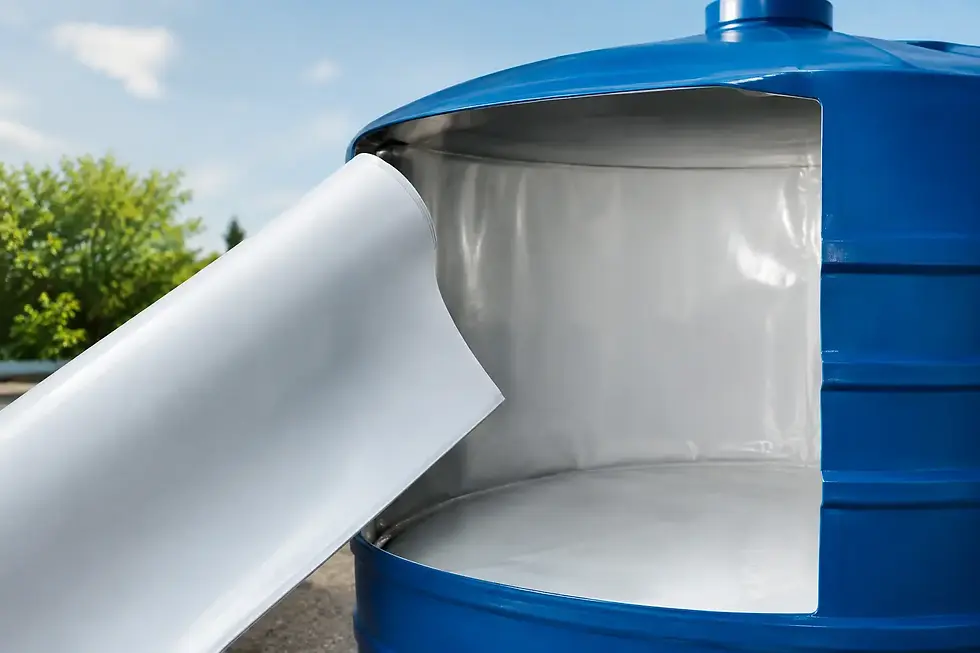
Flexible polypropylene lining systems can provide a new internal containment barrier within suitable tanks. They are particularly valuable where the original shell remains structurally sound but internal surfaces are degraded, difficult to clean or no longer appropriate for potable water duty. A properly designed liner isolates stored water from the existing tank surface and can be installed with far less demolition than a full replacement project.
Lining is also well suited to difficult locations. Roof-mounted tanks, confined plant areas and installations with restricted delivery routes often make replacement more disruptive and expensive. A liner system can be brought to site in manageable sections, manufactured to suit the tank geometry and installed efficiently by trained operatives.
The specification must match the application. Potable water, process liquids and acidic solutions each require appropriate materials, detailing and installation controls. A generic membrane or an improvised repair may appear economical initially, but it can create a further failure point if it lacks the required chemical resistance, mechanical strength or hygienic suitability.
When coating provides the best outcome
Epoxy resin coating systems can restore internal surfaces where the substrate is suitable for preparation and the coating is compatible with the service conditions. Coatings are not simply painted onto a tank. Performance depends on thorough cleaning, surface preparation, repair of defects, environmental control and correct application thickness.
For steel and concrete tanks, a specified epoxy system can provide a durable protective finish, improve cleanability and slow further substrate deterioration. It may be the preferred solution where a liner is unnecessary, where the internal form requires a bonded coating system, or where the tank’s operational requirements favour a particular finish. The decision depends on the tank condition, the stored medium and the expected service life, not on a one-size-fits-all product preference.
When replacement is justified
Where inspection identifies serious structural damage, extensive panel deterioration, persistent leaks beyond economic repair or non-compliant configuration, replacement may offer the most dependable long-term result. Modern GRP and fibreglass sectional tanks can be specified around access constraints, capacity, insulation requirements and connection layouts.
A capable contractor should manage the full scope: removal or decommissioning of the old tank, base and support considerations, delivery planning, installation, associated pipework alterations and commissioning. This reduces the risk of a replacement project becoming fragmented between multiple suppliers and trades.
Compliance Is Designed Into the Work
Water storage compliance is not achieved by paperwork alone. It is built into the condition of the tank, the materials used, hygienic detailing and the quality of installation. Potable water tanks must be protected from contamination, capable of inspection and cleaning, and maintained in a condition that supports a controlled water hygiene regime.
For fire sprinkler tanks, reliability is the priority. A minor leak, compromised liner or degraded connection can reduce available reserve over time. Work on these tanks needs careful planning so that insurers, responsible persons and system maintainers understand the impact of any isolation or temporary arrangement.
Process and specialist chemical storage introduce further demands. Chemical compatibility, secondary containment, corrosion resistance and safe working procedures must be considered before a lining, coating or replacement material is proposed. What succeeds in a cold-water storage tank may be entirely unsuitable for an acid storage application.
Documentation should reflect what has actually been done. Clear records of survey findings, materials, repairs, installation controls and recommendations for future inspection give the asset owner a sound basis for planned maintenance and compliance management.
The Operational Value of Specialist Tank Work
The lowest quotation can become the highest-cost option if it overlooks access, shutdown planning or the real cause of failure. Specialist water tank contractors bring the engineering judgement needed to avoid repeated reactive repairs. They can identify whether a leaking tank has a localised joint defect, a failed internal protective system, a structural issue or an overflow arrangement that is masking a larger problem.
Speed matters, but it should not mean shortcuts. Rapid installation capability is valuable when a site has limited storage redundancy or when a defect threatens operations. The work still requires safe isolation, cleaning where necessary, controlled preparation and checks before the tank returns to duty. Good planning reduces downtime without lowering the standard of the finished installation.
In-house manufacturing and product development can make a material difference here. Bespoke liners, insulated covers and tank components can be made to match the dimensions and operating conditions of the asset rather than forcing the site to accept an off-the-shelf compromise. This is especially useful for older tanks where dimensions, access points and penetrations rarely match current standard arrangements.
Questions to Ask Before Appointing a Contractor
Before appointing a supplier, establish whether they can survey, diagnose and deliver the proposed solution rather than merely selling one product. Ask how they assess structural condition, what preparation is required, how they control contamination risk and what access or isolation they need from the site team.
It is also sensible to ask about the material’s suitability for the stored liquid, expected maintenance requirements and how the work will affect business operations. For a roof tank, lifting and access planning may drive the programme. For an underground tank, confined-space controls and ventilation may be decisive. For a sprinkler tank, maintaining fire protection arrangements may be the governing concern.
The proposed scope should be clear about what is included around the tank itself. Covers, lids, insulation, access hatches, overflows, warning pipes, valves and pipework interfaces can all affect the final performance of the installation. A high-quality liner or coating cannot compensate for an inadequate lid or a poorly managed overflow.
Build Maintenance Around Asset Condition
Water storage assets benefit from a planned approach rather than attention only after a leak or water-quality concern. Periodic surveys allow early signs of corrosion, coating failure and component deterioration to be addressed before they become an emergency. They also make budgets more predictable, as the owner can compare refurbishment and replacement options before a forced outage dictates the decision.
Nationwide Water Solutions Ltd approaches tank work as a lifecycle decision: survey the condition, specify the right remedial method and install a durable solution suited to the tank’s duty. The most useful next step is often a competent survey, because it turns an uncertain risk into a defined scope of work and a practical plan for protecting the water storage asset.


Comments