
Process Tank Repair Options That Protect Production
Updated: Aug 6

A process tank rarely fails without warning. Rust staining around seams, recurring product contamination, damp patches beneath the base, blistered coatings and unexplained losses in level are all signs that containment may be deteriorating. The right process tank repair options can restore a serviceable asset before a minor defect becomes an operational stoppage, environmental incident or expensive replacement project.
The correct route depends on what the tank stores, its construction, the condition of the substrate and the consequences of taking it out of service. A repair that is suitable for treated water may not tolerate an acidic process liquid. Equally, a coating repair may be sufficient for isolated surface corrosion, while widespread internal corrosion or leaking joints may call for a fully engineered lining system.
Assess the tank before choosing a repair
Repair decisions should begin with a structured condition survey, not an assumption based on a visible defect. Corrosion often develops from the inside out, particularly where sediment, chemical residues or standing water collect at the base and around joints. External surfaces can appear acceptable while the internal coating has failed across a significant area.
A competent survey should establish the tank material, wall and floor condition, corrosion pattern, integrity of seams and fixings, condition of the roof or lid, access arrangements, and the chemical and temperature demands of the stored liquid. For process tanks, the operating cycle also matters. Continuous use, frequent emptying, elevated temperatures and cleaning chemicals can all shorten the life of an unsuitable repair system.
The survey should also identify whether defects affect containment, product quality, structural stability or site compliance. This creates a clear scope of work and helps avoid a false economy, where a local patch is applied to a tank with more extensive underlying deterioration.
Process tank repair options for common failures
Internal flexible tank lining
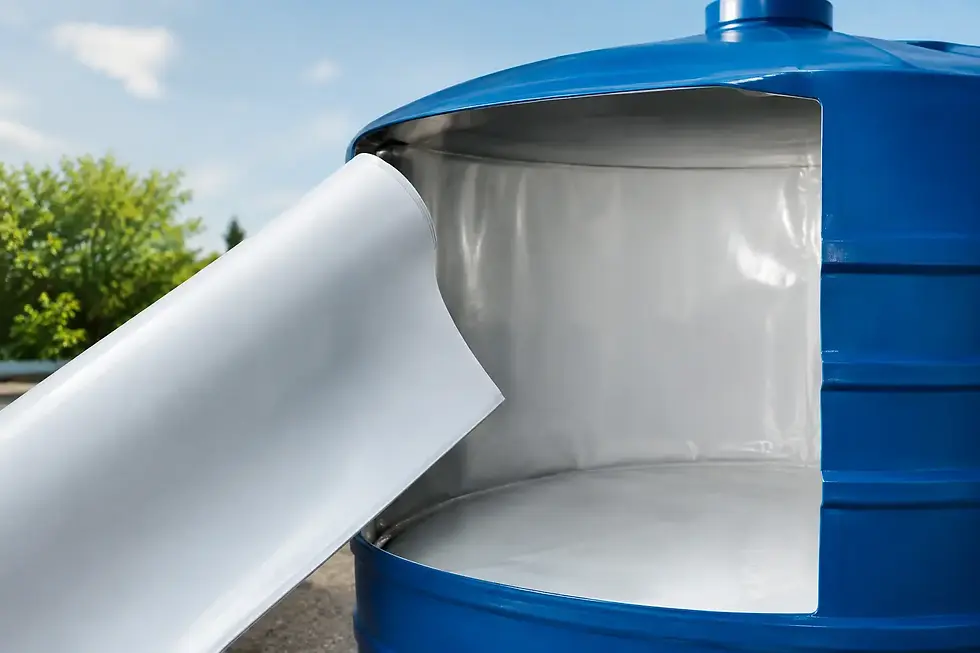
For many ageing steel, concrete and sectional tanks, an internal flexible polypropylene lining is one of the most effective ways to restore containment without removing the tank structure. The liner creates a new internal barrier between the stored liquid and the deteriorated substrate, preventing contact with corrosion, failed coatings and porous concrete.
This approach is particularly valuable where a tank shell remains structurally sound but has developed multiple leaks, general corrosion, coating breakdown or surface defects that would make localised repairs impractical. A properly specified liner can be fabricated to suit the tank dimensions, internal fittings and access constraints, then installed with minimal invasive work to the surrounding plant area.
Material selection is critical. The liner must be compatible with the stored liquid, its concentration, operating temperature and any cleaning regime. Proprietary polypropylene systems offer strong chemical resistance for many industrial applications, but no lining should be specified without confirming suitability for the exact duty. Attention is also needed around inlet and outlet connections, overflows, level controls and penetration details, as these are common points of failure in poorly executed installations.
Epoxy resin coating systems
Epoxy coatings are a practical option where corrosion is predominantly superficial, the substrate is sound and a bonded protective finish is appropriate. After cleaning and surface preparation, the coating is applied to form a protective layer that isolates steel or concrete from the stored liquid.
Coating refurbishment can be highly effective for tanks with local corrosion, pitting that has not compromised the structure, or an ageing coating that has reached the end of its serviceable life. It may also be selected where a smooth, cleanable internal surface is required.
The trade-off is preparation. Coatings depend on the condition of the surface beneath them. If rust, moisture, contamination or poorly adhered historic finishes remain, a new system may fail prematurely. The tank must therefore be cleaned, dried and prepared to the required standard, with defects repaired before coating work begins. In a heavily corroded tank, a flexible lining may offer more dependable containment than attempting to coat an unstable substrate.
Localised welding and steelwork repairs
Where inspection identifies isolated holes, fractured brackets, damaged flanges, failed seams or local steel loss, welding and steelwork repairs can restore the affected section. This is normally appropriate only after assessing the remaining thickness and condition of the surrounding platework.
Local repairs make sense when damage is confined and the wider tank has a reasonable remaining lifespan. They can also be undertaken alongside coating or lining works, ensuring the structure is made sound before a new internal barrier is installed.
Welding alone is rarely a complete answer for internally corroded tanks. The repaired area may be sound, but adjacent platework can continue to deteriorate if it remains exposed to the same conditions. A long-term repair strategy should address the cause of corrosion, not simply the point where it has become visible.
Concrete repair and waterproofing
Concrete process tanks may suffer from cracking, spalling, chemical attack, porous surfaces and failed joint seals. Repair can involve removing unsound concrete, rebuilding damaged areas with suitable repair materials, resealing joints and applying an appropriate protective coating or liner.
The source of the defect must be understood before remedial work starts. Movement cracks, for example, may require a flexible treatment rather than a rigid repair. Chemical attack may demand a high-performance lining that protects the rebuilt concrete from repeat exposure. Where groundwater ingress is present in below-ground structures, external pressure and drainage conditions may also influence the repair specification.
Joint, gasket and penetration repairs
Not every leak comes through the tank wall. Bolted sectional tanks can leak at panel joints, while pipe penetrations, inspection hatches, overflow connections and level sensor fixings can all become weak points. Replacing degraded seals, renewing gaskets and correctly detailing penetrations can stop leakage without major tank refurbishment where the main structure remains in good condition.
These repairs are often best completed as part of a wider inspection and maintenance programme. If one gasket has hardened or failed, others of the same age may be approaching the same condition.
When replacement is the better commercial decision
Repair is not always the lowest-cost option over the life of the asset. Full replacement should be considered where structural corrosion is extensive, the tank no longer meets operational capacity, access makes safe refurbishment impractical, or repeated repairs have become routine.
Replacement can also be justified when the stored product or process has changed. A tank designed for a relatively benign liquid may not be suitable for a more aggressive chemical duty, even with remedial works. In that situation, a new GRP, fibreglass, steel or purpose-designed storage solution may provide the required chemical resistance, insulation, fittings and access arrangements from the outset.
The decision should compare more than the initial project cost. Consider outage duration, temporary storage requirements, expected service life, future maintenance, compliance obligations and the risk of failure. Refurbishing a sound tank with a correctly specified lining can deliver substantial savings against replacement. Conversely, investing in a tank with compromised structural integrity can create continuing risk and cost.
Planning work around production and safety
Process tank repairs require careful isolation, cleaning and safe access arrangements. The stored liquid must be assessed for hazards, and tank entry may be subject to confined-space controls. Cleaning residues, vapours, sludge and contaminated wash water need appropriate management before repair teams can begin work.
Programme planning should account for emptying, cleaning, drying, inspection, repair, curing where coatings are used, testing and return to service. A rapid installation is valuable, but only when preparation and quality checks are not compromised. For critical process infrastructure, it may be possible to stage work around shutdown periods or provide temporary storage to reduce disruption.
Documentation should record the original defects, materials used, compatibility assessment, test results and any recommended inspection interval. This gives facilities teams an auditable maintenance record and supports more informed decisions at the next condition review.
Selecting a repair partner
The most useful repair contractor will diagnose the cause of failure, not push a single product regardless of tank condition. Look for experience across steel, concrete, sectional and specialist liquid storage tanks, together with the capability to supply lining, coating, repair and replacement solutions when needed.
Ask how material compatibility is verified, how penetrations and joints are detailed, what surface preparation is required, and how the completed work will be inspected. Nationwide Water Solutions Ltd provides this lifecycle approach, combining tank surveys with engineered lining, coating, refurbishment and replacement options for demanding commercial and industrial storage duties.
A process tank does not need to look new to perform reliably. What matters is that its structure, containment system and ancillary components are suitable for the liquid, duty cycle and risks of the site. A timely survey and a repair method matched to those conditions can extend service life while protecting production from avoidable interruption.


Comments