
Sectional Tank vs One Piece: Which Fits?
Updated: Aug 6

A tank can look straightforward on a drawing and become a major access problem on site. When assessing a sectional tank vs one piece design, the right answer is rarely about a single material or headline price. It depends on where the tank must sit, the required storage volume, how it will be maintained, the quality of the supporting structure and the consequences of taking the system out of service.
For commercial, industrial and regulated water storage, the selection must support safe operation over many years. A tank that is quick to purchase but difficult to deliver, inspect or repair can create avoidable cost and operational risk.
Sectional tank vs one piece: the core difference
A sectional tank is assembled from individual panels at its final location. In the UK, these are commonly bolted GRP sectional tanks, although steel panel systems are also used for particular applications. The panels, internal stays, seals, roof and fittings are transported separately and installed on a prepared base.
A one piece tank is manufactured as a complete vessel and delivered as a single unit. It may be moulded GRP, polyethylene or another material selected for the duty. Its shell has no panel-to-panel assembly joints, but it remains dependent on correctly installed connections, lids, vents, overflows and bases.
This distinction has practical consequences. Sectional construction solves delivery and access constraints while allowing much larger capacities. One piece construction reduces the number of structural joints in the tank shell and can make sense where capacity is modest and crane access is uncomplicated.
Access often decides the design before capacity does
Plant rooms, rooftops, basements, restricted service yards and enclosed compounds are common locations for commercial water tanks. In many of these environments, a one piece tank simply cannot be moved to its final position without extensive lifting arrangements, temporary removals or structural alterations.
A sectional tank can be taken through standard access routes in manageable components and built in situ. This is particularly valuable for replacement projects where an existing tank is located inside a building or where a route has been narrowed by later construction work. It also avoids the need to manoeuvre a large finished vessel over occupied areas where lifting risk and programme disruption need careful control.
That does not mean sectional tanks are always the easier installation. They require adequate working space around the tank during construction, a sound and level foundation, competent assembly and controlled sealing of every joint. Where a one piece unit can be delivered directly onto a suitable external plinth, the installation programme may be shorter.
The key question is not whether the tank can reach the site entrance. It is whether it can reach its final position safely, legally and without compromising the building, surrounding operations or the tank itself.
Capacity and footprint requirements
Sectional tanks are generally the more flexible option for higher volumes. Their modular format allows the length, width and height to be configured around the available space, subject to engineering limitations and access requirements. This can be useful where a duty requires a specific capacity but the plant area has an awkward footprint or low headroom.
One piece tanks are normally available in fixed mould sizes. They can be an efficient choice for smaller potable, process or rainwater storage duties where the available model dimensions suit the site. However, specifying a larger one piece tank can quickly introduce delivery restrictions and lifting costs.
Height is an especially important consideration. A tall tank may achieve the required volume on a restricted footprint, but it increases loading, affects access to roof-level components and may create installation difficulties beneath existing ceilings or services. A competent survey should establish the usable dimensions, not simply the nominal room size.
Hygiene, water quality and compliance
For potable water storage, both designs must be assessed as complete systems rather than as empty vessels. Water quality depends on suitable materials, a hygienic internal condition, an effective close-fitting lid, screened vents and overflows, secure access arrangements, correct pipework configuration and a maintenance regime appropriate to the risk.
A one piece tank has fewer shell joints, which may simplify cleaning in some applications. However, this advantage can be lost if the tank has poor access, unprotected openings, deteriorated fittings or insufficient insulation. Conversely, a properly installed sectional GRP tank can provide reliable potable water storage when its panel joints, roof, seals and ancillary components are correctly specified and maintained.
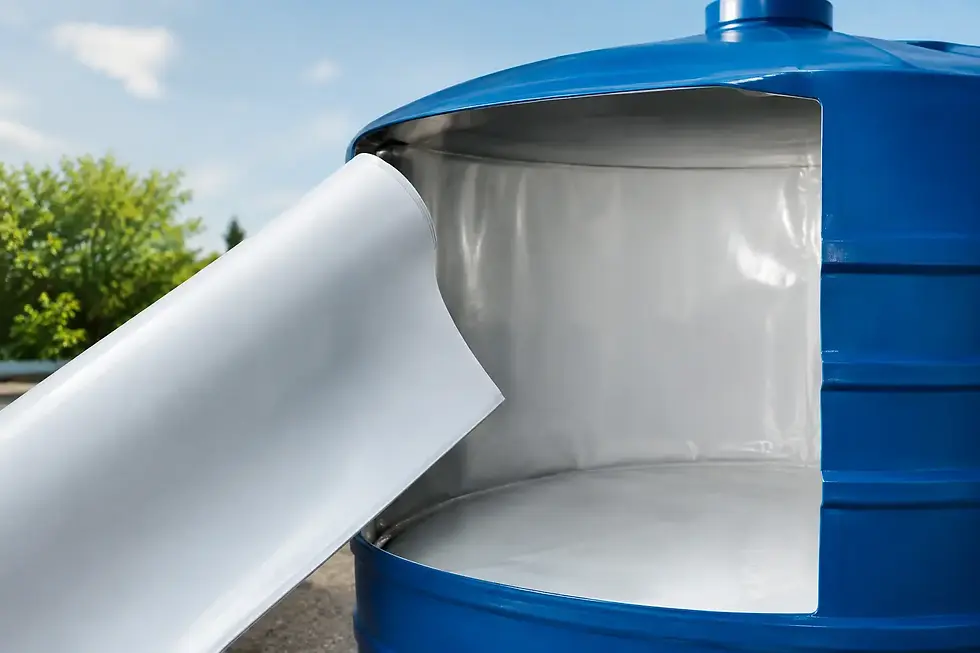
For existing sectional tanks, the condition of the internal surfaces and joints should guide the decision. Deterioration does not automatically mean replacement is necessary. A tank lining system can provide a hygienic, durable internal barrier and extend the usable life of a structurally sound tank while avoiding the disruption of full removal. The lining material must be appropriate for the stored liquid and the intended service conditions.
Facilities teams should also consider whether the tank design allows safe inspection and cleaning. Access hatches need to be practical for maintenance personnel, while roof covers and insulation should protect the stored water from contamination, temperature extremes and unauthorised entry.
Maintenance and repair over the tank lifecycle
No tank construction removes the need for inspection. Sediment, scale, biological contamination, damaged lids, defective screens, corrosion in steel components and ageing seals can all affect a water storage asset.
A sectional tank offers a degree of repairability because individual panels, gaskets, stays and fittings can often be assessed and renewed. Where the main structure remains viable, refurbishment may be more cost-effective than replacement. Internal polypropylene lining and epoxy coating systems can address different surface and containment requirements, provided the underlying substrate and duty are suitable.
One piece tanks have fewer shell joints to inspect, but damage to the vessel can be more difficult to rectify if it is extensive. Repair options depend on the material, the location of the defect and whether the tank is used for potable water, process water, fire protection or chemical storage. A crack near a fitting or a deformed base can require a more fundamental intervention than a local surface repair.
In both cases, maintenance access matters as much as the tank body. A well-designed tank installation includes adequate clearance, safe roof access where necessary, serviceable valves, visible overflows, insulation protection and a base capable of carrying the fully laden load without movement.
Cost is more than the tank purchase price
A one piece tank can appear less expensive because it is factory-complete and may involve less on-site assembly. That comparison is valid only when transport, craneage, access preparation and installation constraints are modest. On a confined commercial site, getting the tank into place may become the dominant cost.
A sectional tank can carry a higher installation element because of panel assembly, sealing and quality checks. Yet it may avoid major building alterations, costly lifting plans or extended closure of operational areas. Its modular capacity can also prevent over-specification, particularly where a site needs a tank built around existing infrastructure.
When comparing quotations, include the full scope: removal or isolation of the existing system, temporary water provision, base works, delivery, lifting, installation, connections, insulation, covers, access equipment, testing, cleaning and commissioning. Also consider the cost of future inspections and the likely service life of the selected solution.
A refurbishment option should be part of this assessment. If a survey confirms that the existing tank structure is sound, lining or coating may deliver a compliant, durable outcome at a lower cost and with less downtime than replacement.
Selecting the right construction for the duty
For an external ground-level installation with clear delivery access, a modest storage requirement and a suitable crane route, a one piece tank can be a practical and efficient choice. It is often well suited to projects where the final vessel can be positioned without complication and the required dimensions align with standard manufactured sizes.
For high-capacity storage, difficult internal access, rooftop locations, basement plant rooms or constrained compounds, a sectional solution is frequently the more realistic route. Its panels can be moved through restricted routes and assembled to suit the available space. This flexibility is also valuable where replacement work must be planned around a live building or critical operation.
The stored liquid should influence the specification from the outset. Potable water, process water, sprinkler storage and chemical duties place different demands on materials, jointing, internal protection, containment and inspection. There is no universal tank type that performs best in every environment.
Nationwide Water Solutions Ltd approaches tank selection as a lifecycle decision, beginning with the actual condition of the asset, access constraints and operational requirements rather than assuming replacement is the only answer. A detailed survey can establish whether a sectional tank, one piece tank or specialist refurbishment route will provide the most dependable result.
The most useful next step is to inspect the tank location and existing infrastructure before finalising a specification. A decision made around real access, water quality controls, structural loading and future maintenance will protect both the water supply and the budget long after installation is complete.


Comments