
Top Causes of Tank Failure in Commercial Sites
Updated: Aug 6

A tank rarely fails without warning. Discolouration at joints, recurring low-water alarms, unexplained make-up water use, coating breakdown or a damp patch beneath the base are all signs that require investigation. The top causes of tank failure are often progressive rather than sudden, which gives duty holders an opportunity to intervene before a local defect becomes a water quality, operational or safety issue.
For commercial, industrial and regulated sites, the right response depends on the tank construction, stored liquid, access conditions and the consequence of downtime. A potable water tank, sprinkler reserve tank and acid storage tank may all develop leaks, but they demand very different materials, repair methods and inspection controls. The objective is not simply to stop water escaping. It is to restore containment, protect the stored medium and extend the useful life of an asset where refurbishment remains technically sound.
Corrosion of Steel Components
Corrosion is among the leading causes of failure in galvanised steel sectional tanks, pressed steel tanks, process vessels and associated steelwork. It commonly begins where protective coatings have deteriorated, at panel joints, around bolt holes and beneath deposits where moisture remains in contact with the substrate. External corrosion can be accelerated by weather exposure, poor drainage, damaged insulation or a plant-room atmosphere with persistent condensation.
Internal corrosion is more difficult to assess without a proper survey. In potable water storage, sediment, ineffective cleaning regimes and damaged internal surfaces can create localised conditions that attack the steel. In process applications, the stored liquid and its concentration may be inherently aggressive. A small area of pitting can eventually perforate a panel, while wider corrosion can compromise the tank's structural capacity.
The appropriate remedy depends on remaining steel thickness and the extent of degradation. Local repairs and a compatible epoxy coating system may be suitable where the substrate is sound. Where corrosion is widespread but the tank shell remains serviceable, a purpose-designed internal lining can isolate the stored water from the damaged surface. If structural integrity is no longer reliable, replacement is the safer and more cost-effective decision.
Failed Joints, Seals and Fixings
Many commercial water tanks are assembled from panels, and every joint is a potential leakage path. Ageing gaskets lose elasticity, bolts corrode, fixings can loosen and earlier repairs may fail because they were applied to contaminated or moving surfaces. Thermal movement, vibration from nearby equipment and uneven settlement can all place additional stress on joints.
A drip at a panel seam should not be treated as a cosmetic maintenance item. It may indicate a failed gasket, corrosion behind the joint or distortion in the tank structure. Re-tightening bolts without assessing the panel condition can be ineffective and, in some cases, can damage weakened steel or strip fixings.
A specialist inspection should establish whether the defect is isolated or repeated across the tank. Targeted joint renewal may be appropriate for a limited issue. However, recurring seam leaks often point to a wider end-of-life problem with gaskets, coatings or panel condition. An internal liner can provide a continuous containment barrier in suitable tanks, avoiding the disruption of dismantling a large sectional structure.
Coating and Lining Breakdown
Coatings and linings are protective systems, not permanent fit-and-forget finishes. Their service life is influenced by surface preparation, curing conditions, water chemistry, chemical exposure, temperature, impact damage and cleaning practices. Once a coating loses adhesion, blisters, cracks or wears through, the underlying material is exposed to moisture and corrosion.
Poor original preparation is a frequent cause of premature failure. Coatings applied over rust, scale, residual moisture or incompatible previous finishes may initially appear satisfactory but fail as adhesion weakens. Equally, selecting a material that is unsuitable for potable water, high temperatures or a specific chemical duty can create an avoidable compliance and containment risk.
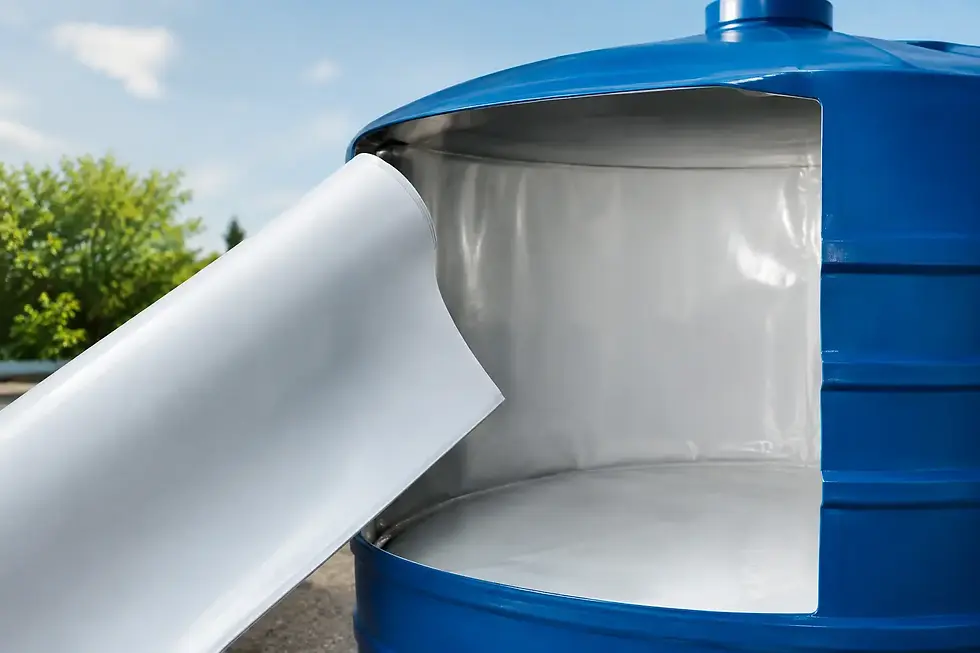
Remedial work should therefore start with identifying the existing substrate and the cause of deterioration. Surface preparation, material compatibility and controlled application are as important as the coating or lining itself. For tanks that remain structurally viable, a correctly specified epoxy system or flexible polypropylene lining can offer a practical alternative to replacement, with less disruption to the site.
Structural Movement and Foundation Defects
A tank relies on an even, adequately designed base. Settlement, inadequate support, corroded bearers, damaged concrete plinths and poorly distributed loads can distort the tank and progressively damage panels, joints and pipe connections. This is particularly relevant to external tanks, elevated installations and older assets where the condition of the support structure has not been reviewed alongside the tank itself.
Signs include uneven water levels, doors or access hatches that no longer sit correctly, repeated leakage from the same area and visible panel misalignment. Underground concrete tanks can present different symptoms, including cracking from ground movement, water ingress through construction joints or deterioration caused by groundwater pressure.
Structural defects cannot be resolved reliably by applying sealant over a leak. The source of movement must be understood first. This may require emptying the tank, examining the base and support arrangement, and coordinating repairs with structural or civil works. A lining can restore internal containment, but it should not be used to conceal a tank that is continuing to deform.
Inadequate Inspection, Cleaning and Planned Maintenance
Deferred maintenance is not a single fault, but it allows smaller defects to develop unchecked. Tanks are often difficult to access and may be taken for granted until an alarm, leak or water quality concern creates urgency. By then, sediment accumulation, damaged insect screens, degraded lids, corroded internals and deteriorated coatings may be present at the same time.
For potable water systems, poor access arrangements can also make routine inspection, cleaning and disinfection more difficult. Damaged or unsealed lids allow debris, insects and contaminants into the tank. Inadequate insulation may contribute to unsuitable water temperatures, while poorly maintained vents and overflows can compromise hygienic protection.
A planned inspection regime should review the tank shell, roof, base, internal surfaces, joints, ladders, access covers, screens, overflow arrangements and connected pipework. The frequency and depth of inspection should reflect the tank's duty and risk profile. A sprinkler tank has availability requirements that differ from a domestic cold-water tank, while process and chemical tanks require assessments based on their specific contents and operating conditions.
Poor Installation and Incompatible Modifications
Failure can be designed into a tank long before it is commissioned. Incorrect panel assembly, poorly supported pipework, unsuitable flange connections, inadequate roof support and unprotected penetrations can all create weak points. Modifications made later, such as fitting new level controls, changing pipework or adding an overflow, may compromise containment if penetrations are not properly sealed and reinforced.
The risk is greater where access is restricted. Plant-room tanks, basement installations and roof-level assets are sometimes repaired using whatever materials can be brought to site quickly, rather than a system suited to the tank and stored medium. This can produce short-term relief but little long-term assurance.
Installation and remedial works should be planned around site constraints without lowering the engineering standard. Nationwide Water Solutions Ltd assesses access, tank condition and operational requirements before specifying a lining, coating, repair or replacement route. In-house manufactured lining systems can be especially valuable where a large replacement tank cannot be brought through the building or where prolonged shutdown is unacceptable.
Chemical Attack and Unsuitable Materials
Chemical attack is a major concern in industrial process tanks, treatment systems and acid storage applications. Even a material that performs well in clean water may deteriorate quickly when exposed to acids, alkalis, solvents, elevated temperatures or fluctuating concentrations. Fittings, sealants and bolts can be just as vulnerable as the tank wall.
Compatibility must be assessed against the full operating duty, including concentration, temperature, dwell time and cleaning chemicals. An incorrect repair material may soften, crack or lose adhesion, leading to a more serious leak than the original defect. Where chemical resistance is critical, the specified lining or coating system must be selected for that exact service rather than assumed to be suitable.
Treat Early Warnings as Engineering Evidence
The best time to address tank deterioration is before a leak affects operations, water hygiene or fire protection provision. A survey that identifies corrosion, failed joints, coating defects or structural movement provides the evidence needed to choose between repair, lining, recoating and replacement.
The most cost-effective solution is not always the least expensive immediate repair. It is the option that restores safe containment, supports compliance and gives the site a realistic service life without repeated disruption. When a tank begins to show signs of decline, a clear condition assessment turns uncertainty into a planned, defensible maintenance decision.


Comments