
What Causes Tank Liner Failure?
- m12674
- Jun 23
- 6 min read
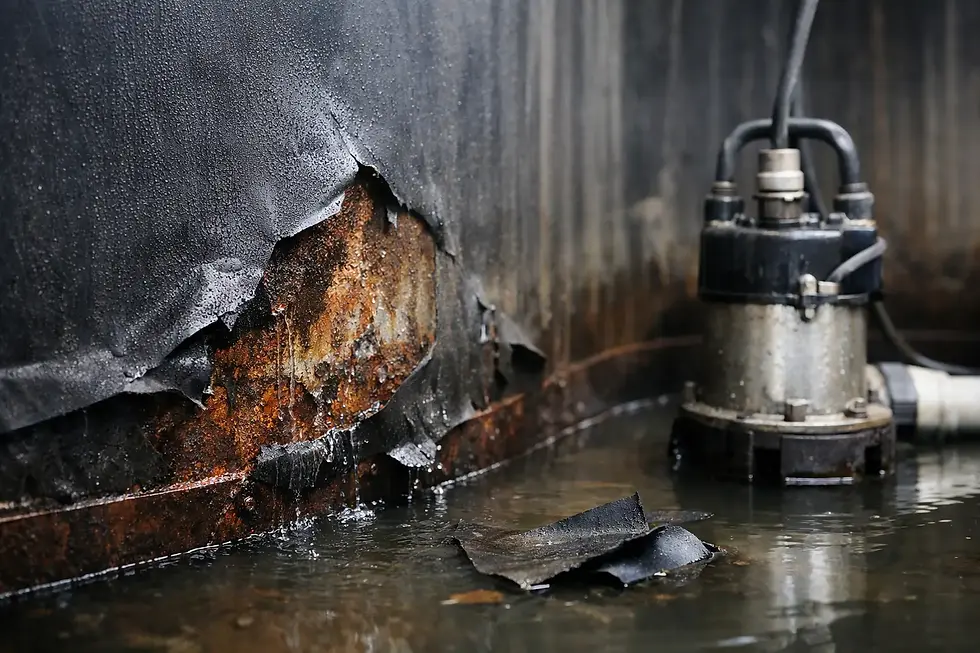
A liner rarely fails without warning. The problem is that the warning signs are often hidden behind covers, above ceiling voids, below ground level, or inside tanks that only receive attention when there is a leak, an inspection failure, or a water quality concern. For facilities teams and asset owners asking what causes tank liner failure, the answer is usually not a single defect but a chain of technical issues - material selection, substrate condition, installation detail, operating environment, and maintenance history all play a part.
In commercial and industrial water storage, liners are expected to do a demanding job. They must remain watertight, stable, hygienic where potable water is involved, and resistant to movement, temperature change, cleaning regimes, and in some cases aggressive chemicals. When a lining system breaks down, the cost is not limited to the liner itself. There may be downtime, contamination risk, compliance concerns, emergency repairs, and avoidable pressure on the wider water storage infrastructure.
What causes tank liner failure in practice
The most common cause is not simply age. Many tank liners fail early because the system installed was not suited to the tank, the stored liquid, or the operating conditions. A liner can appear acceptable on handover and still begin to deteriorate if movement, moisture, poor fixing details, or chemical exposure were not properly accounted for at design stage.
That is why failure analysis has to start with context. A potable cold water tank in a plant room presents a different set of risks to an underground water tank, a steel process tank, or an acid storage vessel. The lining material, the way corners and penetrations are formed, and the condition of the original tank structure all influence service life.
Poor surface preparation and substrate condition
In rigid coating systems especially, inadequate preparation is one of the biggest reasons for premature failure. If corrosion products, laitance, grease, loose coatings, or contamination remain on the substrate, adhesion can be compromised from the start. Even a high-performance coating will struggle if it has been applied over an unstable surface.
Concrete tanks bring their own issues. Moisture content, cracking, surface friability, and contamination can all undermine the bond. Steel tanks may suffer from hidden pitting, scale, or active corrosion around seams and fixings. Where tank refurbishment is carried out under time pressure, surface preparation is sometimes treated as a secondary stage rather than the foundation of the whole lining system. That usually proves expensive later.
Flexible lining systems are less dependent on direct adhesion to the substrate, but substrate condition still matters. Sharp edges, corroded protrusions, failed fixings, and distorted surfaces can place stress on the liner or create localised wear points.
Structural movement and tank distortion
A tank liner is not isolated from the structure around it. If the tank walls flex, the floor moves, the roof loads the sides unevenly, or support conditions change, the lining system absorbs that stress. This is where the choice between a flexible liner and a rigid coating becomes critical.
Older sectional tanks often experience movement over time. Bolted joints can shift, panels can bow, and internal supports can impose changing loads. Concrete structures may crack or move slightly as buildings settle. Underground tanks can be affected by surrounding ground pressure and water ingress. If the liner was designed for a static environment but installed in a tank with ongoing movement, splits, debonding, wrinkling, or stress fractures become far more likely.
This is one reason engineering-led surveys matter. The visible defect may be a blister, a split seam, or a lifted corner, but the root cause can be structural rather than cosmetic.
Incorrect liner specification
Not all liners are interchangeable. A material suited to potable water is not automatically suitable for elevated temperature process water, intermittent chlorination, or aggressive chemical storage. One of the clearest answers to what causes tank liner failure is simple mis-specification.
Chemical compatibility is often underestimated. Even relatively modest concentrations can degrade unsuitable materials over time, particularly where exposure is continuous or cleaning chemicals are used regularly. Temperature also matters. As temperatures rise, some materials soften, age more quickly, or become more vulnerable to creep and deformation.
There is also a difference between a lining system that performs well in ideal conditions and one that is appropriate for a live operational environment. Access limitations, tank geometry, existing defects, and turnaround requirements all influence what should be specified.
Weak detailing around joints, corners and penetrations
Tank liners usually fail first at the difficult details rather than on the open flat areas. Corners, outlets, overflows, access points, support brackets, internal columns, and pipe penetrations create stress concentrations and installation complexity. If those details are poorly formed, badly sealed, or not designed to accommodate movement, failure often starts there.
Seams are another high-risk area. A seam that is technically complete but inconsistently welded, badly aligned, or put under tension can become the first point of leakage. Likewise, terminations at the top edge of the liner need to be secure and correctly integrated with the tank construction. A sound sheet material can still fail if the perimeter fixing detail is weak.
In refurbishment projects, these details become more demanding because the installer is working around existing tank features, legacy modifications, and irregular surfaces. That calls for experience, not just materials.
Chemical attack, water quality and disinfection regimes
Stored water is not always chemically benign. Potable water tanks may be subject to chlorination and periodic disinfection. Process tanks can contain dissolved solids, treatment chemicals, or variable pH levels. Specialist tanks may store acids or other aggressive liquids. Each of these factors affects liner performance.
Chemical attack can show itself as embrittlement, swelling, softening, discolouration, blistering, or loss of mechanical strength. In some cases the deterioration is gradual and not immediately visible during routine checks. By the time leakage or hygiene concerns appear, the liner may already be well into failure.
There is rarely a one-size-fits-all answer here. The concentration, dwell time, operating temperature, and cleaning frequency all affect long-term resistance. A technically suitable specification should always be based on the actual stored media and the full operating regime, not just the tank type.
Ageing, UV exposure and thermal cycling
Even well-specified liners have a service life. Over time, materials age. Plasticisers can migrate, surfaces can harden, flexibility can reduce, and repeated expansion and contraction can weaken critical areas. This is especially relevant in tanks exposed to fluctuating temperatures or external environmental conditions.
UV exposure is another factor for tanks with translucent covers, roof openings, or external installations. Some liner materials tolerate this far better than others. Where exposure has not been anticipated, brittleness and surface degradation can develop sooner than expected.
Thermal cycling is often overlooked in internal tanks. Plant shutdowns, seasonal variation, or changing process conditions can repeatedly stress the liner. A system that performs adequately at a constant temperature may behave very differently when that temperature regularly changes.
Installation quality and site conditions
A good specification can still fail in the wrong hands. Installation quality has a direct bearing on liner longevity, particularly where confined access, awkward geometry, or live site constraints are involved. Cleanliness, temperature during installation, curing conditions for coatings, seam control, and final detailing all matter.
On busy sites, refurbishment works are sometimes squeezed into narrow shutdown windows. That can create pressure to shorten preparation stages, reduce drying time, or accept borderline site conditions. Those compromises are a common route to premature failure.
The practical answer is to use systems that match the site reality as well as the tank duty. In many refurbishment situations, proprietary flexible polypropylene lining systems offer a strong advantage because they can accommodate movement, isolate defects in the original substrate, and be installed quickly with less dependence on perfect ambient conditions than some rigid coating approaches. That does not make them universal, but in the right application they can extend service life and avoid unnecessary replacement.
How failure usually presents itself
Liner failure is not always a dramatic split with visible leakage. More often it starts with subtler signs - local blistering, staining, edge lift, wrinkling, corrosion beneath the lining, cracking at corners, or unexplained water loss. In potable systems, there may also be concerns around cleanliness, sediment, or inspection non-conformance.
The key is not to treat these signs as isolated defects. Spot repairs can be effective where the issue is genuinely localised, but repeated patching of a fundamentally unsuitable or deteriorated system often delays the proper remedial decision.
For asset owners, the right response depends on the condition of the tank itself. If the structure remains serviceable, refurbishment with an appropriate modern lining system can be a cost-effective route. If there is significant structural failure, severe corrosion, or major compliance shortcomings, full replacement may be the more reliable long-term option. A specialist survey is what separates those two paths.
Nationwide Water Solutions Ltd works in exactly this area - assessing tank condition, identifying why systems are failing, and recommending whether lining, coating, repair, or replacement is the correct engineering response.
The useful question is not only what causes tank liner failure, but what conditions are being allowed to continue unchecked. Most failures begin long before the leak becomes visible, which is why early inspection and accurate specification usually save far more than emergency repair ever will.


Comments